Sauce Packaging Machine vs Condiment Packaging Machine: VFFS, Piston Filler or Rotary?
What This Guide Covers
- Sauce Packaging Machine vs Condiment Packaging Machine: The Distinction That Matters
- Start With Rheology: Four Viscosity Bands and What Each Rules Out
- Three Architectures, One Question: Where Does the Package Come From?
- VFFS for Sauce: Where Film Wins, and Where It Runs Out of Road
- Sauce Packaging Machine on the Film Side
- Piston Fillers for Condiments: Volume, Particulates and the Valve Nobody Specifies
- Condiment Packaging Machine on the Container Side
- Rotary Premade and Spout Pouches: The Shelf-Facing Option
- Fill Accuracy: What ±0.5% Actually Measures
- Hot Fill, pH and the Stainless Grade That Actually Matters
- Seal Integrity on a Liquid Pack: Three Tests, Not One
- Throughput: Why Sachet Speeds Are Quoted per Lane
- The Selection Matrix, and How to Read It
- FAQ: Sauce and Condiment Packaging Questions
- How This Guide Was Written
Sauce Packaging Machine vs Condiment Packaging Machine: The Distinction That Matters
Search either term and you will be shown the same catalogue. That is not sloppy search results — it reflects something real about the equipment, and misunderstanding it is how buyers end up with the wrong machine.
A sauce packaging machine and a condiment packaging machine are not two categories of machine. They are two habitual buying patterns that converge on the same equipment from different directions. In practice, the phrase sauce packaging machine is used most often by buyers thinking in pouches — a sachet of chilli sauce, a stand-up pouch of pasta sauce, a spout bag of oyster sauce. The phrase condiment packaging machine is used most often by buyers thinking in containers — a glass bottle of ketchup, a jar of chilli paste, a PET bottle of soy sauce. Same product family, different package, and therefore a different machine architecture underneath.
So the useful question is never "which machine is for sauce?" It is "what is my product's flow behaviour, and what package does my customer expect?" Those two answers pick the machine. The search term does not.
The one-sentence version. Thin sauce in a sachet wants film and a vertical machine; thick condiment with visible pieces in a jar wants a piston filler; premium sauce in a spout pouch wants a rotary premade carousel. Everything else — brand, price, speed claims — is negotiation on top of that.
Start With Rheology: Four Viscosity Bands and What Each Rules Out
Viscosity is the single most useful number in this decision, and almost nobody brings it to the first conversation. You do not need a rheometer result. You need to know which band your product sits in, because the band eliminates filling systems before you ever discuss price.
| Band | Typical range | Products | Filling system that fits | What it rules out |
|---|---|---|---|---|
| Thin | roughly 1–500 cP | Soy sauce, fish sauce, vinegar, thin hot sauce, cooking wine | Gravity or overflow filler; gear or magnetic flow meter for high speed | Piston fillers, which are hard to keep accurate at low volumes and drip badly |
| Medium | roughly 500–5,000 cP | Ketchup, BBQ sauce, mayonnaise, salad dressing, oyster sauce | Piston filler, or peristaltic for shear-sensitive emulsions | Gravity filling — it will not empty the nozzle reliably |
| High | roughly 5,000–20,000 cP | Tomato paste, chilli paste, pesto, ginger-garlic paste, peanut butter | Positive-displacement piston, wide-bore nozzle, sometimes progressive cavity | Any pump with a narrow throat; centrifugal and gear pumps both fail here |
| Particulate | any band, plus solids | Salsa, marinara with pieces, relish, chunky fruit sauce, bean paste | Piston with rotary valve and enlarged nozzle bore | Standard poppet or ball check valves, which crush or jam on solids |
Two of these bands interact, and that is where projects go wrong. A chunky marinara is not simply "thick" — it is thick and particulate, so it needs both the positive displacement of a piston and the bore size of a solids-handling valve. Choose a filler from the viscosity column alone and you will buy a machine that fills smooth tomato paste perfectly and destroys your marinara.
There is also a fifth property that never appears in a viscosity figure but ruins more sauce lines than any other: shear sensitivity. Mayonnaise, hollandaise and most oil-in-water emulsions can be permanently broken by an aggressive pump — the emulsion splits, the sauce goes oily and grainy, and no downstream process puts it back together. If your product is an emulsion, the specification you need is not "viscosity" but "low-shear, positive displacement, no gear pump".
Three Architectures, One Question: Where Does the Package Come From?
Once the filling system is settled, the architecture question is mechanical rather than chemical. It reduces to a single sentence: does the machine make the pack, or is the pack delivered to the machine?
| Architecture | How the pack is made | Typical format | Where the filling system sits |
|---|---|---|---|
| VFFS (vertical form fill seal) | Machine forms a tube from roll film around a former, seals the back, fills, seals and cuts | Pillow bag, side-gusset, quad seal; 3–1,000 ml depending on model | Inline above the former — piston pump, auger or gravity nozzle |
| Piston filler (container filling) | Container is supplied — bottle, jar, can, pail — and indexed under the nozzles | Glass, PET, tin, composite; 100 ml to several litres | Integrated on the same frame, often 6, 8 or 12 heads |
| Rotary premade pouch | Finished pouch is picked from a magazine, opened by vacuum and air, filled, sealed once | Stand-up Doypack, zipper, spout, gusset; 50–1,000 ml | On the carousel — piston pump, peristaltic or servo gear pump |
The consequence of that one sentence is a cost structure. A VFFS takes ownership of forming and sealing, so it buys cheap film and pays in changeover and seal tuning. A premade or container line refuses that ownership, so it buys expensive converted packaging and pays very little in changeover. We set out the arithmetic behind that trade-off in full in our VFFS versus premade pouch comparison, including the film-width formula that lets you check any quotation — the same formula applies here, because a sauce sachet is still a bag made from a roll.
What is specific to sauce is that the architecture decision is often made for you by the customer, not the plant. If your market buys 30 g sachets for food service, you need film. If it buys 250 ml glass bottles, you need a container filler. If it buys 500 g spout pouches on a supermarket shelf, you need a carousel. Very few producers get to choose freely.
VFFS for Sauce: Where Film Wins, and Where It Runs Out of Road
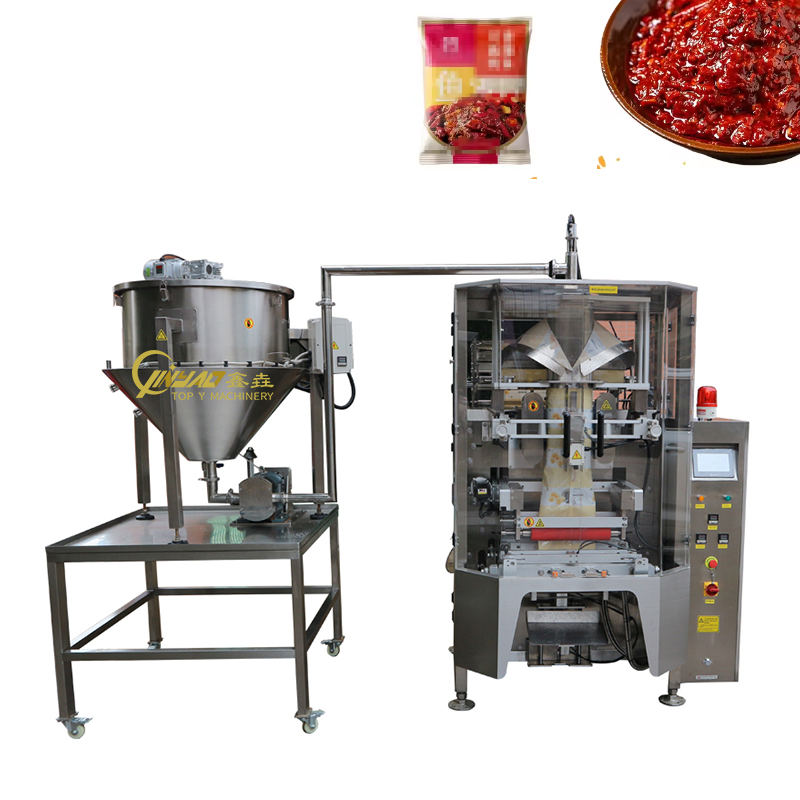
The vertical machine is the cheapest route to a sealed single-portion sauce pack, and for food-service volumes it is hard to beat. Our chilli sauce VFFS packing machine is representative of the class: a piston or pump dosing unit above a vertical former, 304 stainless contact parts, glass safety door that stops the machine on opening, and bag width adjusted electrically within the former's range.
What it does well
- Material cost. Roll film is the cheapest way to buy packaging. A sachet carries a few grams of laminate; the equivalent premade pouch carries the converter's printing, lamination and three seals in its price.
- Speed at small formats. Our VP series runs 10 to 60 bags per minute on the VP320 and up to 70 on the VP420, with a high-speed variant quoted to 100. For 20 g sachets that is a great deal of output from one lane.
- Footprint. Vertical machines use height rather than floor. In a plant where floor space is the constraint, that matters more than it sounds.
- Hygiene by geometry. A vertical tube drains; there is no open product path lying horizontal. For CIP and washdown routines this is a genuinely easier machine to keep clean.
Where it stops
- No spouts, no zippers beyond inline options. A spout is a rigid part welded to the pouch — film cannot form one. Inline zipper film exists and works, but a slider zipper is effectively premade-only.
- Bag width is a hardware change. Bag length is a recipe parameter on any PLC; bag width needs a different forming tube and often different jaws. If your sauce range spans narrow sachets and wide catering bags, you are buying formers, not settings.
- Sealing over product is the enemy. Liquid in the seal area is the most common cause of leakers on any vertical liquid machine. Anti-drip nozzles, a clean cut-off and correct jaw timing are not optional extras; if a supplier does not raise this, be careful.
- Large formats get slow. On the same 7-model range, bag speed falls from 10–60/min at 320 mm film width to 2–30/min at 1,050 mm. A 5 kg catering bag is a different economic proposition from a 20 g sachet.
| TOPY-VP model | Bag length (mm) | Bag width (mm) | Speed (bags/min) | Film width (mm) | Sensible sauce use |
|---|---|---|---|---|---|
| VP320 | 30–220 | 50–150 | 10–60 | 120–320 | Single-serve sachets, 15–50 g |
| VP420 | 70–300 | 60–200 | 10–70 | 120–420 | Retail sachets and small pouches |
| VP520 | 80–350 | 100–250 | 15–60 | 220–520 | 250–500 g pouch for retail |
| VP620 | 80–350 | 100–250 | 15–60 | 220–620 | Same bag size, wider former options |
| VP730 | 200–400 | 140–350 | 10–50 | 300–730 | 1 kg catering packs |
| VP820 | 150–500 | 250–400 | 5–30 | 340–820 | 2–3 kg catering bags |
| VP1050 | 200–500 | 140–500 | 2–30 | 300–1050 | 5 kg bulk sauce bags |
Read the table as a warning against single-number quotations. A supplier who tells you "60 bags per minute" without naming the model and bag size has quoted you the top-left cell and nothing else. The same range spans 2 to 70 bags per minute depending on which row you are actually buying.
Sauce Packaging Machine on the Film Side
For a sauce that has to leave the plant as a sealed bag rather than a container or a premium pouch, this is the configuration we build most: a vertical former with a paste dosing unit, in 304 stainless, with the bag width trimmed electrically inside the former's range.
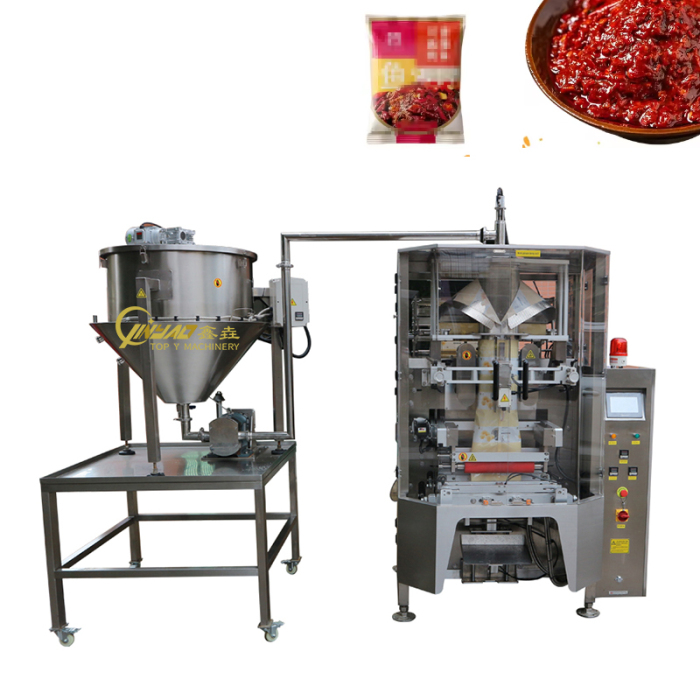
Packaging Machines | Fully Automatic | Chili Sauce | Paste Liquid | Plastic Bag | Forming Filling Sealing
- TOPY-VP series: 7 models, bag width 50–500 mm, speed 2–70 bags/min by model
- 304 stainless contact parts; glass safety door stops the machine on opening
- Bag width adjusted by electric motor within the former range
- Handles multi-layer laminate, monolayer PE and PP film, 0.03–0.20 mm by model
Piston Fillers for Condiments: Volume, Particulates and the Valve Nobody Specifies
If your condiment goes into a bottle, jar or can, the machine you are looking for is a container filler, and for anything thicker than soy sauce that means pistons. The principle is straightforward: a cylinder of known volume is filled from the hopper, and the piston pushes that volume out through a nozzle. Accuracy comes from the geometry of the cylinder, not from a flow meter, which is why a piston holds its accuracy when viscosity drifts.
Our tomato sauce and chilli garlic paste piston filler is the configuration we build most for condiments: 8 piston heads, 100–1000 ml per head, ±0.5% filling accuracy on a weight basis, 304 stainless contact parts and a PLC touch screen with recipe storage.
The valve decides whether you can run chunky sauce
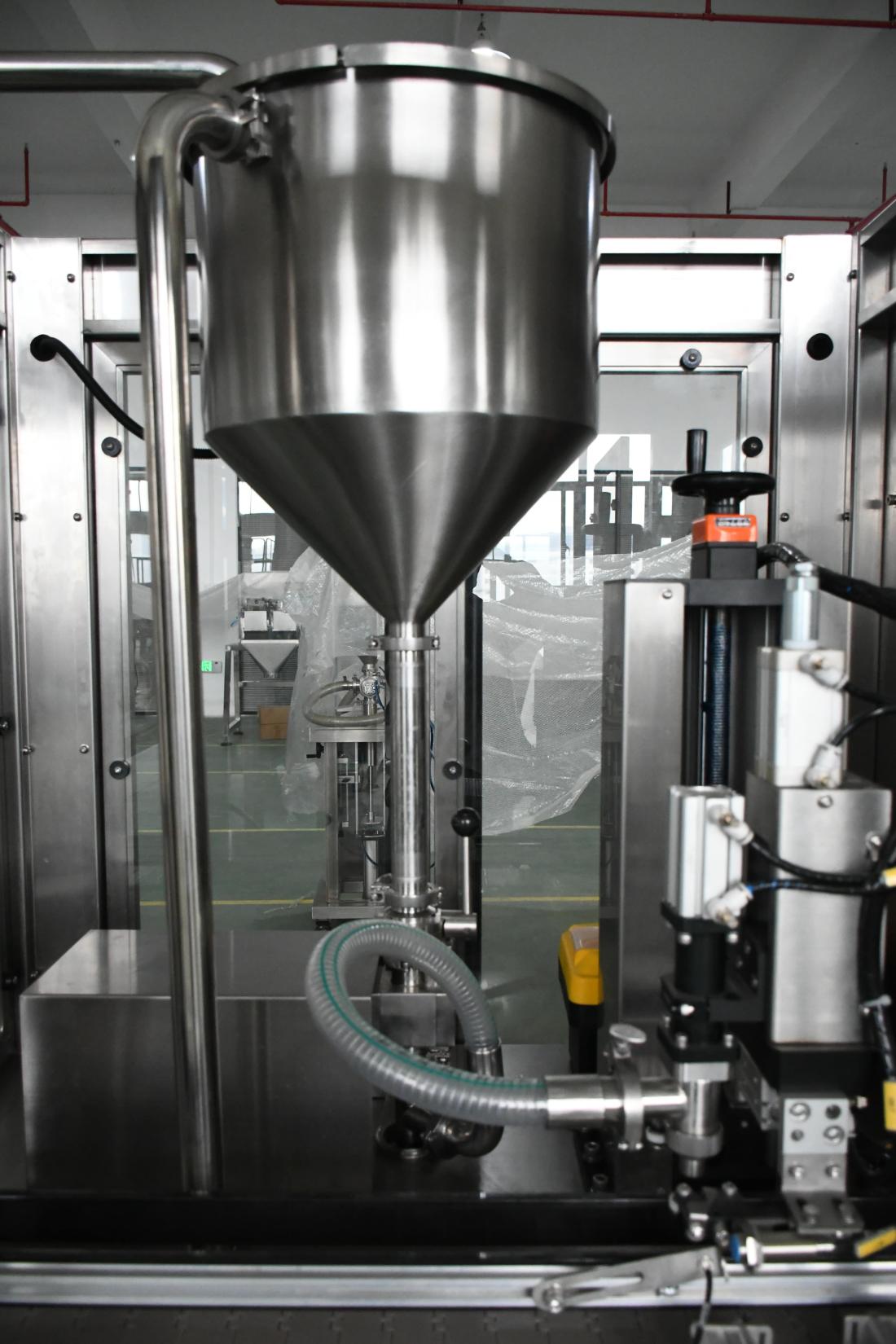
Here is the specification that separates a condiment filler from a generic paste filler, and it is almost never on the first quotation. A piston draws product through a check valve. Standard poppet or ball check valves have a narrow throat, and a narrow throat does two bad things to a chunky sauce: it chokes on solids, and when it does pass them, it shears them. Your salsa arrives in the jar with the tomato pieces turned to pulp — a product-quality failure that no amount of downstream QC recovers.
The fix is a rotary valve plus an enlarged nozzle bore, so the largest particle in your sauce passes without being squeezed. When you specify, do not say "handles particulates". Send three things instead: the maximum particle dimension in millimetres, the percentage of solids by weight, and a sample jar of the sauce at production temperature. A supplier who cannot tell you the bore size in millimetres from those three inputs is guessing.
The emulsions need a different piston. Mayonnaise and salad dressing are not thick sauces — they are fragile ones. The piston itself is fine; the failure mode is shear at the valve and nozzle. Low-shear nozzle geometry and smooth-bore product paths keep the emulsion intact, which is why we build the mayonnaise version of the same filler as a separate configuration rather than a different nozzle on the same head.
What to check beyond the head count
- Hopper geometry and agitation. Thick paste does not flow like water. A conical hopper with the wrong angle, or no agitation, gives you uneven fills in the last third of every batch.
- Nozzle drip. A piston that cuts off cleanly leaves no tail on the bottle rim; one that does not will contaminate your capping station and your labels. Ask for a video of the cut-off at your fill weight.
- Container changeover. A machine that fills 250 ml and 500 ml jars needs either a quick-change neck guide and lift, or two machines. Ask what the changeover involves and who does it.
- CIP connection points. If you run two sauces on one line, cleaning between them is a production constraint, not a hygiene afterthought. Specify CIP ports and a documented cleaning cycle.
And the reverse case, which is worth saying because it is where money gets wasted: thin sauces rarely need pistons at all. Soy sauce, vinegar and cooking wine are better served by a multi-head liquid seasoning filling machine with anti-drip valves and 6, 8 or 12 heads, because on a water-thin product the engineering problem is drip, foam and fill level in a clear bottle — not displacement.
Condiment Packaging Machine on the Container Side
For a condiment that ships in a jar, bottle or can, the piston filler is the answer, and the specification that matters is not the head count but whether the valve can pass your particles without crushing them.
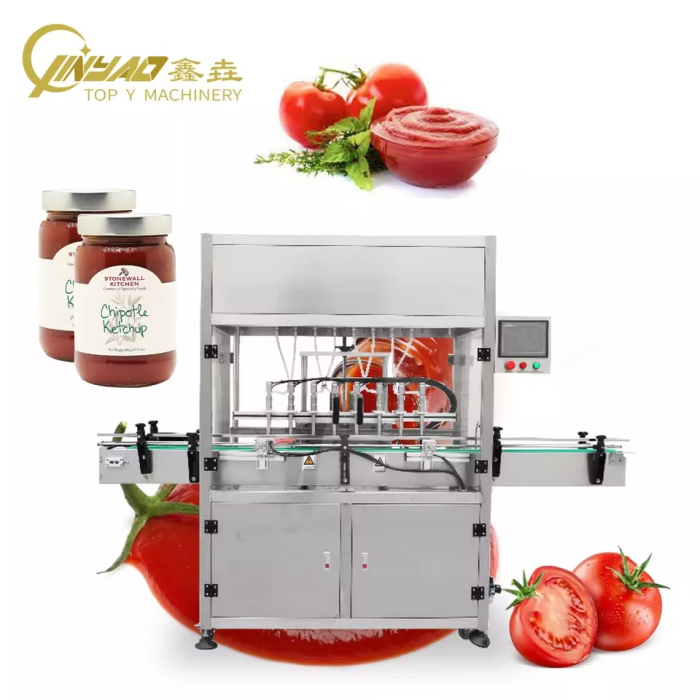
High Accuracy Tomato Sauce Filling Machine - Chilli & Garlic Paste Piston Filler
- ±0.5% filling accuracy on a weight basis; 8 piston heads
- 100–1000 ml per head, adjustable; 304 stainless, CIP-friendly contact parts
- Wide-mouth anti-clog nozzles for pulp, seeds and spice particles
- PLC touch-screen control with recipe storage; cans, bottles, jars and bags
Rotary Premade and Spout Pouches: The Shelf-Facing Option
The third architecture takes a finished pouch from a magazine, opens it, fills it and seals it once. It exists because the pack itself is a marketing decision, and marketing decisions are not always engineering decisions.
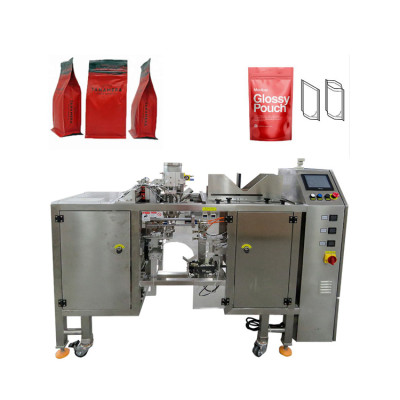
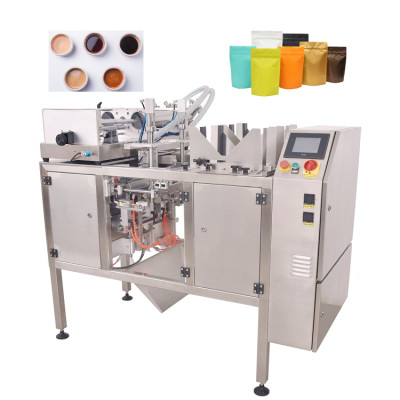
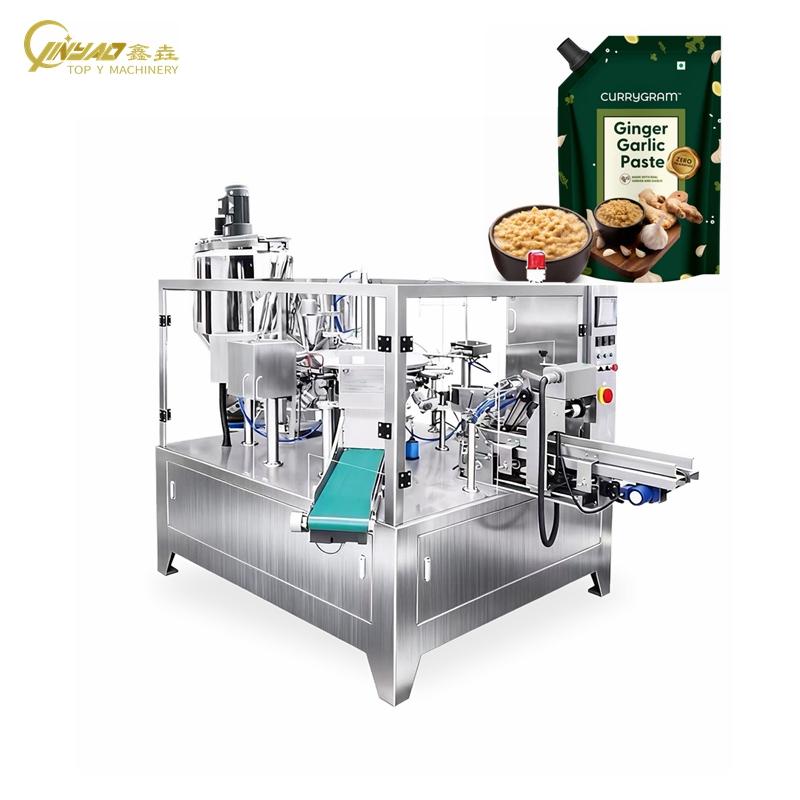
Our rotary spout pouch machine for dipping sauce and peanut paste runs a carousel: pouch pickup, vacuum-and-air opening, fill, seal, discharge. Bag range 90–400 mm wide by 100–500 mm long, 10–60 bags per minute, Doypack / stand-up zipper / gusset formats, 600 L/min air consumption, 304 stainless.
Why a sauce producer chooses this over film
- The spout. A rigid fitment welded by the converter is the one thing film cannot do, and for sauces it is the feature that sells: resealable, squeezable, no ladle, no drips down the bottle neck.
- The shelf face. A stand-up Doypack presents a full printed panel. For a premium pasta sauce or a speciality condiment, that panel is worth more than the film saving.
- Changeover economics. A new pouch size is a magazine and gripper adjustment; a new artwork on the same size is a new carton. In a plant running many SKUs, that beats a former change every time.
- The "no pouch, no fill, no seal" logic. A pouch that fails to open is rejected before dosing, and can be reused. On a film machine a mis-formed bag usually has product in it by the time you see the fault.
And why it is not the default
Cost per pack. The converter's work is embedded in the pouch price, and for a high-volume single-SKU sauce that gap is large enough to pay for a VFFS twice over. If your volume is one sauce in one format, this machine is a more expensive way to do the same job — an honest answer we give regularly.
Fill Accuracy: What ±0.5% Actually Measures
Fill accuracy claims are the most misread numbers in sauce packaging, because two different things are being measured and they are both called "accuracy".
| What is measured | How it is checked | Typical published figure | What it means in your plant |
|---|---|---|---|
| Volumetric accuracy | Volume delivered per cycle, from cylinder geometry | ±1% of fill volume is the usual piston figure | Drifts when product density or temperature changes — the cylinder did not change, the sauce did |
| Weight-based accuracy | Filled container weighed, servo compensates per cycle | ±0.5% achievable with servo control and check-weighing | Holds through density drift, because the machine corrects against mass rather than trusting volume |
| Repeatability | Spread of consecutive fills on one setting | Tighter than either accuracy figure | A machine can be repeatable and wrong — consistently over-filling at a fixed offset |
So when a supplier says "±0.5%", the first question is: ±0.5% of what, measured how? Our own condiment filler is quoted at ±0.5% on a weight basis, which is a stronger claim than ±0.5% volumetric and only possible because the control loop weighs. If a quotation gives ±0.5% without saying which, treat it as ±1% volumetric until proven otherwise.
There is a commercial consequence that buyers often miss. On a 300 g jar, ±0.5% is 1.5 g. Over a million jars that is 1.5 tonnes of product variance — and if your process averages on the high side rather than centred, you are giving away product on every jar. Ask the supplier to show the distribution, not the tolerance: a machine centred at target with a tight spread is worth more than one that never exceeds the limit but leans high.
Hot Fill, pH and the Stainless Grade That Actually Matters
Three product properties decide more of your machine specification than any brochure feature: fill temperature, pH, and salt content.
Hot fill
Many sauces are filled hot as a preservation step. That changes the machine in specific places: seals must tolerate the temperature at the jaw, nozzles must not distort, and the product path must cope with thermal expansion. Filling hot also raises the risk of condensation in the seal area, which is a leaker waiting to happen. Typical laminates seal somewhere between 130 and 200 °C at 0.3–0.6 MPa with a dwell of 0.5–1.5 seconds — but those are ranges, and your film supplier's own window is the one that governs. Get it in writing and test at your fill temperature, not at ambient.
The regulatory line that matters: an acidified or acid sauce with a pH of 4.6 or below can generally be hot-filled and pasteurised in the pack. Above pH 4.6, hot fill alone does not make the product commercially sterile, and you are into retort territory — which changes the pack, the film and the whole line. Confirm your pH and your process authority's view before you buy anything.
The 304 versus 316L question
Almost every sauce machine is quoted in 304 stainless, including ours. For most products that is correct and sufficient. But 304 is vulnerable to chloride stress corrosion cracking, and two very common sauce ingredients are chloride sources: salt and soy sauce. Add a hot, acidic, high-chloride product and repeated CIP with chloride-based sanitisers, and a 304 weld in a stagnant crevice can crack.
Ask this before you sign. "My product is X% salt at pH Y, filled at Z °C, cleaned with this sanitiser. Is 304 adequate for the wetted parts, and which parts are welded rather than formed?" If the answer is a confident "304 is fine" with no reference to chloride concentration, get a second opinion — the upgrade to 316L on wetted parts is far cheaper before the machine is built.
Seal Integrity on a Liquid Pack: Three Tests, Not One
A sauce pack fails in three distinct ways and each needs its own test. This is the section buyers skip and then discover in the warehouse.
| Test | Standard | What it finds | What it misses |
|---|---|---|---|
| Seal strength (peel) | ASTM F88 | Whether the seal is bonded strongly enough to survive handling | A strong seal with a channel through it — the pack still leaks |
| Burst | ASTM F2054 | Whether the pack holds pressure as a whole | Slow leaks that only appear under stacking load over weeks |
| Leak (bubble emission) | ASTM F2096 | Actual holes and channel leaks | Weak-but-intact seals that fail later |
Run all three on the same sample batch, at the same fill temperature and the same film lot you will use in production. A machine that passes a peel test and fails bubble emission is not a machine with a tolerance problem — it has a nozzle or jaw geometry problem, and it will leak for the life of the asset.
For sauce specifically, add two production checks that cost nothing: seal-area inspection (is there product in the seal?) and a hot-tack check at line speed (does the seal set before the pack leaves the jaw?). Hot tack is the one that fails when you speed up a line you already accepted at lower speed, which is exactly what happens three months after installation.
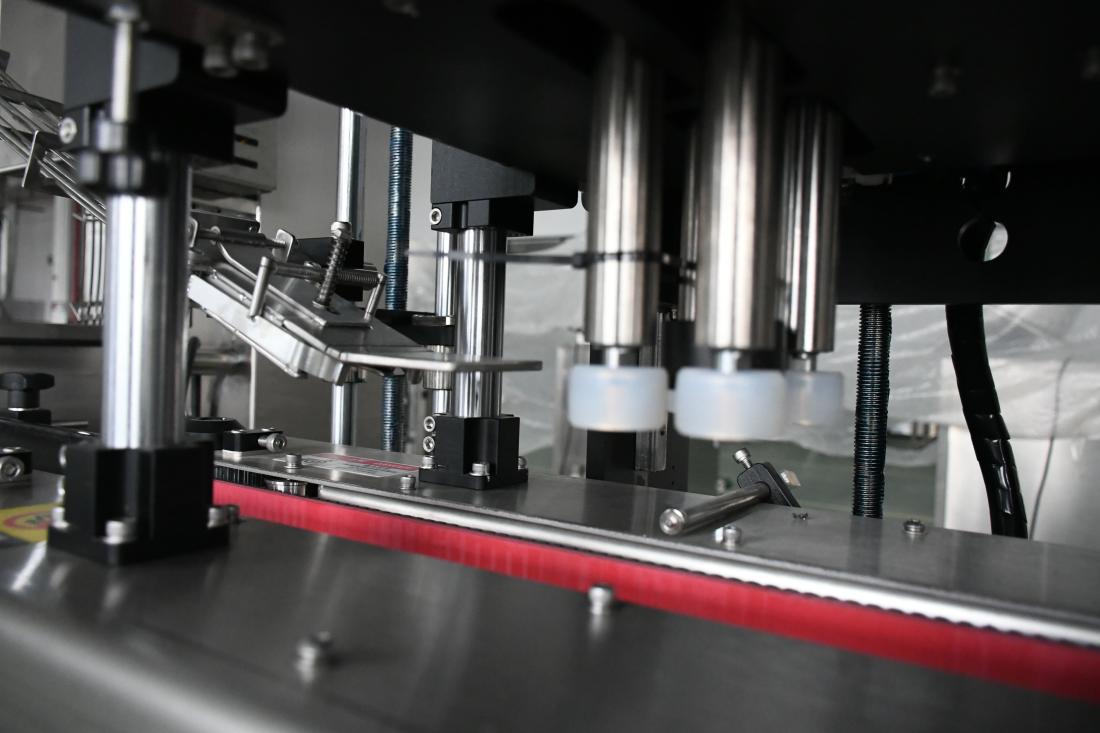
The acceptance protocol is where this becomes contractual. Our factory acceptance test checklist sets out how to make seal tests measurable before shipment rather than discoverable after it.
Throughput: Why Sachet Speeds Are Quoted per Lane
Vertical sachet machines achieve their headline speeds by running several lanes at once. This is not a marketing trick, it is the only way the arithmetic works, and it changes how you should read a speed claim.
| Configuration | Typical output | What that means for a sauce producer |
|---|---|---|
| Single lane | 30–80 sachets/min | Right for a speciality sauce or a small plant; one operator, simple changeover |
| 4-lane | 150–320 sachets/min | The usual choice for mid-volume condiment production |
| 8–12 lane | 400–800 sachets/min | Large-scale single-product sauce; changeover is a project, not a task |
Three derating factors apply to any of those numbers, and you should apply them before you size a line:
- Fill time, not machine time. A thin soy sauce fills in a fraction of a second; a 20,000 cP chilli paste needs several seconds per dose. The machine's rated speed assumes a filler that keeps up. Yours is the filler you actually bought.
- Seal dwell on a wet pack. Liquid in the jaw area forces a longer dwell or a second stage. That directly caps cycles per minute, and it is the most common reason a delivered machine runs slower than the quoted rate.
- Film tension and registration at speed. Printed film with an eye-mark must stay in register as the machine accelerates. Above a certain speed on a given film, registration drift becomes the limit rather than the mechanics.
So when you compare quotations, compare them at your fill weight, your viscosity and your lane count. Two machines quoted at 60 bags per minute on a 20 g water-like product may both deliver 35 on a 40 g ketchup.
The Selection Matrix, and How to Read It
Here is the whole article compressed into a table. Find the row that describes your product honestly, not the row you would like it to be.
| Your situation | Architecture | Filling system | Why |
|---|---|---|---|
| Thin sauce (soy, vinegar, fish sauce) in sachets, high volume | VFFS | Gravity or gear pump | Film is cheapest and viscosity does not need positive displacement |
| Thin sauce in glass or PET bottles, retail | Container filler | Overflow or gravity, 6–12 heads | Fill level in a clear bottle is a visual quality issue, so fill to level |
| Medium sauce (ketchup, BBQ, oyster) in bottles | Container filler | Piston | Needs positive displacement and a clean cut-off at the bottle rim |
| Thick paste with particles (chilli, salsa, marinara) | Container filler, or VFFS for bulk | Piston with rotary valve, wide bore | Particles must pass unbroken; standard check valves fail this |
| Emulsion (mayonnaise, dressing) | Container filler | Low-shear piston, or peristaltic | Shear destroys the emulsion permanently |
| Sauce in a spout pouch or premium stand-up pouch | Rotary premade | Piston or servo gear pump | A rigid spout cannot be formed from film; the shelf panel is the product |
| Multiple sauces, frequent changeover | Rotary premade, or container filler with CIP | Any, with recipe storage | Changeover time costs more than material at low volume per SKU |
| Bulk catering sauce, 3–5 kg | VFFS, large former | Piston or pump | Film saving at that volume is large; bag-in-box style packs are a film job |
Two honest notes on reading it. First, the rows are not mutually exclusive — a sauce producer with a retail pouch and a catering bag commonly ends up with two machines, and that is a correct outcome rather than indecision. Second, the matrix cannot tell you which machine to buy, only which family. Within that family, the decision comes down to the eight inputs below, and to whether the supplier will show you the numbers instead of the brochure.
The eight inputs that get you a comparable quotation
- Product viscosity, in cP, at your fill temperature. If you have no figure, say so and send a sample.
- Maximum particle size in millimetres and percentage of solids by weight.
- Fill weight per pack, and the tolerance you will actually reject on.
- Pack format, material and dimensions — film width and repeat, or pouch drawing, or bottle neck finish.
- Required packs per minute at that fill weight, sustained, not peak.
- Fill temperature, pH and salt content.
- Changeovers per week and number of SKUs.
- Market and compliance route: food-contact framework, machinery conformity, and whether the product is acidified, hot-filled or retort.
FAQ: Sauce and Condiment Packaging Questions
Is a sauce packaging machine the same as a condiment packaging machine?
Mechanically, largely yes — both fill, seal and protect a liquid or semi-liquid food. Commercially, the two terms are used for two buying patterns: "sauce packaging machine" usually means a pouch or sachet line, "condiment packaging machine" usually means a bottle or jar filling line. The machine you need is determined by viscosity, particle content and container, not by which term your customer used.
Which filling system is best for chilli sauce with seeds?
A piston filler with a rotary valve and an enlarged nozzle bore. The piston gives volumetric accuracy at high viscosity, and the rotary valve is what lets seeds and pulp pass without being crushed or jamming the seat. A standard poppet or ball check valve will do both — choke, and shear the solids when it eventually lets them through. Specify the maximum particle size in millimetres so the bore can be sized for it.
Can a VFFS machine make spout pouches?
Not as a standard configuration. A spout is a rigid fitment welded to the pouch, and film cannot be formed into one. There are inline fitment applicators that weld a spout onto a formed bag, but they add a station, cost and cycle time, and the range of spout types is narrower than a converter can offer. If a spout is central to your product, a rotary premade machine is the natural choice.
Do I need 316L stainless for sauce?
Not for most sauces — 304 is the standard and is adequate for typical products. Upgrade to 316L on wetted parts when the product is high in chloride (salt, soy sauce, fish sauce), acidic, filled hot, and cleaned with chloride-based sanitisers, because that combination attacks 304 at welds and in crevices. Ask the question explicitly rather than accepting a default, and ask it before the machine is built.
What does ±0.5% fill accuracy actually mean?
It depends what is being measured, and quotations rarely say. Volumetric accuracy — typically ±1% for a piston — is the volume the cylinder delivers and drifts when product density or temperature changes. Weight-based accuracy, ±0.5% or better, is measured on a filled container with the control loop correcting each cycle, so it holds through density drift. Ask which figure is quoted, and ask for the distribution of a hundred consecutive fills rather than the tolerance alone.
How do I test seal quality on a sauce pack before shipment?
Three tests, not one: seal strength to ASTM F88, unrestrained burst to ASTM F2054, and bubble-emission leak to ASTM F2096. A pack can pass peel strength and still leak through a channel in the seal, so passing one test proves very little. Run all three on the same batch, at your fill temperature and with your production film lot, and add a hot-tack check at line speed so the result still holds when you speed the line up later.
How This Guide Was Written
Author and standing. Written by the TOP Y Machinery engineering team in Foshan, Guangdong. We build all three architectures discussed here — vertical form fill seal machines, piston container fillers and rotary premade pouch machines — so this guide cannot recommend a platform on the grounds that we only sell one. Where the honest answer favours something we do not build, such as a retort process or a converter's die-cut pouch, it says so.
What the figures are based on. The bag-size, film-width, speed and fill-accuracy figures for the TOPY-VP, TOPY-FM and TOPY-RPM machines are our published specifications, reproduced so you can check the logic rather than trust the claim. The viscosity bands, lane-speed ranges, seal temperature envelope and standard test references are conventional industry planning figures as published by equipment and material suppliers; they are ranges, not guarantees, and your product will sit somewhere inside them rather than at the midpoint. The pH 4.6 acidification threshold is the standard food-preservation boundary, and your process authority's determination governs your process, not this article.
What this guide deliberately does not do. It does not quote prices, because a price without a viscosity reading and a pack drawing is a guess. It does not give a customer return on investment, because the labour rate, the pack cost and the margin are yours. It does not claim any single architecture is best, because the three exist for reasons that are still true.
Review. Reviewed 2026-11-01. The specification tables are the part most likely to age as our range changes, and they will be re-checked whenever the product pages are updated. Standards references — ASTM F88, F2054 and F2096 — are cited as published documents, not paraphrased into vaguer language. If you find an error, tell us and we will correct it and record the correction.
If you want the matrix in this article applied to your own product, send the eight inputs from the selection section to our engineering team. If the honest answer is a machine we do not make, we will say that too.
Related Reading
- Paste VFFS packing machines: the full range for sauces, pastes and thick liquids
- 5 kg bulk sauce bag packaging machine for catering volumes
- Rotary spout pouch packing machines for sauce and paste
- Doypack packing machine buying guide: what to know before you buy
- Liquid food packaging machine: a complete guide to pouches, spout bags and Doypacks
- Liquid VFFS packing machines for thin sauces, juices and edible oils
- Food packaging machine types in 2026: VFFS, HFFS, rotary and pouch systems