Vertical Bagging vs Premade Pouch: Bag Formats, Film Consumption and Changeover Time Compared
What This Comparison Covers
- VFFS vs Premade Pouch: Three Numbers Decide the Machine
- One Architectural Difference Decides Everything Else
- Bag Formats: The Constraint You Cannot Engineer Around
- Film Consumption: The Width Formula You Can Check Against Any Quotation
- Worked Example: 13.5 Grams of Film per Bag
- Where Roll Film Is Lost, and Where Premade Pouches Are Lost
- Changeover Time: Bag Length Is a Parameter, Bag Width Is a Part
- What Premade Pouch Changeover Time Costs Over a Year
- Where Seal Quality Problems Appear on Each Platform
- The Crossover, Built from Your Numbers Not Ours
- Vertical Bagging Machines (VFFS) on the Film Side
- Premade Pouch Machines on the Format Side
- FAQ: Formats, Film and Changeover Questions
- How This Comparison Was Written
VFFS vs Premade Pouch: Three Numbers Decide the Machine
Vertical bagging (VFFS) and premade pouch machines weigh, fill and seal the same products, and that is why the comparison keeps going in circles. They differ in one architectural fact, and every cost, speed and flexibility difference follows from it: a VFFS makes the bag from a roll of film, in line, around a forming tube; a premade pouch machine opens a bag that a converter already made, printed and sealed on three sides.
So decide on three numbers, in this order — and notice that machine price is not one of them:
- Does the bag format you need exist as roll film? If you require a spout, a slider zipper, a die-cut shape, a flat-bottom box pouch or a matte-and-gloss finish on the same panel, the answer is no, and the comparison ends. No amount of engineering on a VFFS produces a format that film cannot form.
- How many changeovers per year will the line actually be asked to do? Not how many SKUs you have — how many times per week someone walks up to the machine and changes the bag. This number, more than annual volume, is what separates the two platforms in practice.
- How many million packs of one format per year? Once changeovers are few and volume is high, film cost dominates and VFFS wins on unit economics. Once changeovers are frequent, the film saving is spent on downtime before it reaches the bank.
The version we give on a phone call. If your bag needs a feature film cannot form, buy the premade machine and stop negotiating on film price. If your bag is a pillow, gusset or quad seal and you change it fewer than once a week, buy the VFFS and put the difference into a better weigher — because a cheap weigher on a fast machine manufactures expensive scrap.
One Architectural Difference Decides Everything Else
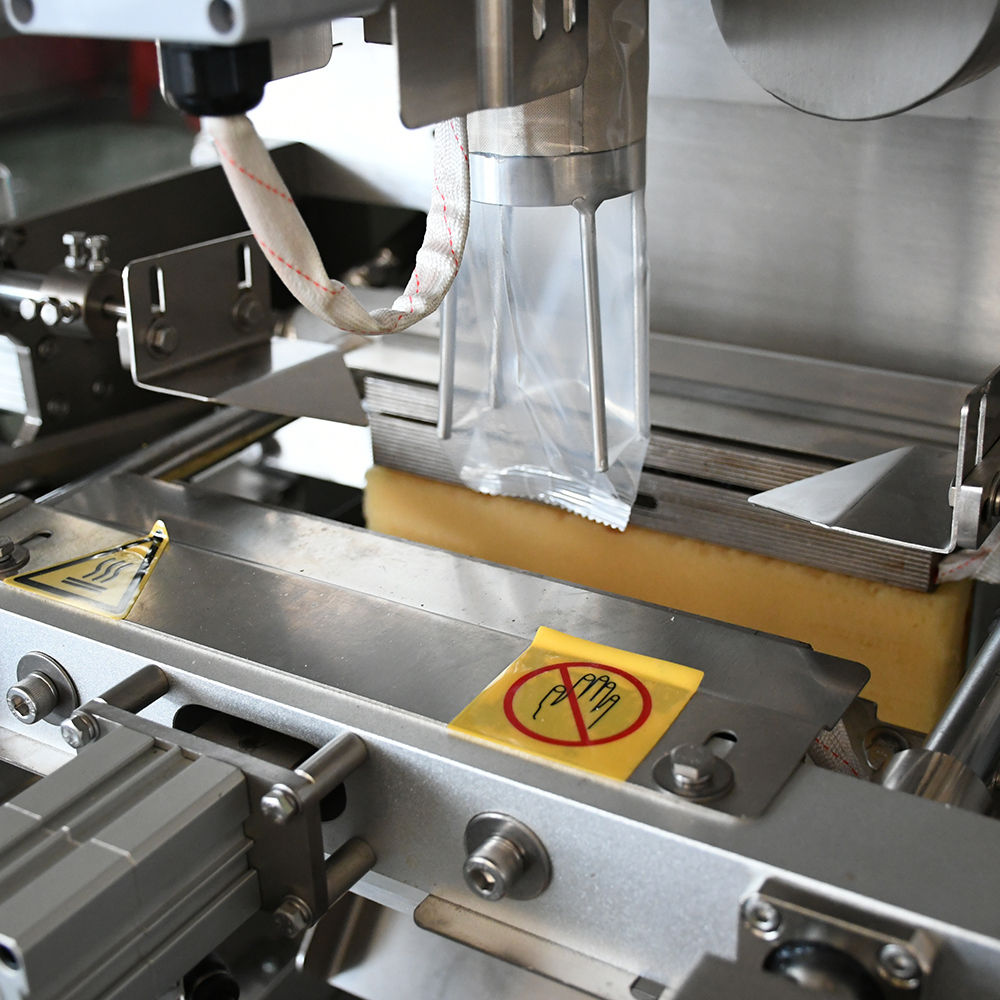
Follow the bag. On a premade pouch line, the bag has already lived a full life before it reaches you: the converter printed it, laminated it, cut it, sealed three of its four sides, fitted the zipper or welded the spout, and packed it into a carton. Your machine performs one operation the converter did not: it opens the pouch, fills it, and closes the fourth side. On a VFFS, you perform six operations the converter would have performed — forming, back-sealing, filling, top-sealing, cutting, and the quality control that goes with all four.
This is not a detail about who does the work. It is a detail about where the work can go wrong, and who pays when it does:
| What the architecture changes | VFFS (film from roll) | Premade pouch (converted offline) |
|---|---|---|
| Where bag quality is created | On your floor, every shift, by your jaws, tension and dwell | At the converter; you inherit their three seals and their print |
| What you buy from the supplier | Film: width, repeat, core, unwind direction, gauge and seal behaviour all specified to one machine | Finished pouches: a countable, storable, inspectable item |
| Material cost per pack | Lower — you are not paying a converter to form, print and store the bag | Higher — converting, printing and features are embedded in the pouch price |
| Scrap when something goes wrong | One bag length of film, plus the product if it was already dosed | An entire finished pouch, plus the product |
| Format ceiling | Whatever a tube can be folded into | Whatever a converter can make |
| Ramp-up risk | Real: film must be proven on the machine, usually with a line trial | Low: the pouch is already a pouch |
Read that table again with a purchasing hat on, because it explains an asymmetry that surprises buyers. The platform with the cheaper material has the more expensive ramp-up, and the platform with the more expensive material has the cheaper ramp-up. That is not a coincidence — it is the same fact seen from two sides.
Bag Formats: The Constraint You Cannot Engineer Around
Every VFFS bag is a variation on one shape: a flattened tube with a longitudinal seal down the back and a transverse seal at each end. Once you accept that, the format list stops being a list of options and becomes a list of consequences.
| Bag format | On VFFS | On premade pouch | What decides it |
|---|---|---|---|
| Pillow bag (fin seal) | Native — the default | Possible, rarely chosen | Cheapest possible format on film; a premade version adds cost for no gain |
| Side-gusset / folded-bottom bag | Yes, with a gusset former | Yes | Gusseting hardware on the VFFS; a standard pouch conversion offline |
| Quad seal (four-corner) bag | Yes, dedicated former and jaw set | Yes | Film can do it, but the former is format-specific, not shared |
| Stand-up / Doypack pouch | Only with a Doypack attachment that folds and inserts the bottom gusset (Doypack stand-up pouch machine range) | Native — this is what the format was invented for | Speed drops on the VFFS attachment; the bottom fold is a mechanical operation, not a film property |
| Zipper pouch | Possible via zipper film or an inline zipper applicator | Native, including slider and pocket zippers | Inline zipper costs speed and adds a consumable; slider zippers are effectively premade-only |
| Spout pouch | Not on a standard VFFS — needs a separate fitment inserter | Native, welded by the converter | The spout is a rigid part; it cannot be formed from film |
| Flat-bottom / box pouch | Not in practice | Native | Requires a five-panel construction with corner seals made before filling |
| Die-cut shape, handle, window | Window yes; die-cut silhouette no | Yes | A cut silhouette breaks the tube; a registered window is only a print-and-punch operation |
| Spot matte / gloss, cold foil, texture | Limited to what the film supplier can deliver in register | Full converter finishing | Finishing happens after printing; on film it must be printed in |
Two consequences worth saying out loud, because they are usually discovered late:
- The back seal costs you printable area. A fin seal on a 190 mm wide bag consumes roughly 10 to 20 mm of film that becomes a sealed flange down the back. On a premade pouch the fourth seal is at the top, where the customer expects a seal anyway. If your artwork assumes a full-bleed back panel, it will not survive contact with a VFFS.
- A format change on a VFFS is often a hardware change, not a setting change. This is the single most misunderstood point in the whole comparison, and it is the subject of the fifth section.
Film Consumption: The Width Formula You Can Check Against Any Quotation
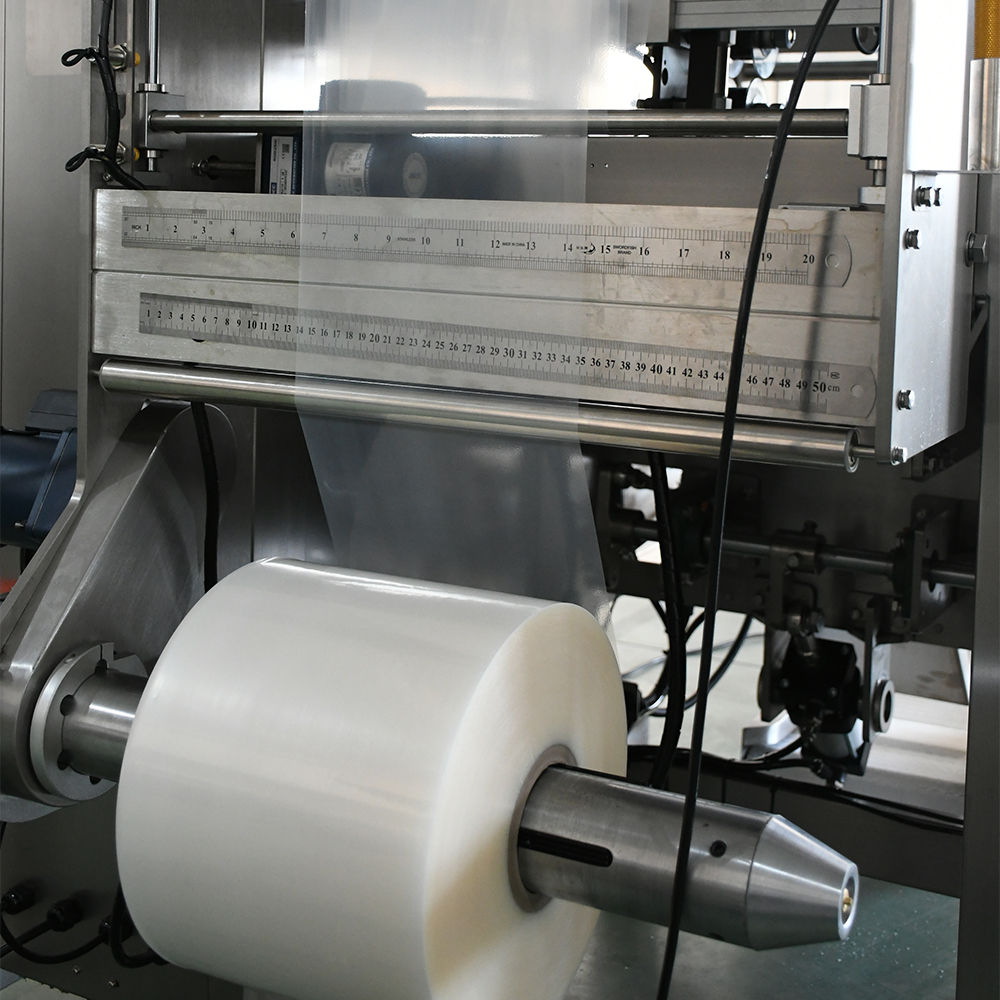
Film consumption is not a matter of opinion. It is geometry, and you can verify any supplier's numbers with one line of arithmetic. The film that forms a bag has to wrap around the product and come back to itself, so:
The rule. Required film width = 2 × finished bag width + seal allowance (typically 10 to 25 mm for the back fin seal). Film consumed per bag = film width × (bag length + 5 to 10 mm for the transverse seal and cut).
You do not have to take that on trust. It is checkable against our own published specification table, because a machine's maximum film width and its maximum bag width have to satisfy the same relationship — otherwise one of the two numbers is decorative:
| Model | Bag width (mm) | Max film width (mm) | 2 × max bag width | Allowance at max (mm) |
|---|---|---|---|---|
| TOPY-VP320 | 50–150 | 320 | 300 | 20 |
| TOPY-VP420 | 60–200 | 420 | 400 | 20 |
| TOPY-VP520 | 100–250 | 520 | 500 | 20 |
| TOPY-VP620 | 100–250 | 620 | 500 | 120 |
| TOPY-VP730 | 140–350 | 730 | 700 | 30 |
| TOPY-VP820 | 250–400 | 820 | 800 | 20 |
| TOPY-VP1050 | 140–500 | 1050 | 1000 | 50 |
Six of the seven models land on an allowance of 20 to 50 mm, which is exactly the fin seal and trim you would expect. The VP620 is the interesting row: its film width exceeds 2 × bag width by 120 mm, because the machine accepts a larger former than the bag-size column advertises. That is not an error, and it is not unique to us — the lesson is that the film-width column describes the machine, while the bag-width column describes a catalogue family. When you specify a bag, specify it against the former you will actually fit, not against the maximum in the brochure. The VFFS packing machine range is organised by former size for exactly this reason.
Two more things the table tells you, if you read the speed column alongside it. First, film thickness rises with model size, from 0.03 mm on the VP320 to 0.20 mm on the VP1050 — a heavier bag needs a stiffer web to hold its shape around a bigger tube. Second, bag speed falls as the bag grows: the VP320 runs 10 to 60 bags per minute and the VP1050 runs 2 to 30, even though both are quoted with the same 100 bags per minute high-speed option on small formats. A bigger bag means more film to index, longer seal dwell, and a longer stroke. Anyone quoting you a single "bags per minute" figure without naming the bag size is quoting the most favourable cell of that table.
Worked Example: 13.5 Grams of Film per Bag
Take a 1 kg coffee bag: 190 mm wide, 300 mm long, in a PET 12 / aluminium 7 / PE 80 laminate, which is 99 µm and a common structure for a degassing-valve coffee pack — the trade-off between barrier and print is the same one behind kraft paper versus foil coffee bags. Run the arithmetic in the order you would on a quotation review:
| Step | Calculation | Result |
|---|---|---|
| 1. Film width | 2 × 190 + 20 | 400 mm — so this is a VP420 job |
| 2. Film consumed per bag | 400 mm × (300 + 8) mm | 0.1232 m² |
| 3. Grammage of the structure | (12 × 1.40) + (7 × 2.70) + (80 × 0.92) | 109.3 g/m² |
| 4. Film mass per bag | 0.1232 × 109.3 | 13.5 g |
| 5. Film cost per bag at $4.20/kg | 13.5 g × $4.20 ÷ 1000 | 5.7 cents |
| 6. Bags obtainable per kg of film | 1000 ÷ 13.5 | about 74 bags |
| 7. Effective cost with 3% start-up and splice scrap | 13.5 × 1.03 = 13.9 g | 5.8 cents |
Now the same bag as a premade stand-up pouch with a zipper, from a converter, at 11.5 cents delivered. The pouch carries more material — roughly 15.8 g once you add the bottom gusset and the zipper tape — but the gap between 5.8 and 11.5 cents is not a material gap. It is the converter's printing, lamination, three seals, zipper welding, inspection and margin, spread over a finished item.
That is a 5.7 cent difference on every bag. At five million bags a year it is $285,000 a year — which is why nobody should be surprised that a plant with one product and few changeovers buys a VFFS and never revisits the decision. And it is equally why a plant with twenty SKUs and two changeovers a day buys the premade machine and never looks back, because it will not run five million bags of anything.
Two checks to run on any film quotation. Ask for the price per kilogram and the grammage of the structure, then divide — some quotations look cheaper per kilogram because the structure is thinner, which changes barrier and seal performance rather than cost. And ask for the film width you are being quoted, not the width of the roll it comes on: a 620 mm roll on a 400 mm job is 220 mm of waste on every single bag.
Where Roll Film Is Lost, and Where Premade Pouches Are Lost
The 2 to 5 percent film scrap figure quoted for VFFS is real, but it is not the number to worry about. The expensive film losses on a VFFS are not scrap at all — they are settings:
- Bag length set long. Nothing marks this as a fault. The bags look fine, the seals pass, the machine runs, and every bag quietly carries an extra 10 mm of film. On the example above that is 4 percent of material, invisible, forever.
- Film width overspecified. Bought because it was in stock, or because the roll was cheaper per kilogram. The waste is in the geometry, not the scrap bin.
- Registration and print repeat. A printed film whose repeat length does not match the bag length forces either a longer bag or an eye-mark fight that shows up as intermittent mis-seals.
- Start-up and splice. Genuinely 2 to 5 percent, and the only one of the four that a scrap bin will show you.
Premade pouches lose material differently, and this is the part buyers consistently underestimate: a pouch that fails to open is thrown away whole. On a rotary premade machine a mis-picked pouch costs the full pouch price — near 11.5 cents in our example, plus any product already dosed into it. A VFFS mis-seal costs a bag length of film, around 5.7 cents, and the film is the cheap half of the loss.
At a 1 percent pouch-open failure rate, a plant running 5 million pouches a year throws away 50,000 finished pouches — about $5,750 of packaging before a cent of product is counted. That is not a reason to avoid premade machines, which is why the industry quotes "no pouch, no fill, no seal" logic as a standard feature. It is a reason to insist that the feature is demonstrated at your speed, on your pouch, rather than assumed.
Changeover Time: Bag Length Is a Parameter, Bag Width Is a Part
Most changeover comparisons are useless because they compare a vague "changeover" against another vague "changeover". The useful distinction is finer, and it follows directly from the film-width arithmetic in the previous section. If film width = 2 × bag width + allowance, then:
Changing bag length is free
The former and the film width stay the same. You index more or less film per cycle. This is a recipe parameter on the touchscreen, measured in a minute or two — and on our VP series the bag width can also be trimmed by electric motor within the former's range.
Changing bag width is a part
The film must be a different width, so the forming tube and often the sealing jaws must be a different set. You buy formers, you stock formers, and you spend 30 to 90 minutes fitting one — and the film on the machine has to be changed with it.
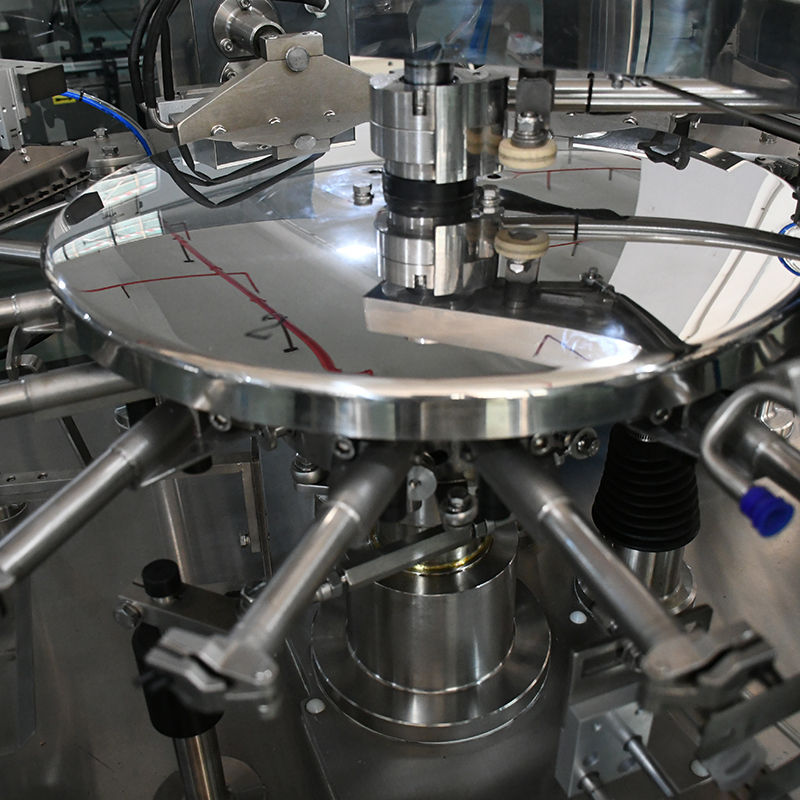
On a rotary premade pouch packing machine the same logic runs the other way. A different pouch size needs a different magazine setting and different gripper or format parts, typically 20 to 45 minutes. But a different artwork on the same pouch size needs nothing at all — you open a new carton and load it. That is the flexibility people mean when they say premade machines handle many SKUs, and it is worth being precise about what is actually flexible.
| What changes | VFFS | Premade pouch | Who does it |
|---|---|---|---|
| Bag length, same width | 1–2 min, recipe on HMI | Not applicable — bag is fixed | Operator |
| Bag width, same length family | 30–90 min, former + jaws + film | 20–45 min, magazine + grippers | Technician, usually |
| New artwork, same size | 2–5 min, new roll | 2–5 min, new carton | Operator |
| New format (pillow → gusset, flat → stand-up) | Hardware: former, jaws, sometimes a Doypack kit | Nothing mechanical if the pouch is the same footprint | Supplier or in-house engineer |
| New product, different filler | Weigher or filler change, 30–120 min | Same | Technician |
| Film or pouch specification change | Line trial strongly advised before committing | Sample approval only | Supplier + your QA |
The question that separates a flexible machine from two machines sharing a frame. "How much do the format parts for my second bag size cost, and how many sets are included?" A palletizing cell needs one gripper; a bagging line needs one former per bag width. If the answer is a five-figure sum per format, the machine is not flexible — it is expensive to repurpose.
What Premade Pouch Changeover Time Costs Over a Year
Translate minutes into capacity and the argument becomes concrete. Take a plant that changes bag twice a day, 250 days a year — 500 changeovers — on a line that otherwise runs 40 bags per minute:
| Platform | Changeover time | Line hours lost per year | Equivalent working days | Bags not produced |
|---|---|---|---|---|
| VFFS, width change needs a former | 75 min | 625 h | about 26 | 1.5 million |
| Premade, format parts change | 30 min | 250 h | about 10 | 0.53 million |
| Difference | 45 min | 375 h | about 16 | about 1 million |
Read the last row carefully, because it is the number that decides most projects. Sixteen working days of line capacity a year, and a million bags of forgone output, is not a rounding error — it is a month of production. Whether it matters depends entirely on whether your line is the constraint. If you have spare capacity and sell everything you make, lost line hours are an inconvenience. If you are turning work away, that million bags is the whole business case for one platform over the other, and it is larger than the film saving in the same year for a plant of moderate volume.
So do the two sums together, never separately. Film saving favours VFFS. Changeover capacity favours premade when changeovers are frequent. The crossover is where those two lines meet on your numbers, and it is not a published threshold — anyone who quotes you a fixed volume without asking your changeover count is guessing.
Where Seal Quality Problems Appear on Each Platform
Both platforms fail. They fail in different places, which means the acceptance test and the spare-parts list differ too.
On a VFFS
- Seal quality is manufactured on your floor. Jaw temperature, dwell time, pressure and web tension all interact, and they interact differently on a 0.03 mm film and a 0.20 mm one. A VFFS seal failure is usually a parameter drift or a film change, not a defect in the material.
- The three-parameter trap. Raising temperature to fix a weak seal can wrinkle the film; raising dwell to fix the wrinkle can burn through a thin laminate. Get the settings window from the supplier in writing, with the film structure named.
- Film specification is machine specification. Width, repeat length, core diameter, unwind direction, gauge and seal behaviour all have to be specified to the machine. This is why a line trial is not optional on a new film — and why a film that worked on one machine can fail on another.
On a Premade Machine
- You make one seal, so seal quality is mostly inherited. The converter's three seals and their print quality arrive pre-made, which moves the risk to goods-in inspection. Ask for their certification and keep samples.
- Opening and pick-up are the new failure modes. A pouch that will not open, opens crooked, or is picked by one edge is a machine-setup problem with a material component: gusset stiffness, zipper tape thickness and film slip all change how a pouch behaves in the magazine.
- Pouch dimensional tolerance matters more than buyers expect. A pouch 2 mm outside its stated width will mis-register in the grippers, and the resulting seals look almost right — which is worse than obviously wrong.
The Tests That Apply to Both
Seal strength, seal integrity and leak are three different measurements and should be three different tests. Seal strength is a peel test to ASTM F88. Unrestrained burst is ASTM F2054. Bubble-emission leak detection is ASTM F2096. A machine that passes a peel test can still leak through a channel in the seal, and a bag that holds pressure on a burst rig can still fail in a carton. Agree all three in the acceptance protocol, with sample sizes, and test the same way on both platforms so the comparison means something. Our factory acceptance test checklist sets out the same three tests with measurable acceptance criteria.
Food-contact compliance sits on top of all of it: EC 1935/2004 as the framework, EU 10/2011 for plastic layers, FDA 21 CFR for the US market. Both architectures can comply, but on a VFFS the compliance evidence follows the film you specify — which is one more reason to specify it precisely rather than accept what is in stock.
The Crossover, Built from Your Numbers Not Ours
Four inputs are enough to place your plant on the right side of this decision. Write them down before you read another brochure:
- Bag format requirement. Spout, slider zipper, flat-bottom, die-cut shape, or matte-and-gloss register → premade, and the analysis is over.
- Changeovers per year. Count them. Multiply daily changes by working days. If the answer is above roughly 300, run the capacity sum above before you compare film prices.
- Annual packs of the dominant format. Below one million, film savings rarely repay the ramp-up and tooling. Above five million of a single format, they usually dominate.
- Whether the line is your constraint. If it is, changeover minutes are worth more than film cents, and the crossover moves toward premade.
| Your situation | The platform that fits | Why |
|---|---|---|
| One product, one bag size, high volume, simple pillow or gusset bag | VFFS | Film saving is the whole story and changeover capacity is irrelevant |
| Premium retail pack with zipper, spout or shelf presence | Premade pouch | Format capability, not cost, decides |
| Contract packer, many clients, many pouch sizes, frequent switches | Premade pouch, or both | Changeover capacity dominates; artwork changes cost nothing |
| Same product in a production size and a retail size | Often both | Large format on VFFS, retail format on premade — a very common pairing |
| Launching, volume unknown, format may change | Premade first | Lower ramp-up risk and no required line trial; revisit at volume |
The pairing in the fourth row deserves a sentence, because it is the answer we see most often in plants that have already solved this. A VFFS running the bulk or production size, and a rotary premade machine running the retail size, is not indecision — it is each platform doing what it is good at. If you are choosing only one and cannot decide, the honest advice is to decide in favour of the format your customer will pay for, and then optimise cost on the platform you chose.
Vertical Bagging Machines (VFFS) on the Film Side
For the film-and-former side of the argument, the machine to look at is the vertical bagger paired with a linear weigher — the configuration we build for nuts, beans, rice and small granules, where the film is doing all the work and the weigher is doing all the accuracy.
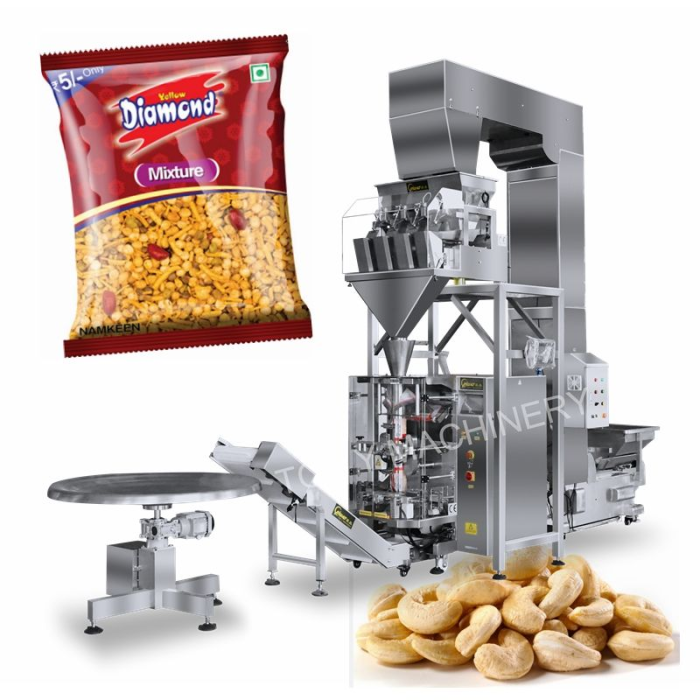
Nuts Packing Machine | Automatic Food Linear Weigher Packing Machine | Cashew Nuts Packing Machine
- Weighing accuracy 0.1–1.5 g on small granules, beans, rice and nuts
- 25–40 bags/min standard; up to 60 bags/min with dual-servo drive
- TOPY-VP series: 7 models, film width 120–1050 mm, bag width 50–500 mm
- Film 0.03–0.10 mm on the 320/420 models; full SS#304 food-grade contact
Premade Pouch Machines on the Format Side
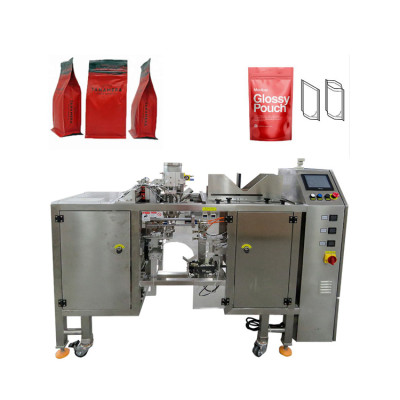
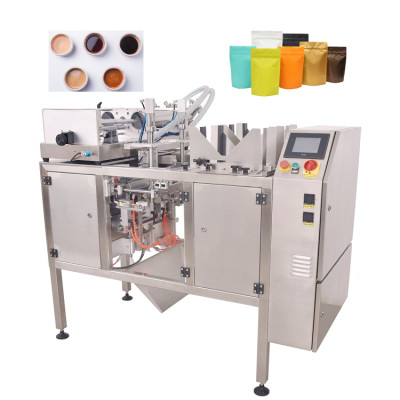
For the format-and-changeover side, the rotary premade pouch machine — a carousel of stations, each pouch opened by vacuum and air, filled, sealed once, and discharged. This is the conservative choice for anyone whose bag has a zipper or whose customer changes their mind about artwork.
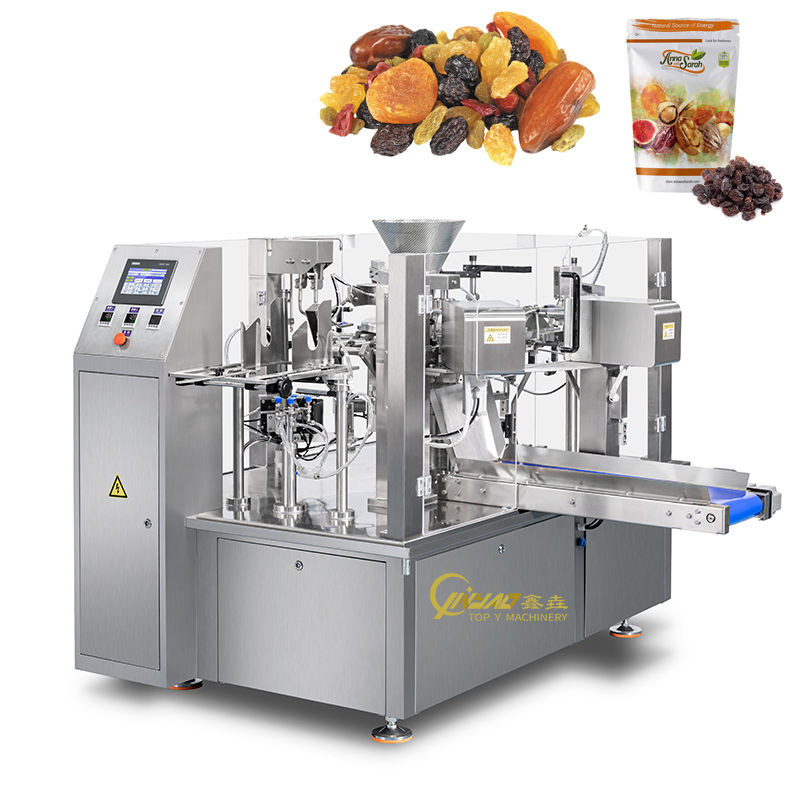
Premade Pouch Packing Machine for Dry Fruit Nuts Almonds Cashew Rotary Packing Machine
- Bag 90–400 mm wide × 100–500 mm long; Doypack, stand-up zipper and gusset
- 10–60 bags/min, frequency-converted, SS#304 construction
- No pouch / no open / no fill / no seal logic, with reusable pouch recovery
- Artwork change is a new carton, not a new setting — the flexibility that matters at 20 SKUs
Both of the numbers above are the same product category — nuts and dry fruit — on purpose. Comparing a VFFS running cashews against a premade machine running shampoo sachets is how bad buying decisions get made, and it is the most common error we see in side-by-side quotations.
FAQ: Formats, Film and Changeover Questions
Which is cheaper per bag, VFFS or premade pouch?
VFFS, on material, by roughly half in the example above — 5.8 cents of film against 11.5 cents of pouch for the same 1 kg coffee bag. The saving is not free: it is paid for in changeover time, forming-tube tooling and a line trial on every new film. Below about a million packs a year of one format, the saving usually does not repay those costs.
Can a VFFS machine make a stand-up zipper pouch?
It can make a stand-up pouch with a Doypack attachment, and it can apply a zipper using zipper film or an inline applicator. What it cannot do is match a converter's freedom: slider zippers, spouts, flat-bottom box pouches and die-cut silhouettes are premade-only. If the zipper is a marketing requirement rather than a convenience, specify a premade pouch and stop trying to make film behave like a converted pouch.
How long does a bag-size changeover take on each?
On a VFFS, changing bag length is a one-to-two minute recipe change; changing bag width needs a different forming tube and often different jaws, so 30 to 90 minutes including the film change. On a premade machine, a pouch size change is 20 to 45 minutes of magazine and gripper work, while an artwork change on the same size is a few minutes because it is just a new carton.
Why is film consumed per bag not simply the bag area?
Because the film wraps around the bag rather than lying flat on it. Film width is twice the finished bag width plus the back fin seal, and film consumed per cycle is that width multiplied by the bag length plus the transverse seal and cut. A 190 × 300 mm bag consumes 400 × 308 mm of film — 123,200 mm² against a single flat face of 57,000 mm², so about 2.2 times the face area, because the film becomes both faces of the bag plus the seals between them. That ratio is why a millimetre saved on width is worth more than a millimetre saved anywhere else: width is multiplied by two before it is multiplied by the length.
Is premade pouch really slower than VFFS?
Not necessarily, and the claim is often repeated without qualification. Our VP420 runs 10 to 70 bags per minute and our rotary premade machine runs 10 to 60 — broadly comparable at similar bag sizes. The large gap people quote comes from small sachets, where a VFFS with a long stroke and light film indexes faster than any pouch carousel can open and seal a premade bag. At 1 kg format sizes, the two platforms are closer than the marketing suggests.
What should I send a supplier to get a comparable quotation?
Bag drawing with finished width, length and gusset; film structure or pouch specification with grammage; product bulk density and fill weight; required bags per minute at the real bag size; changeovers per week; annual packs per format; and the market you sell into, because that sets the food-contact and machinery compliance route. Send all eight and both quotations will be for the same job, which is the only condition under which a comparison means anything.
How This Comparison Was Written
Author and standing. Written by the TOP Y Machinery engineering team in Foshan, Guangdong. We build both platforms, which is the only reason this comparison can be blunt about either: the VP-series vertical bagger and the TOPY-RPM rotary premade machine are both in our catalogue, and we have no commercial interest in which one you buy. Where the honest answer favours a platform we do not build — flat-bottom box pouches, for instance — the article says so.
What the numbers are based on. The film-width, bag-size, film-thickness, speed, power and weight figures in the specification table are our published VP-series data, reproduced so you can check the width formula against real figures rather than take it on trust. The TOPY-RPM bag range and speed are from our published rotary premade specification. The grammage figures are calculated from standard layer densities — PET 1.40, aluminium 2.70, PE 0.92 g/cm³ — and every step is shown so you can substitute your own structure and price. Changeover times are ranges taken from our own commissioning experience and from published industry comparisons; they are planning figures, not guarantees, and your former count and film will move them.
What is deliberately not claimed. No customer ROI, because the labour rate, bag price and contribution margin are yours. No single crossover volume, because the crossover depends on your changeover count and whether the line is your constraint — the two sums in this article are given in full so you can compute it rather than adopt ours. No price for either machine, because a price without a bag drawing is a guess.
Review. Reviewed 2026-10-30. The film-grammage arithmetic and the VP-series table are the parts most likely to age as our range changes; both will be re-checked whenever the specification pages are updated. Seal-test standards (ASTM F88, F2054, F2096) and food-contact references (EC 1935/2004, EU 10/2011, FDA 21 CFR) are cited as published documents, not paraphrased. If you find an error, tell us and we will correct it and record the correction.
If you want the two sums in this article run on your own bag, send the eight inputs from the last FAQ to our engineering team. We will tell you which platform the arithmetic supports — including when the answer is the one that costs us the sale.
Related Reading
- Vertical bagger range: VFFS machines for granules, powder, liquid and paste
- Doypack machine range: premade stand-up, zipper and spouted pouch systems
- Premade pouch packing machine vs VFFS packing machine: which one is better?
- Food packaging machine types in 2026: VFFS, HFFS, rotary and pouch systems
- VFFS vs HFFS packaging machine: 7 key differences
- Multihead weighers, linear weighers and the check weighers that sit on either platform
- Manufacturing capability: how our packaging machines are built and operator training and handover