Palletizing Machine Buyer's Guide 2026: Payload, Throughput and Cell Type
Oct 29,2026
By TOP Y Machinery Engineering Team · Food packaging machinery manufacturer, Foshan, Guangdong, China · Published 2026-10-29 · Checked against ISO 10218-1:2025, ISO 10218-2:2025 and Regulation (EU) 2023/1230
A palletizing machine is selected on four numbers, in this order: the mass of your heaviest single case including the tool that lifts it, your sustained cases per minute rather than your peak, the floor and ceiling you actually have, and how many different case sizes you will run in a normal week. Type, brand, arm reach and software all follow from those four.
Most bad palletizing projects are not bad robots. They are a machine chosen from a quotation that answered a different question than the one the buyer asked — a price per unit that assumed a perfect pattern, a payload figure that excluded the gripper, or a throughput that was measured on one product with the operators standing by. This guide is written to let you detect that mismatch before you sign, using the same arithmetic we use when a buyer sends us a case drawing and a shift pattern.
The one-sentence version. If your heaviest case is under about 20 kg, your sustained rate is under roughly 8 to 10 cases per minute, and your SKU count is high, a collaborative cell is the cheapest machine that will do the job. If any of those three is exceeded, you need a different platform, and no amount of software will close the gap.
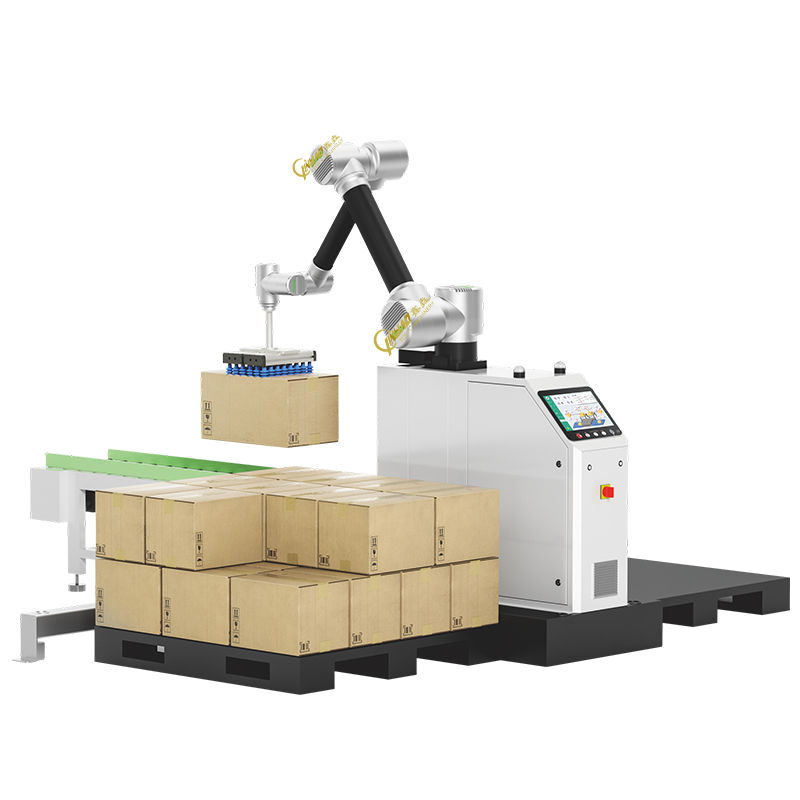
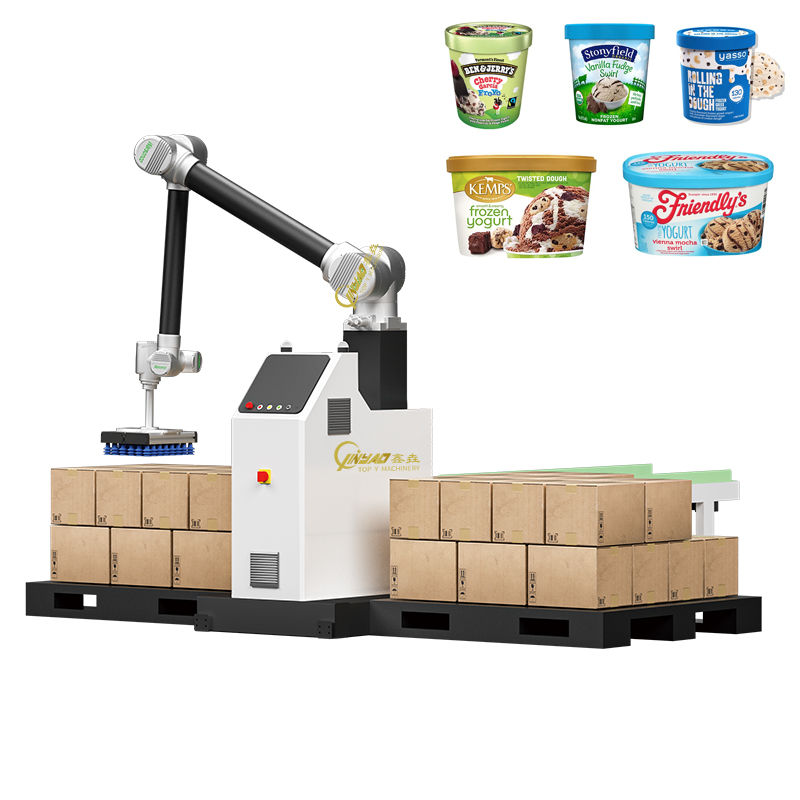
A collaborative palletizing cell: robot, end-of-arm tooling, pallet position and infeed conveyor. The robot is the visible part of the purchase; the conveyor, the pallet position and the pattern logic are where the schedule usually slips.
The five cell types, and the sentence that disqualifies each
Palletizing is usually described as a choice between "robotic" and "conventional". That framing hides three more options and, more importantly, hides the fact that each type has one requirement it cannot work around. The table below is organised around that requirement rather than around speed, because speed is the number vendors quote and the number buyers over-trust.
Cell type
Sustained rate you can plan on
Comfortable payload
What disqualifies it
Semi-automatic with lift assist
3 to 6 cases/min per operator
Any, within manual handling limits
A rate target above roughly 6 cases/min for a full shift; also the option that quietly keeps a back-injury risk in the line
Collaborative arm (cobot cell)
6 to 10 cases/min
5 to 25 kg including tooling
Cases over the payload after tooling mass is subtracted, or a sustained rate above about 10 cases/min
Articulated industrial robot
10 to 30 cases/min
30 to 300 kg
Nothing on rate, but it always needs a full guarding solution and a floor area you have probably underestimated
Layer / conventional palletizer
20 to 60+ cases/min
Full layer, often 100 kg and up
Mixed case sizes or frequent changeover; re-patterning is mechanical work measured in hours, not minutes
Gantry / Cartesian
5 to 15 cycles/min
Up to several hundred kg
A building constraint that will not take an overhead structure, or a rate that needs a moving arm
The rates above are planning figures, not catalogue figures. A catalogue rate is measured with one case size, an ideal pattern, no pallet exchange inside the measurement window, and an infeed that never gaps. Your line will have none of those four things simultaneously, which is why the next two sections are arithmetic rather than adjectives.
Why changeover flexibility, not speed, is usually the deciding factor
A plant running one case size for a season should not buy flexibility it will never use — a layer palletizer will outrun any robot on that duty and cost less per case at scale. A co-packer running nine case sizes across a week, with two of them appearing only when a customer books a promotion, is in the opposite position: on that duty the correct comparison is not cases per minute but minutes per changeover, multiplied by changeovers per week.
Ask for the changeover time as a measured number for a pattern change you actually need, not for a repeat of the pattern already loaded. If the answer is "our engineer changes it remotely", the real number includes the time to reach that engineer.
Payload is not the weight of your box
This is the single most common engineering error we see in inbound enquiries, and it is worth doing slowly. The payload rating on a palletizing arm is the mass the arm can hold at the flange, with the centre of gravity within the manufacturer's stated offset. Everything you bolt onto the flange spends part of that budget before your product is lifted.
The four deductions
End-of-arm tooling mass. A vacuum plate with a frame, cups, vacuum generator and hose set typically lands between 5 and 9 kg on a carton cell. A mechanical bag clamp with a pneumatic group is often heavier. This mass is permanent — it is deducted from every single cycle.
Multi-pick. Many buyers ask for two or four cases per cycle to raise throughput. That multiplication applies to the cases, not to the budget: two 10 kg cases plus 7 kg of tooling is 27 kg, which is over a 25 kg rating no matter how the cases are arranged.
Centre-of-gravity offset. A case 800 mm long, gripped near one end, creates a moment the arm feels as extra load. Manufacturers publish a load diagram rather than a single number for exactly this reason; if the quotation quotes one number, ask for the diagram.
Vacuum loss on porous board. Recycled corrugate and uncoated board leak air through the liner. A gripper sized for coated board can drop a case that looks identical. The correct specification is cup count and vacuum flow at the expected leak rate, not cup diameter.
A worked example from our own cell
Our TOPY-CPR30 collaborative palletizing cell is rated 25 kg payload with a 1,600 mm working radius, ±0.04 mm repeat positioning accuracy and a maximum stacking height of 2,100 mm including the pallet. Read plainly, that looks like "a 25 kg machine". In practice:
Item
Mass
Running total of the 25 kg budget
Rated payload at the flange
25 kg
25 kg available
Vacuum plate, frame and cup set
7 kg
18 kg product budget remaining
Single-pick case
14 kg
Works, with 4 kg margin
Same case, two picked per cycle
28 kg
Exceeds the rating: the cycle is not permitted, regardless of tooling
That is the whole argument. The machine did not get weaker between rows three and four. The buyer's mental model of "25 kg" did. When you write your requirement, write it as case mass, tooling mass and picks per cycle, and let the integrator do the sum.
The tooling on the flange is the first item in the payload budget, and the item most often left out of a quotation comparison. A cell quoted with a lighter gripper is not a cheaper cell — it is a cell with a different duty.
Throughput: read "boxes per minute" as a range
A quoted rate is a nominal figure, measured on a pattern the vendor selected and an infeed that never stops. Any real line applies three derating factors, and the honest way to compare two quotations is to apply the same three to both.
The three losses
Pattern complexity. A simple column stack of one case size runs at close to nominal. An interlocked pattern with rotated courses, or a mixed-SKU pallet, costs between 5 and 20 percent of cycle count, because the arm makes more small moves and the pattern logic has more states.
Pallet exchange. If the cell must stop while a full pallet is removed, every pallet costs you the exchange time. Two pallet positions with an automatic exchange and a cell with one manual position have the same nominal rate and materially different daily output.
Infeed gaps and stops. The palletizer can only place what arrives. Downstream checkweighing rejects, upstream film splices, and the natural gaps in a multi-product run all show up here — which is why the packing conveyor system between the wrapper and the cell matters as much as the cell.
Doing the sum
Take a cell quoted at 8 cases per minute, a case of 400 × 300 × 250 mm, and a 1,200 × 1,200 mm pallet:
Step
Calculation
Result
Nominal hourly rate
8 cases/min × 60
480 cases/hour
Cases per pallet
3 × 4 per layer × 8 layers
96 cases per pallet
Nominal pallets per hour
480 ÷ 96
5 pallets/hour
After pattern and exchange losses at 85 percent
5 × 0.85
4.25 pallets/hour
Over an 8-hour shift at 90 percent availability
4.25 × 8 × 0.90
about 30 pallets per shift
Thirty pallets per shift is the number to put in a business case. Five is the number that appears in the brochure. Both are true, and only one of them is a plan.
Ask this question of every supplier. "For the pattern you are quoting, what is the measured cycle time over a hundred consecutive cycles, and what is the rate over an eight-hour run with pallet exchanges included?" A supplier who can only answer the first has quoted you a demonstration, not a machine.
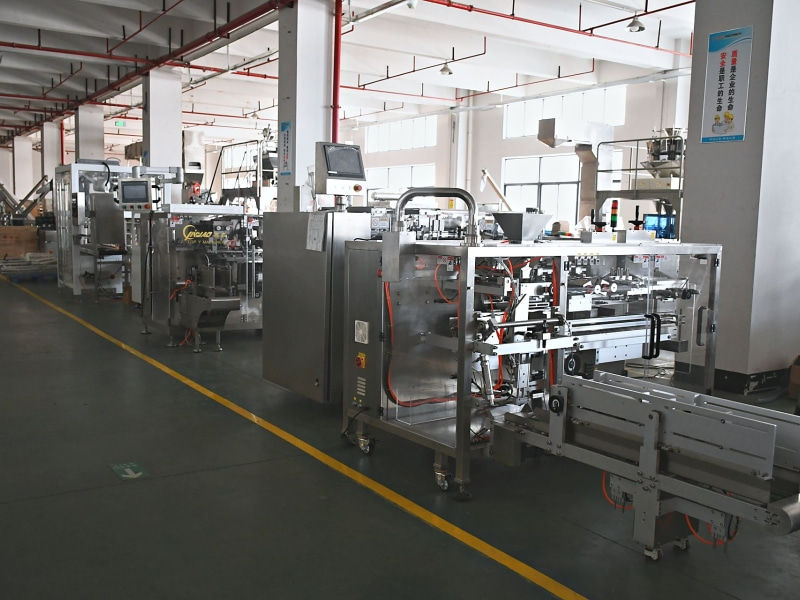
Lines under test in our assembly hall. In a palletizing project the conveyor and the accumulation between the wrapper and the cell are part of the specification, not an accessory: they are what absorbs the gaps that would otherwise be lost palletizer cycles.
Footprint, reach and the geometry nobody mentions
Working radius is usually drawn as a circle on a quotation, and that circle is misleading. A cell rated 1,600 mm reach does not reach 1,600 mm at every height: the arm's usable envelope narrows as it rises, and the published maximum stack height of 2,100 mm on our CPR30 is a best case — the figure we plan to in most installations is 1,600 mm, with 2,100 mm available on a 1,200 × 1,200 mm pallet in the right position. The shape that matters is the volume in which the arm can hold a case, not the radius on the data sheet.
What to measure before the drawing is made
Ceiling height above the stack. The required clearance is the stack height plus the case plus the arm's vertical overtravel plus any lift column. A cell that needs 2.1 m of stack inside a room with a 2.4 m ceiling and a sprinkler main is a redesign, not a quotation. Plan on the 1,600 mm planning figure for stack height unless the layout has been checked for the full 2,100 mm.
Pallet removal aisle. The cell occupies one footprint; the forklift removing a full pallet occupies another. Both need drawing, and the second is usually forgotten.
Floor condition. Industrial floors are specified by flatness and levelness numbers, and a palletizing cell is one of the few pieces of equipment that cares. Uneven floor tilts the pallet, and a tilted pallet turns a repeatable pattern into a leaning one. Ask for the floor survey before the base is cast, and allow for shimming or grouting.
Pallet size range. Our CPR30 accepts pallets up to 1,300 × 1,300 mm, which covers 1,200 × 1,000 and the 1,200 × 800 EUR pallet with margin. If you run export pallets outside that range, that is a specification item, not a detail.
Case size range. The same cell is specified for cases between 260 and 800 mm long, 200 and 800 mm wide, and 150 and 800 mm high. A 150 mm case and an 800 mm case are both inside that range, but a pattern mixing them is a different engineering problem from a pattern of one size.
An accurate way to start: print the cell and the forklift aisle to scale on the factory floor in tape, run a shift around the tape for a day, and see what the fitters say. It costs one roll of tape and catches most layout arguments before they become drawings.
The case is the machine: what actually fails on a palletizer
In our experience the robot is rarely the part of a palletizing cell that causes trouble. The case, the pallet and the pattern cause the trouble, and all three are usually outside the supplier's control. A buyer who understands them gets a stable pallet; a buyer who does not gets a cell that works perfectly in the factory and poorly in the warehouse.
Five failure modes worth designing against
Air in bagged product. A bag that leaves the wrapper with internal air will settle under its own stack weight, and a pallet built on the first night will be leaning by the third. Degassing, a short accumulation conveyor, or flipping the bag before palletizing solves it. No pattern solves it.
Compression creep in corrugate. Board loses stacking strength with humidity and with time. A pallet stacked to the calculated limit in a dry month will fail in a humid one after weeks in storage. Design to the warehouse residence time, not to the day of packing — and check the board's edge crush specification rather than its basis weight.
Overhang. A case that overhangs the pallet edge loses support for the layer above it. A small, uniform overhang on all four sides is tolerable; an irregular overhang from a pattern that was never squared is what breaks the wrap and the stack. This is a pattern-quality question, and it is measurable — see the acceptance section.
Slip sheets and layer pads. Both add stability and both add cycle time. If your customer requires tie sheets or corner boards, say so in the quotation, because the gripper and the pattern are designed around them.
Pallet quality. Pallet dimensional standards such as ISO 8611 exist for a reason. A cell that repeats to ±0.04 mm placing cases onto a pallet whose deck boards vary by 15 mm is wasting its accuracy. Agree a pallet rejection criterion with your supplier and enforce it at goods-in.
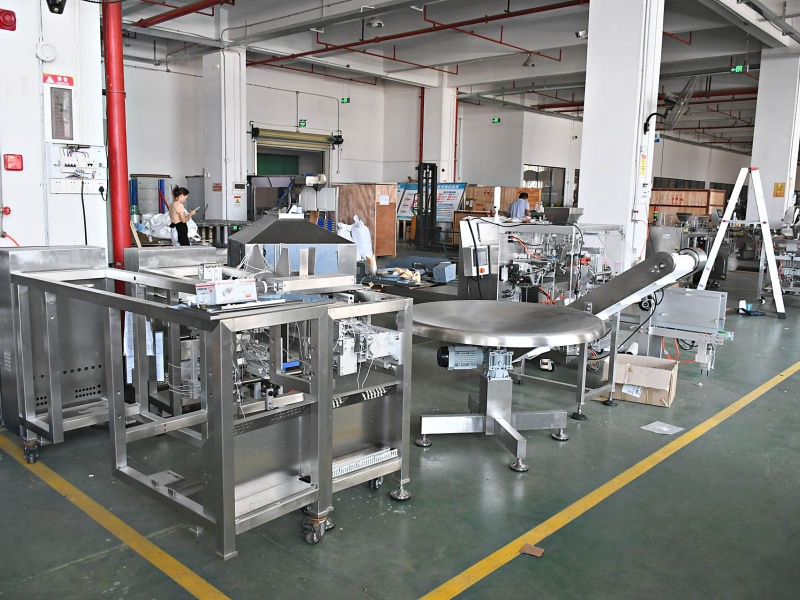
Assembly and commissioning bay at our Foshan works. A palletizing cell leaves here only after a run on the buyer's own cases and pattern — the layout, the guarding and the pattern logic are all proved on the floor, not on a drawing.
Safety in 2026: what the standards actually require
Safety is where a palletizing project most often becomes more expensive than the quotation, and where the gap between a marketing claim and a compliant installation is widest. Three things changed recently enough that older buying guides are out of date.
The standards that apply now
ISO 10218-1:2025 and ISO 10218-2:2025 replaced the 2011 editions and absorbed the collaborative-robot requirements that previously lived in ISO/TS 15066:2016. Part 1 covers the robot, Part 2 covers the application and the robot cell. The 2025 revision also introduces cyber-security requirements for networked robot systems — relevant the moment your cell is connected to a line control or a factory network.
EN ISO 12100 remains the risk-assessment method. The assessment, not the data sheet, determines whether a guard is required.
Regulation (EU) 2023/1230 replaces the Machinery Directive 2006/42/EC and applies from 20 January 2027. Machinery placed on the EU market before that date is assessed under the Directive; after it, the Regulation. Two practical consequences for a 2026 purchase: digital instructions become the default with paper available on request, and obligations extend to importers and distributors — so if you are importing, you inherit duties that used to sit only with the builder.
The collaborative claim, examined
"Collaborative" describes a robot's design, not your cell's compliance. Power-and-force limiting only removes the need for guarding if the application stays inside the limits in the risk assessment — and a palletizing application moving a 14 kg case at the arm's rated 1.2 m/s generally does not, because the transient contact force in a pinch against the pallet or the conveyor frame is well above the quasi-static values in the collaborative standard. On our CPR30 the safety fence, light curtain and safety mat are options, and the honest answer to "do I need them?" is: your risk assessment decides, and for a cell of this payload the assessment usually says yes for the pallet and conveyor zones, even if the pick zone can be open.
Four documents to demand with any palletizing quotation. The risk assessment to EN ISO 12100, the EU Declaration of Conformity with the essential health and safety requirements listed, the performance level or safety integrity level claimed for each safety function (emergency stop, protective stop, enabling device), and the guarding solution drawing. A quotation without these is a price, not an offer.
Budget for guarding honestly. A fence, a gate with an interlock and a safety-rated stop circuit is a real cost, and it is a cost that does not appear in a quotation that assumed an open cell. If the guarding is excluded, ask what it costs installed before you compare suppliers.
Where a 25 kg collaborative cell is the wrong answer
We build collaborative palletizing cells, so it is worth being direct about when we tell a buyer not to buy one. Four conditions, each of which is sufficient on its own:
Cases above the payload after tooling
If your heaviest case is 22 kg and the tooling is 7 kg, you are at 29 kg and no collaborative arm in the class will do it. Move up to an industrial arm.
A sustained rate above about 10 cases/min
Peaks can be absorbed by accumulation. A sustained 15 cases/min cannot: you need an industrial arm or a layer palletizer.
One product, high volume, 24/7
If you never change pattern, the flexibility you paid for is idle capital. A layer palletizer will beat the cell on cost per case.
Bagged product that never settles
Heavy, shifting bags need mechanical support or a layer former. Vacuum on a bag that moves inside its own wrap is a design fault, not a tuning issue.
The reverse case is equally worth stating. If your line runs a handful of case sizes, the rate is modest, the floor is tight, and the changeover happens weekly, an industrial arm is over-specified and a layer palletizer will never be re-patterned fast enough. The palletizing machines we build are aimed at that middle ground, and the portable robotic palletizer version exists because that middle ground is often two lines in the same building, one of which needs the cell this month and the other next year.
Pattern and reach checks before the cell is built. The volume in which the arm can hold a case at height is smaller than the quoted working radius, and it is cheaper to discover that here than in your plant.
The thirteen points a real quotation must contain
Use this as a checklist against any palletizing quotation, ours included. A supplier who cannot answer a point should say so; a supplier who answers all thirteen has done the engineering.
Case mass range, tooling mass, and picks per cycle, with the payload sum shown.
Case dimension range and the pattern drawing for each family you will run.
Pallet size range and maximum stack height including pallet.
Measured cycle time over 100 consecutive cycles, and the pattern it was measured on.
Sustained hourly rate including pallet exchange, with the derating factors stated.
Cell footprint, overall height, and the forklift removal aisle assumed.
Guarding solution: fence, interlock, scanner or mat, and which is included in the price.
Risk assessment to EN ISO 12100 and the safety functions with their claimed performance level.
Declaration of Conformity, and the conformity route for your market and your 2026 shipping date.
Infeed interface: conveyor height, accumulation length, and what happens when the line stops.
Changeover procedure and measured time for a new pattern, by whom.
Spare parts list with consumable life for cups, seals and belts.
Acceptance criteria and the test protocol you will both sign at handover.
Acceptance: how to test a palletizer before you pay
A palletizing cell is easy to demonstrate and harder to accept, because the demonstration shows the machine working and acceptance has to show it working under your conditions. The protocol below is the one we run; if your supplier's protocol has fewer measurements, add them before the machine ships.
What to measure, and what not to confuse
Test
Method
What a pass looks like
Cycle time
100 consecutive cycles on the production pattern, logged per cycle
A distribution, not an average: p95 within the rate you were promised
Stack quality
Measure the top layer's squareness and overhang on four sides, ten pallets
Overhang within the agreed tolerance on all four sides, every pallet
Grip reliability
Vacuum-loss and case-drop test on the most porous board you use
No drop in 500 cycles; vacuum sensor alarms within the specified time on a deliberate leak
Pallet sensing
Missing pallet, double-stack and misaligned pallet tests
Cell stops and alarms; it does not attempt to stack
Pattern change
Your operator, not the supplier's engineer, changes to a second pattern and times it
Inside the agreed time, with no code and no laptop
Each function verified and recorded with its response
Endurance
Eight-hour run with pallet exchanges
Rate held, no manual intervention beyond normal operation
Note what is not on the list: repeat positioning accuracy. A figure like ±0.04 mm describes how precisely the arm returns to a taught point. It does not describe how square your pallet will be, because the stack depends on the case, the board and the pattern. Treat it as an engineering quality indicator, not a delivery specification.
A commissioning week, in the order it actually happens
Days 1 and 2 — mechanical. Base, frame, conveyor interface and guarding. This is where floor condition and pallet aisle come back to visit if they were skipped in planning.
Day 3 — pattern teaching and reach verification. Every family of case size, at the top layer as well as the bottom. The top layer is the one that exposes a reach assumption.
Days 4 and 5 — rate ramp. Starting below nominal and climbing, with the operators present so the stopping and restarting behaviour is seen, not just the running behaviour.
Day 6 — operator training. Pattern change, alarm clearing, pallet change, daily checks. Our operator training and handover programme runs to this schedule, and it is the day that decides whether the cell is used as designed.
Day 7 — handover. Signed rate, signed stack quality, spares handed over, and the acceptance record filed with the risk assessment.
The same discipline applies to the machine before it leaves the builder. Our factory acceptance test checklist covers the pre-shipment run in the same measurable terms.
Cost and ROI: the numbers that actually decide a palletizing machine purchase
Palletizing machines are quoted all over the map, because a "palletizing machine" can mean a lift assist and a robot cell with two pallet positions and guarding. Rather than quote a price band that will be wrong for your case, here is the structure of the cost and a worked example with the assumptions written down so you can replace them with yours.
What is in the number
Robot or mechanism, sized on payload after tooling.
End-of-arm tooling, which is often 8 to 15 percent of the cell and is where cheap quotations economise.
Infeed and pallet conveyors, plus accumulation — the part most often excluded.
Guarding and safety functions, plus the risk assessment and the Declaration of Conformity.
Pattern software and the HMI, and whether pattern changes need the supplier.
Installation, commissioning, training, and sea freight with the duties and documentation of your market — our shipping cost and transit note covers the freight side in detail.
Spares and consumables: vacuum cups, seals, belts. Small per year, and the item that stops a cell when nobody stocked it.
A worked model, with the assumptions visible
Assumption
Value used
Replace with yours
Operators currently palletizing
2 per shift, 3 shifts
Count the people whose job this is
Hours saved per shift
5.5 of 8 productive hours
Measure a shift; do not estimate it
Loaded labour cost per hour
your local figure
Include on-costs, not base wage
Cell rate achieved
4.25 pallets/hour (the derated figure above)
Use the derated number, never nominal
Energy
3.5 kW installed on the arm, plus conveyors
Multiply by your tariff and running hours
Maintenance and spares
2 to 4 percent of cell cost per year
Ask for the spares list and price it
Run those against your own numbers and the model will tell you something useful in about ten minutes. If the labour saving alone does not return the capital inside roughly two years, the honest justification for the cell is usually not labour at all — it is consistency of pallet quality, the removal of a manual handling injury risk, or the ability to run a third shift without recruiting. Those are legitimate reasons. They are just different reasons, and they belong in the business case under their own heading, because a business case built on a labour saving that will not materialise is the one that gets a good project cancelled at the second review.
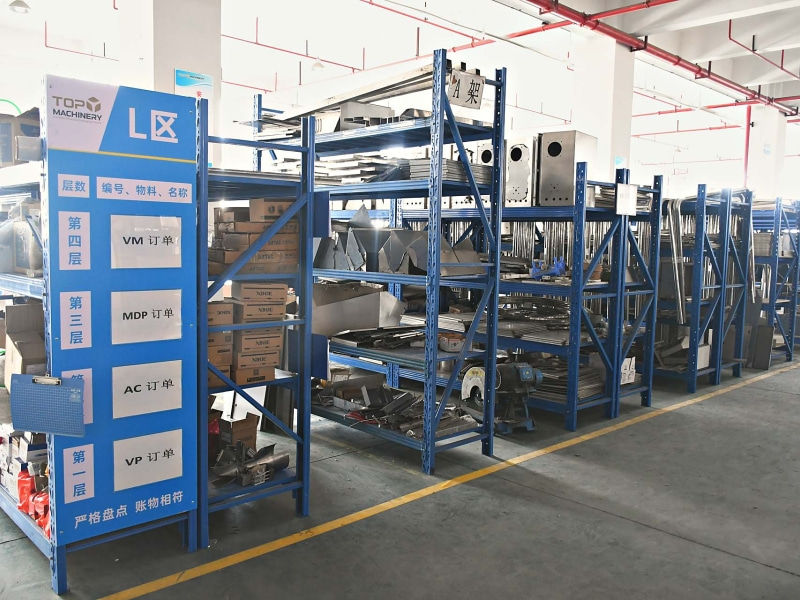
Component store at our works. Consumables — vacuum cups, seals, belts — are the cheapest line in the project and the fastest way to stop a cell, which is why the spares list belongs in the quotation rather than in a conversation after installation.
FAQ
How much does a palletizing machine cost?
It depends on which of the five cell types you need, because the gap between a semi-automatic lift assist and a guarded industrial robot cell is a multiple, not a percentage. A collaborative cell lands in a moderate band and a layer palletizer in a higher one, both before conveyors, guarding and installation. The reliable way to get a comparable number is to send case mass, case dimensions, pallet size, sustained rate and shift pattern, and ask for a cell scope that states what is included. Our 2026 packaging machine cost guide explains the same structure for the rest of the line.
How many cases per minute can a collaborative palletizer handle?
Plan on 6 to 10 cases per minute sustained, with the higher end only on simple patterns and one case size. Our CPR30 is specified to 8 cases per minute, which is about 480 cases per hour before derating. If you need 15 cases per minute continuously, the correct machine is an industrial arm or a layer palletizer, and buying a collaborative cell for that duty will disappoint you for the life of the asset.
Can a palletizer handle bags as well as cartons?
Yes, but the end effector changes: bags need either vacuum with a flattening action or a mechanical clamp, and heavy bags that shift inside their own wrap generally need a layer former rather than a robot. The specification that matters is not "bag" but bag mass, filled dimensions, and how much the product moves inside the bag after it leaves the wrapper.
Do I need a fence around a collaborative palletizer?
Your risk assessment decides, and for a palletizing cell of this payload it usually says yes for the pallet and conveyor zones. Collaborative design permits reduced guarding where the application stays within the force and pressure limits of the collaborative standard; a 14 kg case moving at 1.2 m/s against a pallet edge generally does not. Our fence, light curtain and safety mat are options because the answer is site-specific, not because a fence is optional in practice.
How much floor space does a palletizing cell need?
Draw three footprints, not one: the cell, the pallet removal aisle for the forklift, and the accumulation conveyor between the wrapper and the cell. The first is the one on the quotation and the smallest of the three. Height matters as much as area, because the stack plus the case plus the arm's overtravel sets the ceiling requirement.
How long does installation and commissioning take?
Plan a working week on site for a single cell with the site prepared, and longer if the conveyors or the guarding are being built around existing equipment. Our installation, commissioning and training service runs to the seven-day sequence described above, and the day that most often slips is operator training, because it needs your operators present rather than the fitters.
How this guide was written
Author and standing. This guide is written by the TOP Y Machinery engineering team in Foshan, Guangdong. We design and build food packaging machinery and the end-of-line equipment around it, including the CPR30 collaborative palletizing cell referenced throughout, and we commission those cells in customers' plants. That is our commercial interest and it is stated here rather than left for you to find.
What the technical content is based on. Payload, reach, stack height, pallet and case limits, accuracy and installed power for the CPR30 are the figures we publish on the robotic palletizing and carton handling pages, measured on our own cells. The throughput arithmetic is set out in full above so you can redo it with your own case and pallet. The standards references are to published documents: ISO 10218-1:2025 and ISO 10218-2:2025, ISO/TS 15066:2016, EN ISO 12100, ISO 8611 for pallets, and Regulation (EU) 2023/1230, which applies from 20 January 2027. Where a number is a planning figure rather than a measured one, it says so.
What this guide does not do. It does not quote you a price, because a price without a case drawing is a guess. It does not claim a customer return on investment, because the labour rate is yours and the shift pattern is yours. And it does not tell you that a collaborative cell fits every application — three sections above exist specifically to help you rule it out.
Review. Reviewed 2026-10-29. The standards and regulation references in the safety section are the ones that change most often, and that section will be re-checked each time the machinery regulation guidance is updated, before January 2027 at the latest. If you find an error in this guide, tell us and we will correct it and note the correction.
If you want the arithmetic in this guide run against your own case, send the case mass, dimensions, pallet size, sustained rate and shift pattern to our engineering team. We will tell you which of the five cell types fits, and which one does not.