Foreign Object Detection on Food Packaging Lines: Metal Detection vs X-ray vs Checkweigher
Table of contents
- The three technologies answer three different questions
- Metal detection: what it catches, and what defeats it
- X-ray: the answer when the packaging is metal
- Checkweigher: not a contaminant detector, and that matters legally
- Where the inspection point belongs on the line
- Turning a detector into a CCP: test packs, frequency, records
- Making the rejection reliable
- Where the interface fails
- Metal detection, X-ray and checkweigher side by side
- FAQ
The detector is the cheap part. The interface is where the money goes
Foreign object detection on a food packaging line is usually bought as a stand-alone machine and installed as an afterthought. That is the wrong order. A metal detector, an X-ray system and a checkweigher each answer a different question, each has a failure mode the others do not have, and all three only work if the packaging machine feeding them can stop, reject and recover cleanly.
This guide sets out which technology detects what, how the packaging material and the product decide which one you can use, where the inspection point belongs, and what your auditor will ask to see. It is written for the buyer or plant engineer specifying a line, not for a metrology laboratory.
The three technologies answer three different questions
The first decision is not which brand. It is which hazard you are actually controlling. If your hazard analysis says the risk is metal from worn machine parts, a metal detector is the proportionate control. If the risk is glass from a nearby filling station, or bone in a meat product, a metal detector cannot help you at all.
Metal detection
Finds ferrous, non-ferrous and stainless steel contamination using electromagnetic induction. Cannot see glass, stone, bone or plastic. Struggles with wet, salty or conductive products, and with metalised film.
X-ray inspection
Finds contaminants by density difference: metal, glass, stone, calcified bone, dense plastic and rubber. Also verifies fill level, missing components and package integrity. Cannot see low-density material, and needs radiation controls.
Checkweighing
Verifies mass in motion against a target. It is a quantity control and a giveaway control, not a contaminant detector. It catches missing items and gross underfill, not a 1 mm fragment.
Metal detection: what it catches, and what defeats it
A metal detector creates an electromagnetic field with a transmitter coil and measures the disturbance a metal particle causes in receiver coils. It can find ferrous, non-ferrous and stainless steel, and that last category matters more than buyers expect: stainless steel is the least detectable of the three, so a machine that passes a ferrous test ball may still miss a stainless fragment of the same size.
The practical constraint is product effect. Wet, salty, acidic or hot products are themselves conductive, so they generate a signal that masks the contaminant. Multifrequency systems with dynamic phase adjustment exist to suppress that product signal, but they trade sensitivity for stability and the trade-off has to be made against your actual product, not against a specification sheet.
Three things that quietly kill metal detection performance: a product that is conductive enough to sit close to the detection threshold; metalised or foil-laminated packaging film, which screens the field entirely; and aperture sizing that is generous because the bag is large. A detector is only as good as the smallest contaminant it can reliably reject in your actual pack, at your actual line speed.
X-ray: the answer when the packaging is metal
X-ray inspection measures how much of the beam each product absorbs, which depends on density. That makes it the only practical option in two situations: when the contaminant risk is non-metallic (glass, stone, bone, dense plastic), and when the packaging itself is foil or metalised film, which leaves a metal detector blind.
X-ray systems also deliver verification the metal detector cannot. Because they build a density image of the whole pack, they can check fill level, confirm that a component or a sachet is present, and detect seal defects and voids. Where a line produces mixed packs or multi-component meal kits, that imaging capability is often worth more than the contaminant detection it was bought for.
The constraints are real. Sensitivity falls as product thickness and density rise and as line speed increases, so the system has to be sized against the actual product matrix. And X-ray means radiation, which brings enclosure, interlock, signage and local regulatory obligations that a metal detector does not carry. Budget for the paperwork as well as the machine.
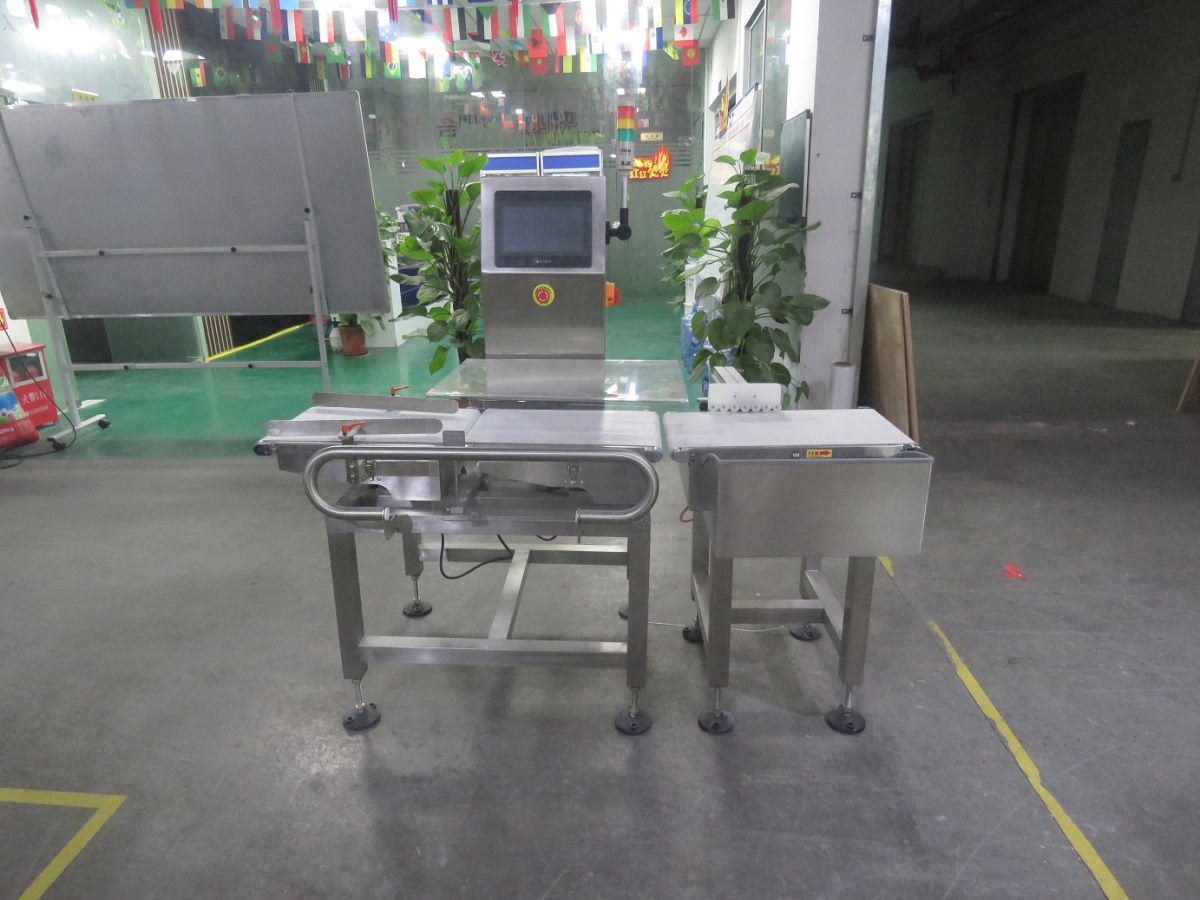
Checkweigher: not a contaminant detector, and that matters legally
A checkweigher weighs every pack in motion and sorts it against a nominal set-point. That is a quantity function, and it is increasingly a legal one. Where the checkweigher is used for legal-for-trade purposes or to demonstrate net-content compliance, it is a regulated measuring instrument, and the approval regime depends on where you sell.
European Union
Automatic weighing instruments fall under the Measuring Instruments Directive 2014/32/EU, Annex VIII — module MI-006. Checkweighers sit in accuracy categories X and Y with classes XI to XIIII and Y(I) to Y(b), aligned to OIML R51 and R61. Note the common error: MI-005 covers liquid measuring systems such as fuel dispensers, not weighers.
United States
A legal-for-trade checkweigher needs an NTEP Certificate of Conformance, assessed against NIST Handbook 44, which covers scales and belt-conveyor weighing devices. Net-content testing is governed separately by NIST Handbook 133. In China the equivalent approvals run under JJG 539 and JJG 648.
Two consequences follow. First, if you need the checkweigher to be legal for trade, specify the approval regime before you order, because retrofitting a certificate is not possible. Second, know what a checkweigher is not: it will not find a metal fragment, and it should never be presented in a HACCP plan as the control for physical contamination. Auditors ask precisely this question, and an answer that confuses quantity control with contaminant control is a finding.
Where the inspection point belongs on the line
Positioning is not a matter of floor space. It follows from what you are trying to protect. The rule of thumb is to place the inspection point as late as possible in the packaging process, so that the pack is complete and closed, and as early as possible in the distribution process, so that rejected product can still be held.
- After sealing, before case packing. The standard position for pack-level inspection. The pack is closed, one reject action removes exactly one saleable unit, and nothing has yet been aggregated into a case where a single reject becomes expensive and untraceable.
- On the bulk infeed, before the filler. Justified where incoming raw material carries the highest contamination risk and rejecting bulk is cheaper than rejecting filled packs. It is also the only position that protects the filler itself from damage.
- After case packing. Occasionally used for whole-case verification of piece counts. Rarely a substitute for pack-level inspection, because a failed case-level test quarantines every pack inside it.
- Not both ends without a reason. Two inspection points double the verification workload. Keep the CCP where the hazard is best controlled and document why the other point is monitoring rather than control.
One more placement rule that is easy to miss: the rejection device needs physically clear space and a defined destination for rejected product. If the reject point is buried between two conveyors, or the reject bin sits where an operator walks, the detection system will be bypassed within a month — not maliciously, but because clearing it is inconvenient.
Turning a detector into a CCP: test packs, frequency, records
A detector becomes a critical control point only when its performance is verified, recorded and defensible. Buying the machine is the easy half. The credible half is the testing regime, and it is what an auditor will actually open your file to see.
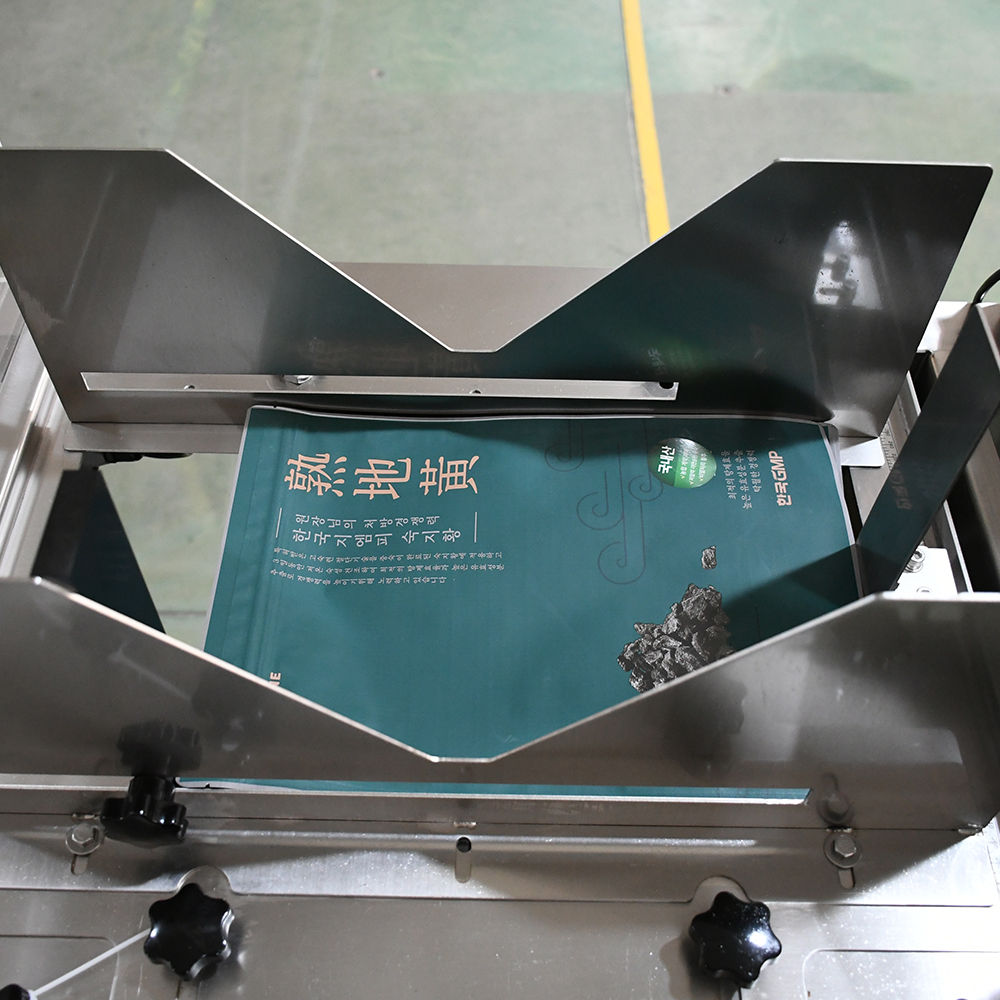
The accepted practice is to test with a physical sample of known material and size, carried through the machine inside a pack that matches the real product. Testing the detector with the sample held in open air proves nothing, because product effect and pack geometry are exactly what you are testing.
Test pack construction
A genuine pack of the actual product carrying a sample of defined material and size, free of other contamination, and marked so it cannot escape into the supply chain if it is missed.
Test frequency
At start and end of production, at batch changes, after any change to machine settings, and after maintenance or repair. The frequency must be tight enough that all product since the last successful test can still be quarantined on site.
Sample sizes
Define the smallest contaminant you commit to detecting, per material type, for each product and pack format. Ferrous, non-ferrous and stainless steel are three different tests with three different results.
Records and failure action
Who tested, when, with what sample, what result. And a written rule for what happens on a failed test: reject the test pack, quarantine back to the last successful test, recalibrate, retest, and record the disposition.
The scheme requirements are converging on exactly this. BRCGS Global Standard Food Safety Issue 9 remains the current edition as of 2026 — Issue 10 is still under development and not expected to be published before the second half of 2027, so an Issue 9 documented system is what your next audit will be measured against. FSSC 22000 Version 7, published in May 2026, and IFS Food Version 8, mandatory since January 2024, ask the same underlying question: can you demonstrate, with records, that the device was working when the product passed through it.
Making the rejection reliable
A detection system that signals correctly but rejects badly is worse than no system, because it creates a false sense of control. Four design points do most of the work.
- Match the reject device to the pack. Pushers suit rigid containers and cartons; air blast suits light or irregular packs; a retracting or dropping belt section suits packs that must not be pushed across a neighbouring lane. A pusher used on a light bag simply knocks it over and it continues down the line.
- Confirm the reject happened. A detection signal is not evidence of removal. Reject confirmation proves the pack actually left the stream, and it is the difference between a claim and a control.
- Protect the reject bin. A lockable, password-controlled bin with a tunnel guard between detector and reject point stops a determined operator from clearing a jam by pulling the rejected pack back onto the line. It also means the contents are a documented, accountable quantity.
- Log everything. Settings, test results, rejects, alarms. Data logging serves two purposes: it supports the HACCP record, and it gives you the failure pattern when a recurring fault is being argued about.
Where the interface fails
Almost none of the problems above are detector problems. They are interface problems between the packaging machine and the inspection device, and they are decided long before either machine is built.
How TOP Y Machinery handles the line interface
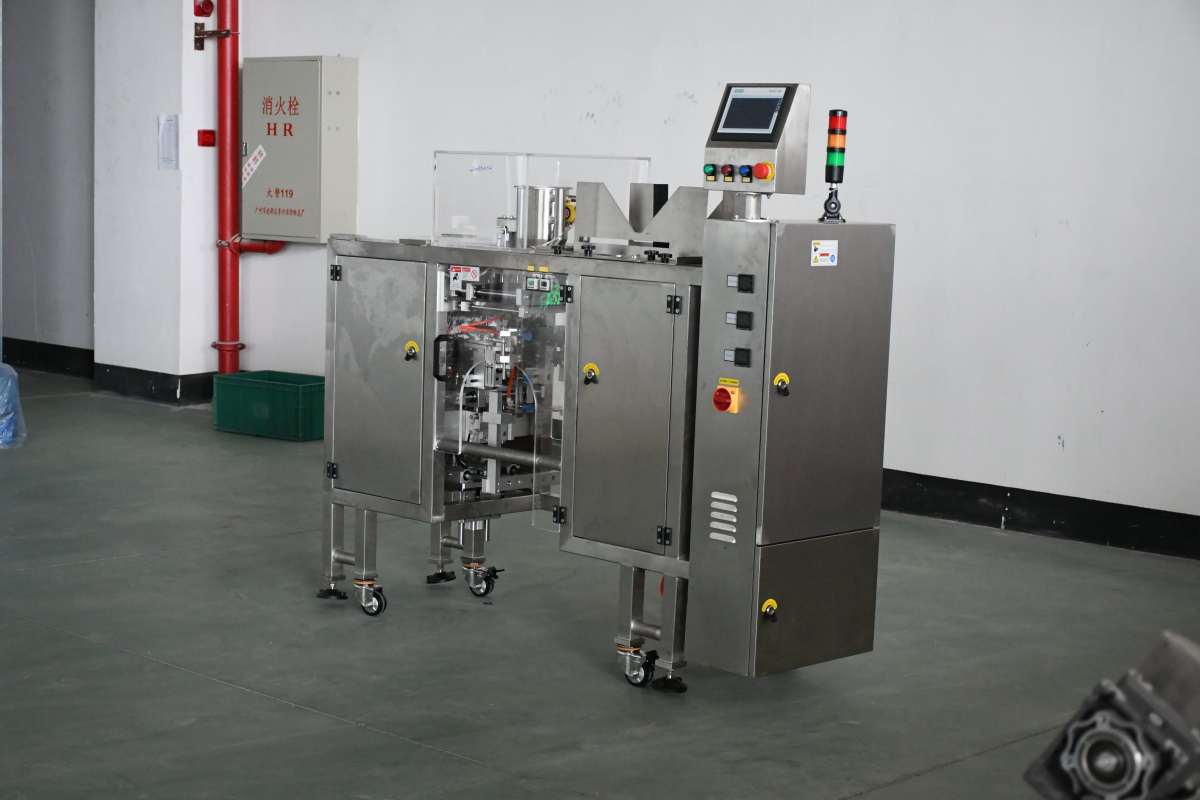
TOP Y builds the packaging machine, not the detector — inspection equipment normally comes from a specialist supplier. That is precisely why the interface is worth engineering rather than assuming. From our base in Foshan, Guangdong, established in October 2011 with 4,500+ m² of workshop and a team of over 50 including mechanical design, electrical, commissioning and after-sales engineers, four practices carry most of the weight.
- The interface is settled on the drawing. Conveyor heights, transfer points, signal wiring, the stop logic and the space reserved for the reject device are agreed as drawings and issued for confirmation before production starts. Adding a detection point to a machine that is already built means rebuilding conveyors and re-running control logic on site, at your cost and on your schedule.
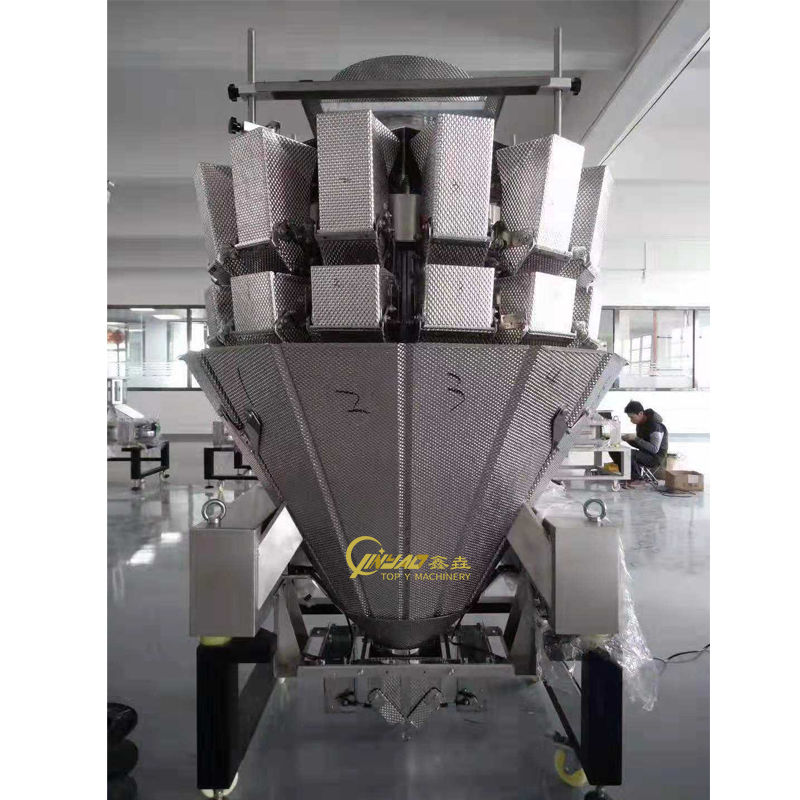
- It is commissioned as a whole unit, not in parts. Sub-assemblies are verified in batches, then the complete machine is assembled and run as one line. Feeding, metering, sealing, drive and control have to behave together — and so does the handshake with the weigher, metal detector, checkweigher, conveyor and case packer around it.
- Real material, not empty cycles. Machines are commissioned on actual product and actual film. That is the only way to find out what your product does to a detector's sensitivity before your operators do.
- Your team is trained on the interface, not just the machine. Our operator training covers accuracy control, reject handling and metal detector challenge testing alongside film loading and seal parameters, and ends with a signed record your quality system can file. When an auditor asks an operator to run a challenge test, that record is the answer.
There is a second-order benefit, and it is the one that pays every week. When operators can read a fault code and test the reject path themselves, a stopped line is a fifteen-minute correction rather than a service call. The line interface is not only a compliance topic; it is the difference between a stoppage your team clears and a stoppage your supplier has to fly in for.
Metal detection, X-ray and checkweigher side by side
| Consideration | Metal detection | X-ray inspection | Checkweigher |
|---|---|---|---|
| Detects | Ferrous, non-ferrous, stainless steel | Metal, glass, stone, bone, dense plastic, rubber | Mass deviation only |
| Blind to | Glass, stone, bone, plastic, low-density material | Low-density material and very thin films of it | Any contaminant that does not change mass materially |
| Blocked by packaging | Yes — foil and metalised film screen the field | No, foil packs are handled routinely | No |
| Product limitation | Wet, salty, acidic, hot products cause product effect | Sensitivity falls with product thickness and density | Belt stability and vibration dominate accuracy |
| Extra capability | None | Fill level, missing components, seal and void checks | Giveaway control, SPC data, filler calibration |
| Regulatory angle | Not a measuring instrument; driven by HACCP and scheme requirements | Radiation controls, enclosure, interlock, local registration | Legal-for-trade approval where applicable: EU MI-006, US NTEP, China JJG |
Read the table as a sequence of eliminations rather than a ranking. If your packaging is foil, metal detection is out regardless of cost. If your hazard is bone or glass, metal detection was never the answer. If what you actually need is net-content compliance and giveaway reduction, none of the contaminant technologies substitutes for a checkweigher — and vice versa.
FAQ
Can a checkweigher replace a metal detector?
No. A checkweigher measures mass and cannot identify a metal fragment, a glass shard or a bone fragment. It detects missing components and gross underfill. Treating it as the physical contamination control in a HACCP plan is a common and avoidable finding.
My product is packed in foil. What are my options?
X-ray inspection. Foil and metalised film screen the electromagnetic field a metal detector depends on, so metal detection is not usable in that pack. X-ray works on density difference and is unaffected by the foil.
Why does my metal detector miss some stainless steel but find ferrous easily?
Stainless steel is the least detectable of the three material categories because it is the least electrically conductive and often non-magnetic. A machine that passes a ferrous test ball is not thereby approved for stainless. Specify and test all three material types separately, at the smallest size you commit to detecting.
How often should we run a challenge test?
At minimum at the start and end of production, at batch and format changes, after any change to detector settings, and after maintenance or repair. The controlling principle is quarantine capability: the interval must be short enough that every pack produced since the last successful test can still be isolated on site if a test fails.
Do we need legal-for-trade approval for our checkweigher?
Only if it is used to demonstrate net-content compliance or for trade purposes. In the EU that means MID 2014/32/EU Annex VIII, module MI-006; in the US an NTEP Certificate of Conformance assessed against NIST Handbook 44, with net-content testing under NIST Handbook 133. If you do need it, decide before ordering — it cannot be retrofitted onto an unapproved instrument.
Which BRCGS version will our audit be against?
Issue 9. As of 2026 it remains the current published edition, and Issue 10 is still in development with publication not expected before the second half of 2027. Keep up with BRCGS position statements in the meantime, because they amend audit requirements between editions.
What to specify before you order
Five items, and all five belong on the drawing or in the purchase order rather than in a conversation after delivery. Define which hazard the inspection point controls, and therefore which technology. Confirm your packaging material allows that technology to work. Fix the physical space and the transfer height where the detector will sit, along with the signal wiring and stop logic between it and the packaging machine. Define the reject device, the reject confirmation and the destination for rejected product. And write the challenge-test regime, including sample sizes per material type, into the handover documentation.
The machines that cause trouble on a packaging line are rarely the ones that were specified badly. They are the ones where the interface was left for the site team to solve on a Friday afternoon. Settling it on the drawing costs nothing.
Related reading
- Food Packaging Equipment Compliance Guide: FDA, EU 1935/2004 and Food-Contact Materials
- The Comprehensive Guide to Industrial Food Packaging Equipment
- Food Packaging Machine Types in 2026: VFFS, HFFS, Rotary and Pouch Systems
- Packaging Machine Maintenance: Daily, Weekly and Monthly Checklist
- Manufacturing Capability: How Food Packaging Machines Are Built
- Operator Training for Food Packaging Machines