The Comprehensive Guide to Industrial Food Packaging Equipment
As we navigate the complexities of food production, understanding the tools that bring our culinary creations to the market is paramount. The principal role of food packaging is to protect products from outside influences, contain the food, and provide consumers with essential ingredient and nutritional information. This guide will explore the essential world of industrial food packaging equipment, ensuring your products are presented in a way that is not only safe but also aesthetically pleasing.
The right industrial food packaging equipment is more than just a purchase; it's a strategic investment that impacts every facet of your operation, from regulatory compliance to brand perception. In the competitive landscape of the food and beverage industry, packaging serves as a critical link between production and the consumer, influencing logistics, presentation, and sales. Automated systems, in particular, play a significant role by enhancing production speed, ensuring hygiene, and extending shelf life, making them vital for any large-scale operation.
Join us as we explore the landscape of industrial food packaging equipment, from sealing and bagging to conveying and strapping. We'll delve into the various types, the nuances of labeling, and the true cost of ownership to help you make informed decisions and optimize your packaging line for maximum efficiency and success.
Key Takeaways
- Diverse Equipment is Key: A modern food packaging line utilizes a variety of specialized machines, including heat sealers, shrink tunnels, bagging machines, conveyors, and strapping machines, each performing a critical function.
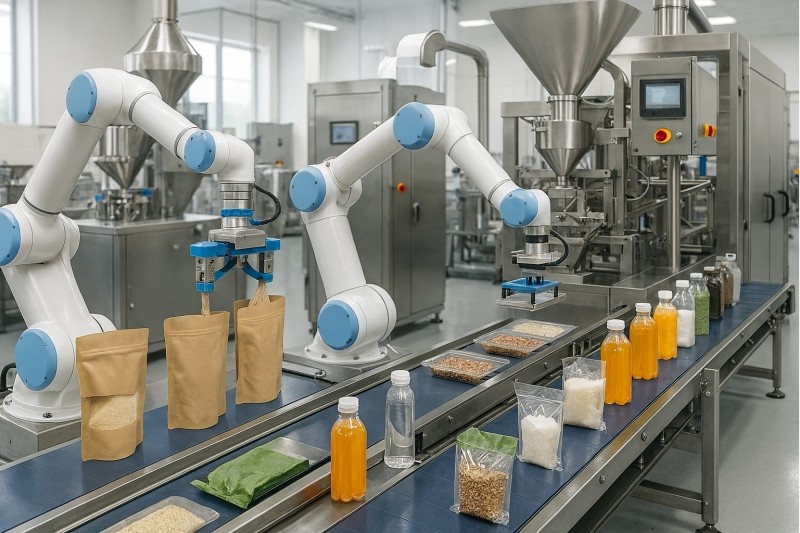
- Automation Drives Efficiency: Automated and robotic systems are a major trend, helping to increase production speed, reduce labor costs, minimize human error, and ensure consistent quality and hygiene.
- Labeling is Crucial for Compliance and Branding: Advanced labeling equipment is essential for meeting strict regulatory requirements, such as those from the FDA, and for creating a strong brand identity that builds consumer trust.
- Total Cost of Ownership (TCO) Matters: Evaluating equipment goes beyond the initial price. TCO includes capital, operational, maintenance, and support costs. A holistic view is necessary for a sound long-term investment.
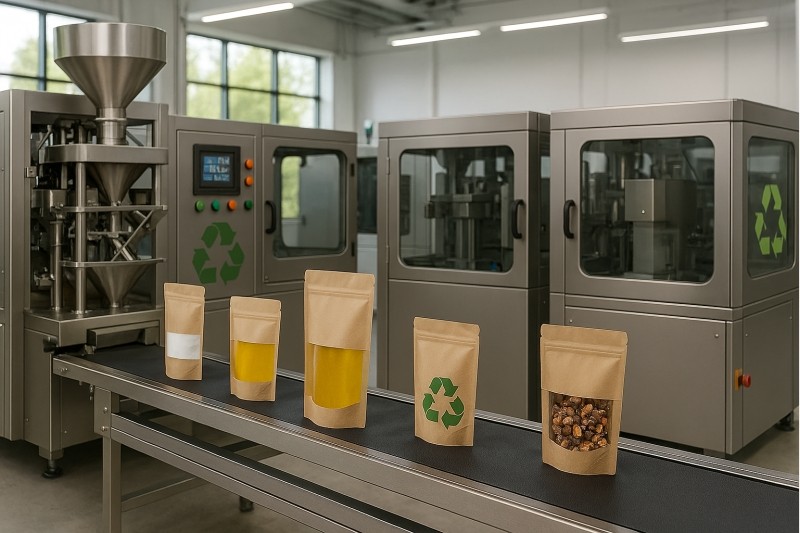
- Sustainability is a Driving Force: There is a growing demand for packaging machinery that can handle eco-friendly, recyclable, and biodegradable materials to meet consumer expectations and reduce environmental impact.
- Customization and Flexibility are Future-Proof: As product lines expand and consumer demands change, modular and flexible packaging systems that allow for quick changeovers and handle various SKUs are becoming increasingly important.
Understanding the Diverse Types of Industrial Food Packaging Equipment
The backbone of any efficient food production line is a suite of specialized packaging machinery. Each piece of equipment is designed to perform a distinct role, from initial filling to final sealing and securing. Understanding the function of each machine is the first step toward building a cohesive and productive packaging workflow.
Heat Sealers: Ensuring Product Integrity in Industrial Food Packaging
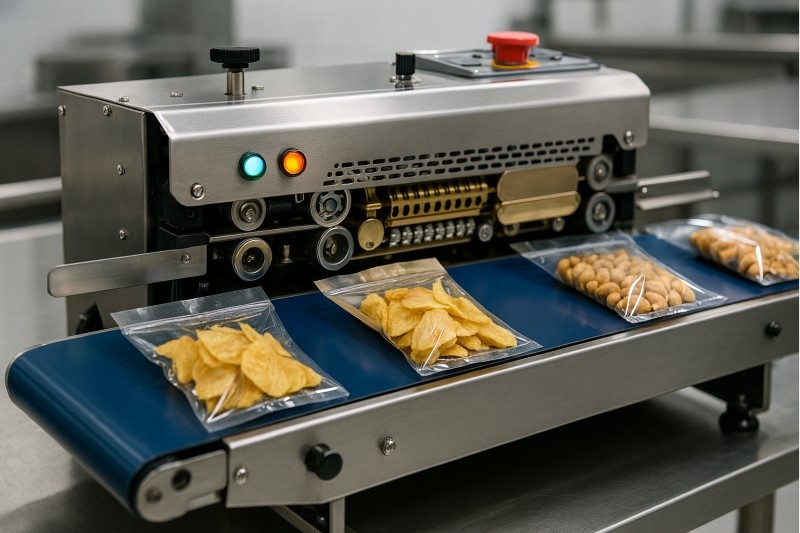
Heat sealers are vital for creating airtight and tamper-evident seals on various types of packaging. By applying heat and pressure to thermoplastic materials, these machines ensure that food products are protected from contaminants like air, moisture, and bacteria, thus preserving freshness and extending shelf life.
Manual, Semi-Automatic, and Automatic Heat Sealing Solutions
The level of automation in heat sealing equipment directly corresponds to production volume and operational complexity.
- Manual Heat Sealers: These are typically handheld or tabletop devices where an operator manually places the bag, lowers the sealing jaw, and removes the package. They are best suited for small-scale operations, startups, or laboratory testing due to their low cost and simplicity.
- Semi-Automatic Heat Sealers: In this setup, an operator positions the package, but the sealing process is activated by a foot pedal or push-button. Some models include conveyor belts that automatically move the package through the sealing station, increasing speed over manual methods.
- Automatic Heat Sealers: These machines are fully integrated into a production line. They automatically feed, fill, seal, and discharge packages with minimal human intervention. Continuous band sealers are a common type of automatic sealer, using heated bands to seal pouches as they move along a conveyor. This makes them ideal for high-volume, continuous production environments.
| Sealer Type | Best For | Speed | Cost | Key Feature |
|---|---|---|---|---|
| Manual | Small businesses, startups, lab use | Low | Low | Portability and simplicity |
| Semi-Automatic | Medium-volume operations | Medium | Medium | Foot-pedal or button activation improves consistency |
| Automatic | High-volume industrial production | High | High | Fully integrated and continuous operation |
Applications of Heat Sealers in Food Packaging
Heat sealers are incredibly versatile. They are used for sealing everything from snack bags and coffee pouches to vacuum-sealed meats and frozen foods. Specific applications include:
- Pouches and Bags: Sealing stand-up pouches, poly bags, and gusseted bags for products like chips, nuts, and coffee.
- Tray Sealing: Applying film lids to trays for ready meals, fresh produce, and meats.
- Vacuum Sealing: Removing air from a package before creating a final, hermetic seal, which is crucial for perishable items.
- Medical and Pharmaceutical: Ensuring sterile and tamper-proof packaging for sensitive products.
Shrink Tunnels: The Art of Protective Wrapping in Industrial Food Packaging
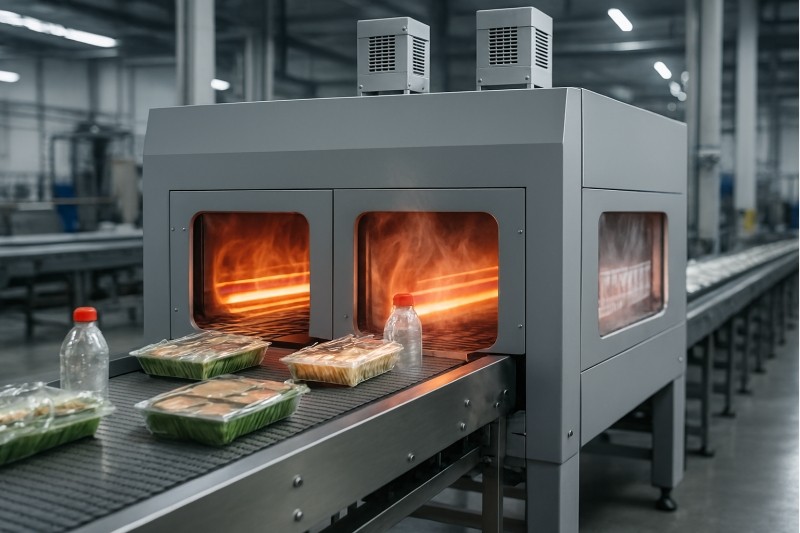
A shrink tunnel is a heated chamber with a conveyor that moves a loosely wrapped product through it. The heat causes the specially designed shrink film to conform tightly and neatly around the product, creating a durable, tamper-resistant, and aesthetically pleasing outer layer. This process not only protects the product but also enhances its appearance on the shelf.
Single vs. Dual Chamber Shrink Tunnels
The primary difference between shrink tunnel models lies in their chamber design, which affects speed and shrink quality.
- Single Chamber Shrink Tunnels: These are the most common type, featuring one heated zone. The conveyor speed and temperature can be adjusted to achieve the desired shrink level for standard applications. They are highly effective for a wide range of products and production speeds.
- Dual Chamber Shrink Tunnels: These advanced models have two independently controlled heating zones. This allows for more precise temperature and airflow adjustments, which is ideal for irregularly shaped items, products with heat-sensitive surfaces, or high-speed wrapping operations where a perfect shrink is critical. The ability to customize the shrink conditions in two stages often results in a superior finish.
Bagging Machines: Efficiently Containing Your Food Products
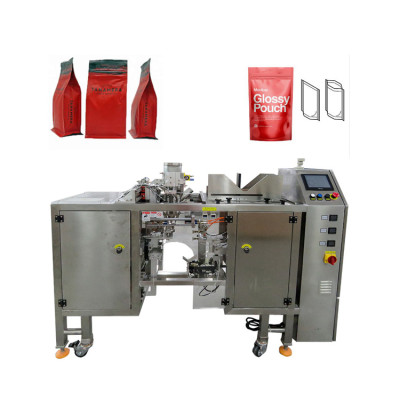
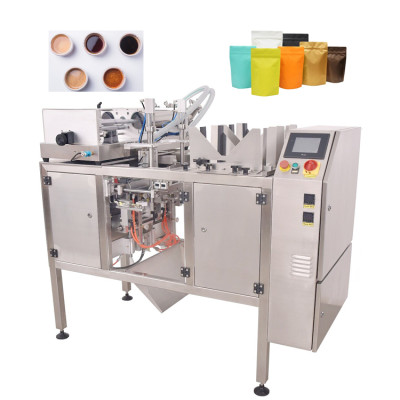
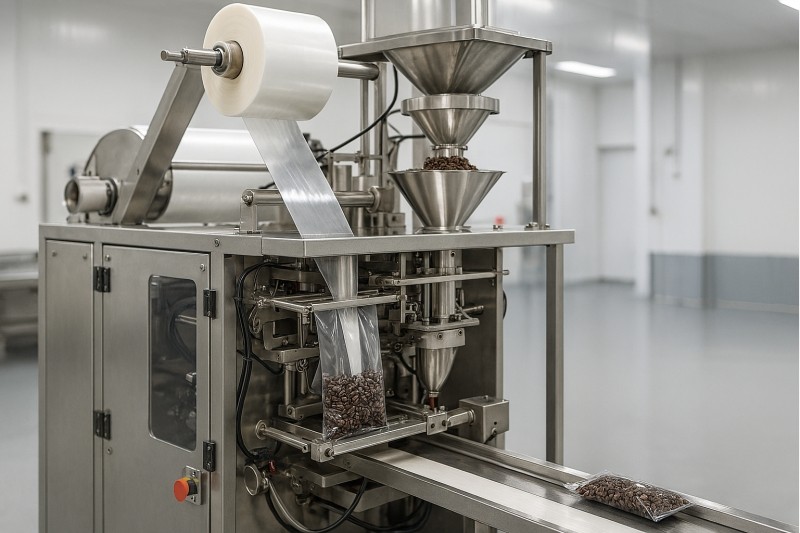
Bagging machines are used to package a huge variety of bulk materials, from powders and granules to solid items. These machines streamline the process of filling and sealing products into bags, significantly increasing efficiency compared to manual methods. They are essential in industries packaging goods like coffee, snacks, produce, pet food, and more.
Automation Levels in Bagging Machine Operations
Similar to other packaging equipment, bagging machines come in various levels of automation to suit different production needs.
- Manual Baggers: Require an operator to perform all steps: placing the bag, initiating the fill, and moving the bag to be sealed. They are best for low-volume or specialty products.
- Semi-Automatic Baggers: An operator typically places a pre-made bag onto the filling spout, and the machine then handles the weighing, filling, and sealing. This improves accuracy and speed over purely manual operations.
- Fully Automatic Baggers: These systems, such as Vertical Form Fill Seal (VFFS) and Horizontal Form Fill Seal (HFFS) machines, automate the entire process. They form the bag from a roll of film, fill it with the product, seal it, and cut it, often achieving speeds of over 100 bags per minute. These are indispensable for large-scale, high-speed production lines.
Conveyors: The Lifeline of Your Industrial Food Packaging Line
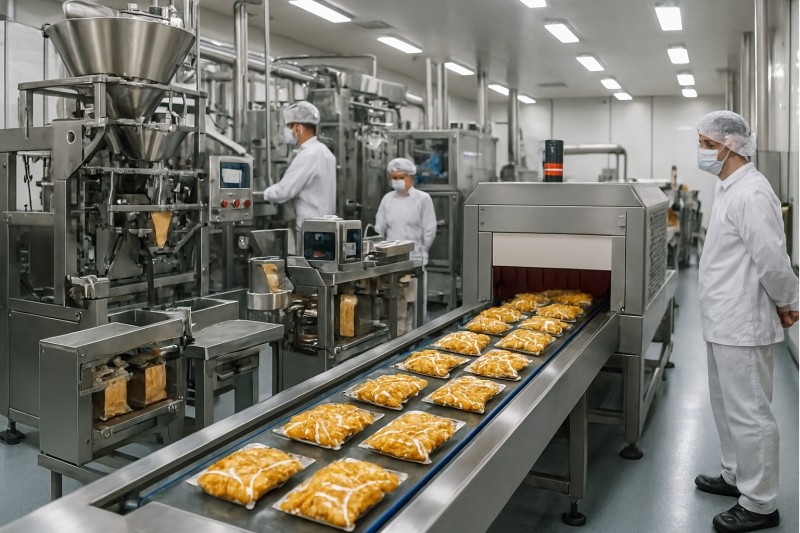
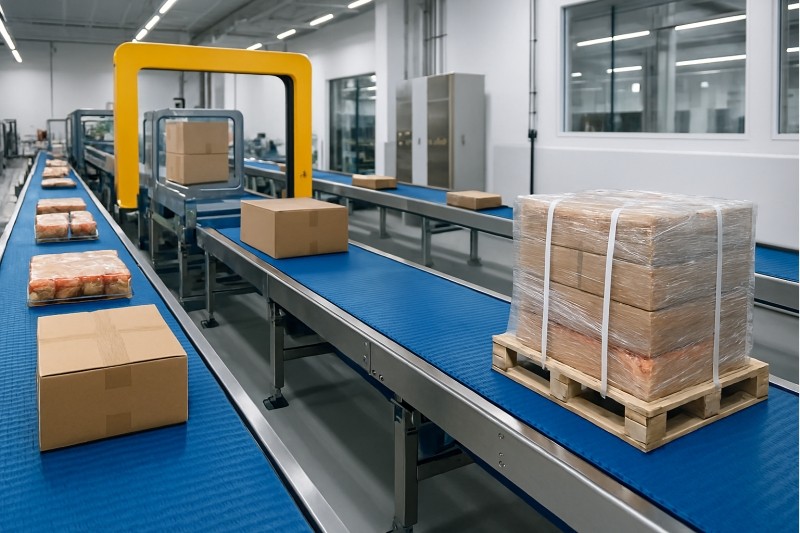
Conveyors are the circulatory system of a packaging facility, responsible for moving products, containers, and finished packages between different stages of the production line. A well-designed conveyor system is crucial for creating a smooth, efficient, and uninterrupted workflow. Food-grade conveyors are specifically designed to meet stringent hygiene standards (NSF, FDA, USDA) and are often built with stainless steel or other non-corrosive materials for easy washdown.
Powered vs. Non-Powered Conveyor Systems
Conveyors can be broadly categorized as either powered or non-powered (gravity) systems.
- Powered Conveyors: These systems use motors to move products along the line. They are essential for controlling the speed, spacing, and flow of items, especially for inclines, declines, and automated processes. Common types include belt conveyors, roller conveyors, and modular plastic chain conveyors.
- Non-Powered (Gravity) Conveyors: These rely on gravity to move items. They are typically used for accumulating products or moving them down a slight decline between workstations. They are a simple and cost-effective solution for non-critical transport where precise control is not necessary.
Strapping Machines: Securing and Unitizing for Industrial Food Packaging
Strapping machines are used to bundle individual products together or to secure loads to pallets for transport. By applying plastic or metal straps around a package or bundle, these machines provide stability and prevent shifting or damage during shipping. They are commonly used at the end of the packaging line for unitizing cases of products like canned goods, beverages, and other bulk items.
Like other equipment, strapping machines range from handheld manual tools for low-volume needs to semi-automatic and fully automatic systems for high-speed applications. Fully automatic arch strappers can detect a package on a conveyor, apply the strap, and seal it without any operator intervention, making them a key component of an automated end-of-line packaging process.
Mastering Food Labeling with Advanced Industrial Food Packaging Equipment
In the modern food industry, a label is far more than just a sticker; it's a critical intersection of regulatory compliance, consumer information, and brand identity. Effective food labeling, supported by advanced industrial equipment, is fundamental to building consumer trust and achieving commercial success. Proper equipment ensures that labels are not only visually appealing but also accurate and compliant with a complex web of regulations.
The Cornerstone of Food Labeling: Compliance and Brand Image
Food labeling is a discipline where precision is non-negotiable. It serves two parallel, equally important functions: adhering to legal standards to ensure consumer safety and projecting a powerful brand image that attracts and retains customers.
Regulatory Requirements and Consumer Trust in Labeling
In the United States, food labeling is primarily regulated by the Food and Drug Administration (FDA) and, for meat, poultry, and egg products, the U.S. Department of Agriculture (USDA). These agencies mandate that labels provide clear and accurate information, including:
- The common name of the food.
- Net quantity of contents.
- A detailed list of ingredients in descending order of weight.
- The name and location of the manufacturer or distributor.
- Comprehensive nutritional information via the Nutrition Facts panel.
- Clear declaration of major food allergens.
Adherence to these rules is a hallmark of accountability and builds a foundation of trust with consumers, who are increasingly health-conscious and discerning about what they purchase. Inaccurate or incomplete labels can lead to costly recalls, legal penalties, and significant damage to a brand's reputation.
Enhancing Brand Identity Through Quality Labeling
Beyond compliance, a label is often the first physical interaction a consumer has with a product, making it a powerful marketing tool. Effective packaging and labeling work together to tell a brand's story and create a distinct identity that stands out on crowded store shelves. Key elements that contribute to a strong brand identity include:
- Logo and Color Scheme: Consistent use of a brand's logo and color palette helps customers quickly identify products and builds recognition.
- Typography: The choice of fonts should be both legible for required information and reflective of the brand's personality.
- Material and Finish: The quality of the label material itself—whether matte, glossy, textured, or eco-friendly—conveys a message about the product's quality and the brand's values.
Well-designed labels that align with the brand's core message can create an emotional connection with the target audience, fostering loyalty and encouraging repeat purchases.
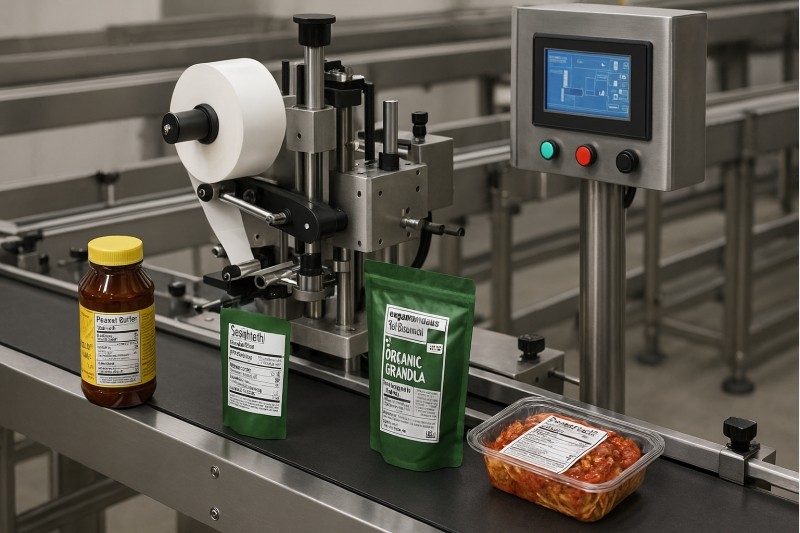
Boosting Efficiency with Automated Industrial Food Packaging Labeling Equipment
In today's fast-paced manufacturing world, manual labeling is often too slow, costly, and prone to error. Automated labeling machines revolutionize packaging operations by significantly increasing speed, improving accuracy, and reducing labor costs.
Semi-Automatic vs. Fully Automatic Labeling Solutions
The choice between semi-automatic and fully automatic systems depends largely on production volume, product variety, and budget.
-
Semi-Automatic Labelers: These machines are ideal for smaller operations, artisanal producers, or businesses transitioning from manual processes. An operator typically places the container onto the machine, which then applies the label when triggered by a footswitch or sensor. While they require manual interaction, they a cost-effective way to improve consistency and speed over hand-labeling.
-
Fully Automatic Labelers: Designed for high-volume production lines, these systems handle the entire labeling process with no operator intervention. Products are fed via conveyor, and the machine automatically applies labels with high speed and precision. These systems can label hundreds of products per minute and seamlessly integrate with other packaging machinery, making them essential for large-scale manufacturing.
| Feature | Semi-Automatic Labeler | Fully Automatic Labeler |
|---|---|---|
| Operation | Operator-assisted | Fully automated, conveyor-fed |
| Speed | Moderate | Very High (up to 500+ products/minute) |
| Best For | Small to medium batches, diverse products | High-volume, continuous production |
| Consistency | Good | Excellent, high precision |
| Initial Cost | Lower | Higher |
| Labor Needs | One operator required | Minimal supervision needed |
Seamless Integration and Error Reduction with Automation
Automated labelers can be integrated into a packaging line to create a cohesive, streamlined workflow. This integration minimizes downtime and manual handling, further boosting efficiency. More importantly, automation drastically reduces the risk of human error. Automated systems report error reductions of up to 85% compared to manual processes. By using sensors and vision systems, they ensure the correct label is applied to the correct product with perfect alignment every time, which is critical for avoiding mislabeling issues that could lead to recalls.
Key Considerations for Selecting Industrial Food Packaging Labeling Equipment
Choosing the right labeling machine is a strategic decision that can significantly impact your operational efficiency and scalability.
Assessing Production Volume, Container Types, and Labeling Demands
To make an informed choice, you must evaluate several key factors:
- Production Volume: Your current and forecasted production volume is a primary determinant. A small-scale business will have different needs than a large industrial plant. Select a machine that can handle your current output with room to scale.
- Container Types: Consider the size, shape, and material of your containers. Are you labeling cylindrical bottles, flat boxes, or flexible pouches? Different machine types, such as wrap-around, front-and-back, or top-and-bottom labelers, are designed for specific applications.
- Labeling Requirements: Assess your needs for speed, precision, and the type of labels being applied (e.g., pressure-sensitive, sleeve). Some products may require tamper-evident labels or multiple labels on a single container, which necessitates more sophisticated machinery.
Navigating Labeling Regulations with Confidence in Industrial Food Packaging
The regulatory landscape for food labeling is constantly evolving. Staying informed and compliant is crucial for any food business.
Staying Ahead of FDA Requirements and Allergen Labeling Laws
The FDA periodically updates its labeling requirements. For instance, the Food Allergen Labeling and Consumer Protection Act of 2004 (FALCPA) mandated the clear labeling of the top eight major allergens. More recently, the Food Allergy Safety, Treatment, Education, and Research (FASTER) Act of 2021 added sesame to this list, making it the ninth major allergen requiring specific declaration on labels as of January 1, 2023.
Manufacturers must ensure their labeling systems and processes are flexible enough to adapt to such changes. This includes updating ingredient lists and "Contains" statements promptly. Using robust labeling software integrated with automated equipment can help manage these updates efficiently and reduce the risk of non-compliance.
The Advantages of Modular Industrial Food Packaging Systems
In an industry defined by shifting consumer trends and SKU proliferation, flexibility is a massive competitive advantage. Modular packaging systems are designed to provide this adaptability.
Flexibility and Scalability for Evolving Business Needs
Modular equipment is built with interchangeable components and configurable designs, allowing businesses to customize, reconfigure, or upgrade their production lines with minimal disruption. Instead of replacing an entire machine, a modular system allows you to:
- Scale Up: Easily add new functionality, such as an extra labeling head or a faster filling nozzle, as production demands grow.
- Adapt to New Products: Quickly adjust configurations to handle different package sizes, shapes, or materials with minimal downtime.
- Integrate New Technologies: Incorporate new features like smart sensors or vision systems as technology advances.
This "tailored standardization" approach provides a right-sized solution built from standard parts, offering the benefits of customization while maintaining the cost-effectiveness of scaled production. For businesses looking to future-proof their operations, investing in modular food packaging equipment is a strategic move that enhances efficiency and supports long-term growth.
Calculating the True Value: Total Cost of Ownership for Industrial Food Packaging Equipment
When investing in industrial food packaging equipment, looking beyond the initial purchase price is critical. A savvy business owner understands that the true measure of a machine's value is its Total Cost of Ownership (TCO). TCO provides a complete financial picture by encompassing all expenses incurred throughout the equipment's entire lifecycle. This holistic approach is the only way to accurately predict long-term profitability and ensure a strategic, sustainable investment.
Beyond the Price Tag: Understanding TCO in Industrial Food Packaging
Total Cost of Ownership is a comprehensive calculation that includes not just the upfront acquisition cost but also all direct and indirect expenses related to operation, maintenance, and eventual disposal. Many buyers make the mistake of choosing the cheapest machine, only to find that higher operational and repair costs quickly erase any initial savings. A thorough TCO analysis uncovers hidden costs, allowing for a more accurate projection of return on investment (ROI) and preventing unpleasant financial surprises down the line.
Initial Capital Investment vs. Long-Term Costs
The initial purchase price of equipment often represents only 20-30% of its total cost over a decade. The other 70-80% is comprised of long-term expenses. This stark contrast highlights why focusing solely on the sticker price is a flawed strategy. An initially more expensive machine that is highly efficient, reliable, and easy to maintain will almost always have a lower TCO and deliver greater value over its lifespan than a cheaper, less dependable alternative.
Capital Costs: The Upfront Investment in Industrial Food Packaging Equipment
Capital costs, or Capital Expenditure (CapEx), are the one-time, upfront expenses required to acquire and implement a new packaging machine. These are the most visible costs but are still just one piece of the TCO puzzle.
Key Components of Capital Costs:
- Equipment Purchase Price: The base cost of the machinery.
- Shipping and Installation: The expenses related to transporting the equipment to your facility and setting it up.
- Permits and Certifications: Any fees required for regulatory compliance or safety testing.
- Initial Training: The cost of training operators and maintenance staff on the new system.
Strategies for Reducing Capital Outlays
While capital costs are significant, there are several strategies to manage this initial financial burden:
- Financing and Leasing: Instead of an outright purchase, leasing equipment can free up capital for other business needs.
- Tax Incentives: In the U.S., programs like Section 179 allow businesses to deduct the full purchase price of qualifying equipment from their gross income in the year it's put into service, providing a significant tax break. For 2025, bonus depreciation is another option for larger purchases.
- Right-Sizing Equipment: Avoid over-investing in a machine with capacity far beyond your needs. A modular or scalable system can be a smarter investment.
Maximizing SKU Variability with Flexible Packaging Solutions
In today's market, consumer demand for variety has led to an explosion in Stock Keeping Units (SKUs). This "SKU proliferation" can be a major challenge for production lines with inflexible equipment. Investing in machinery designed for flexibility and quick changeovers is crucial. A packaging line that can easily switch between different product sizes, formats, or materials without extensive downtime can handle a wider variety of SKUs efficiently, ultimately boosting margins and reducing innovation costs.
Operational Costs: Ongoing Expenses for Your Industrial Food Packaging Line
Operational costs are the recurring expenses required to run the packaging equipment day-to-day. These costs constitute a major portion of the TCO and offer significant opportunities for savings through smart planning and technology.
Key Components of Operational Costs:
- Labor: Wages, benefits, and training for operators.
- Utilities: The cost of electricity, compressed air, and other resources consumed by the machine.
- Materials: The cost of packaging materials like film, bags, and labels.
- Downtime: The cost of lost production when a machine is not running, whether planned (changeovers) or unplanned (breakdowns).
Minimizing Operating Costs Through Training and Automation
Automation is a powerful strategy for reducing long-term operational costs. Automated systems can perform repetitive tasks faster, more accurately, and with fewer workers, which directly lowers labor costs. Companies implementing packaging automation report an average labor cost reduction of 20-30% in the first year alone. Proper operator training is also essential. Well-trained staff can run machinery more efficiently, perform basic maintenance, and troubleshoot minor issues, which reduces downtime and improves overall equipment effectiveness (OEE).
The Impact of Efficient Changeovers in Industrial Food Packaging
A changeover is the time it takes to switch a production line from one product or package type to another. In an environment with high SKU variety, frequent changeovers are inevitable. Lengthy changeover processes create bottlenecks and significant downtime, which directly translates to lost revenue.
Modern packaging machines with automated changeover features can dramatically reduce this downtime. These systems use programmable settings and recipes to make adjustments with the touch of a button, ensuring a rapid and repeatable process. By minimizing changeover time, you increase line efficiency, reduce waste from priming and cleanup, and become more agile in responding to market demands.
Maintenance and Support Costs: Sustaining Your Industrial Food Packaging Investment
Maintenance and support costs are the expenses needed to keep your equipment in optimal working condition. Neglecting maintenance is a false economy, as it almost always leads to more frequent and costly emergency repairs, shorter equipment lifespans, and significant unplanned downtime.
Key Components of Maintenance & Support Costs:
- Preventative Maintenance (PM): Scheduled inspections, cleaning, lubrication, and replacement of wear parts designed to prevent breakdowns.
- Emergency Repairs: The cost of labor and parts for unscheduled breakdowns.
- Spare Parts Inventory: The cost of keeping critical replacement parts in-house.
- Technical Support Agreements: Fees for access to expert support from the equipment manufacturer.
Adhering to Maintenance Schedules for Optimal Performance
A structured preventative maintenance (PM) program is one of the most effective ways to lower your TCO. Regular, planned maintenance prevents small issues from escalating into major failures, extends the life of your machinery, and ensures a safer work environment. Studies have shown that every dollar invested in preventative maintenance can save up to five dollars in other expenses, and that a consistent PM program can reduce overall maintenance costs by 15-30%.
The Value of Parts and Service Agreements in Industrial Food Packaging
Partnering with your Original Equipment Manufacturer (OEM) through a service agreement can be an invaluable investment. These agreements often provide:
- Priority Support: Faster response times for service calls and technical support.
- Scheduled Maintenance: Ensures that PM is conducted on time by qualified technicians who know the equipment best.
- Genuine OEM Parts: Using OEM parts guarantees quality, fit, and performance, which protects your machine's warranty and longevity. Aftermarket parts may be cheaper but can cause excessive wear and fail sooner, costing more in the long run.
- Budget Certainty: An SLA provides a level of cost certainty for maintenance, helping you better control and optimize your operating budget.
By accurately calculating the TCO and making strategic decisions around capital, operational, and maintenance costs, you can ensure your investment in food packaging equipment delivers the maximum possible return.
Tailoring Industrial Food Packaging Equipment to Your Business Needs
Selecting and implementing industrial food packaging equipment is not a one-size-fits-all process. It requires a strategic and personalized approach that aligns with your specific products, operational scale, and long-term business goals. Making the right choice involves a careful assessment of your needs and, often, collaboration with industry experts to ensure a sound investment that drives efficiency and growth.
Identifying the Right Packaging Machinery for Your Operations
The first step in choosing the right equipment is a thorough internal analysis. Before you can select a machine, you must have a clear understanding of your own operational landscape.
A comprehensive needs assessment should cover:
- Product Specifications: What are you packaging? Consider the product's state (liquid, powder, solid, fragile), size, and preservation requirements (e.g., vacuum sealing, modified atmosphere packaging). This will dictate the type of filling, sealing, and wrapping technology you need.
- Production Volume: Analyze your current output and future growth projections. A small business with seasonal peaks has different needs than a large-scale manufacturer with continuous, high-speed production. This will determine whether manual, semi-automatic, or fully automatic machinery is most appropriate.
- Packaging Style and Materials: What kind of packaging will appeal to your customers and protect your product? Consider bag types (e.g., pillow bags, stand-up pouches), container shapes, and film materials. Ensure the machinery you choose is compatible with your desired packaging, especially if you plan to use sustainable or recyclable materials which may have unique handling requirements.
- Factory Footprint: Evaluate your available floor space. Compact or modular equipment designs can be invaluable for facilities with limited room. The layout of the machine must integrate logically with your existing production flow to avoid creating bottlenecks.
- Budget and ROI: Look beyond the initial purchase price and consider the Total Cost of Ownership (TCO). While budget is a critical factor, the most cost-effective solution is one that delivers long-term value through reliability, efficiency, and scalability.
By meticulously defining these requirements, you can move from a broad list of options to a shortlist of machines that genuinely fit your business.
Consulting Experts for Informed Decisions on Industrial Food Packaging Equipment
Navigating the vast market of packaging machinery can be overwhelming. This is where the value of expert consultation becomes clear. Partnering with experienced packaging consultants or directly with reputable equipment manufacturers provides access to deep industry knowledge and technical expertise that can prevent costly mistakes.
Benefits of expert consultation include:
- Tailored Solutions: Consultants can analyze your specific needs and recommend a customized equipment configuration that might not be immediately obvious. They can help design a system optimized for your products and workflow.
- Cost-Effectiveness: Experts can identify opportunities for cost savings, such as optimizing material use or suggesting multi-function machines to reduce capital expenditure. Their guidance ensures you invest in machinery that aligns with your budget and maximizes ROI.
- Technical Expertise: A knowledgeable consultant understands the nuances of different technologies and how to integrate them. They can help you plan a full packaging line, from the initial packaging concept to final implementation and after-sales support, ensuring all components work together seamlessly.
- Future-Proofing: An experienced partner will not only solve your current challenges but also help you anticipate future needs. They can recommend scalable and flexible solutions that can adapt as your business grows and market trends evolve. This foresight is crucial for long-term success.
Making a well-informed decision is critical. When you're ready to explore your options and want to ensure you're making the best possible investment for your company's future, it's time to talk to the professionals. If you would like tailored advice for your specific needs, feel free to Get A Quote and connect with our team of specialists.
Frequently Asked Questions (FAQ)
1. What is the most important factor when choosing food packaging equipment? While several factors are critical, the most important is a thorough needs assessment. You must first understand your product's specific requirements (e.g., fragility, preservation needs), your production volume (current and future), and your desired package type. This foundational knowledge dictates all subsequent choices regarding machine type, automation level, and scalability.
2. How can automation in food packaging improve my business? Automation offers numerous benefits, primarily by increasing efficiency, accuracy, and safety. Automated systems can operate continuously at high speeds, significantly boosting production output. They reduce labor costs and minimize human error, leading to less product waste and more consistent package quality. Furthermore, by reducing manual handling, automation enhances hygiene and creates a safer working environment.
3. What are the key differences between a semi-automatic and a fully automatic packaging line? The main difference is the level of operator involvement. Semi-automatic systems require an operator for certain steps, like placing a container or activating the machine, making them ideal for smaller batches or businesses with varied product lines. Fully automatic systems are integrated into a production line and handle the entire packaging process—from filling to sealing and labeling—with minimal human intervention. They are designed for high-volume, continuous production where speed and consistency are paramount.
4. How do I ensure my food labels comply with FDA regulations? Compliance requires careful attention to detail. Your labels must include the statement of identity, net quantity of contents, Nutrition Facts panel, an ingredient list, and the manufacturer's details. Most importantly, you must clearly declare the presence of the nine major food allergens. Given that regulations can change (like the recent addition of sesame via the FASTER Act), it is crucial to stay informed through FDA resources and consider using labeling software or consulting with experts to ensure accuracy.
5. Why is Total Cost of Ownership (TCO) more important than the initial purchase price? TCO provides a complete financial picture of your investment. The initial price is often only a fraction of the total lifetime cost. TCO includes ongoing operational costs (labor, utilities), maintenance expenses, downtime losses, and eventual disposal fees. A machine with a lower sticker price may end up costing more over its lifespan due to higher energy consumption, frequent breakdowns, or expensive repairs. Analyzing TCO helps you make a more strategic and financially sound decision for long-term profitability.
Conclusion
The journey to selecting and implementing the ideal industrial food packaging equipment is multifaceted, requiring careful consideration of machinery types, labeling nuances, and the true total cost of ownership. By understanding this complex landscape, you can build a packaging line that not only meets today's demands but also drives future success. From ensuring product integrity with heat sealers to boosting brand recognition through precise labeling, each component plays a vital role.
We've explored the critical components of industrial food packaging equipment, emphasizing how each piece contributes to overall efficiency, compliance, and profitability. Armed with this knowledge, you are better equipped to make strategic choices that will strengthen your business's future. Automation, modularity, and sustainability are no longer just trends but essential elements for staying competitive in a dynamic industry.
Investing wisely in your packaging line is a testament to your commitment to quality and longevity. As a leading food packaging machinery manufacturer, TOP Y Machineryis dedicated to providing reliable, innovative, and efficient solutions tailored to your unique needs. We encourage you to leverage these insights to enhance your operations and stay ahead of the curve. For a personalized consultation or to learn more about our equipment, we invite you to Get A Quote from our team of experts.