Factory Acceptance Test for Food Packaging Equipment: A Buyer's Checklist Before Shipment
Table of contents
- FAT and SAT are not the same test
- Your FAT date is set by drawing confirmation, not by the order
- What to bring to the test
- The ten-point FAT checklist
- What "pass" has to mean: measurable acceptance criteria
- Seal strength and seal integrity are two different tests
- What to record during the run
- Release, balance payment and shipment
- What FAT cannot cover: SAT and operator handover
- FAQ
The test is the last point at which you still have leverage
A factory acceptance test is the structured run of your machine at the builder's site, on your product and your film, before it is crated. Its value is not the ceremony. It is that a FAT is the last moment in the project where a problem costs the builder time and money instead of costing you a shutdown.
After the machine ships, every correction happens on your floor, in your production window, with your team standing around. Before it ships, the builder has the tools, the drawings, the spare parts and the engineers in the same building. That asymmetry is the entire argument for doing this properly, and it is why the checklist below is written to be printed and carried rather than read.
FAT and SAT are not the same test
Buyers often use the two terms interchangeably, and that is how gaps appear. They test different things, at different places, and they cannot substitute for each other.
FAT — factory acceptance test
At the builder's site, before shipment. Proves the machine was built to the confirmed specification, runs your product, and meets the agreed accuracy and integrity criteria. Covers the mechanical build, the electrical and safety verification, the material documentation, and the spare parts and manual handover.
SAT — site acceptance test
At your plant, after installation and services are connected. Proves the machine performs in your building, on your compressed air and power supply, integrated with your upstream and downstream equipment. Covers reassembly, alignment, line integration, and the operator training that signs your team off.
The practical consequence: a clean FAT does not guarantee a working line, because the line does not exist yet. A FAT proves the machine. A SAT proves the installation. Write both into the purchase order, with separate acceptance criteria, or you will find yourself arguing about which failure belongs to whom while the line is standing still.
Your FAT date is set by drawing confirmation, not by the order
Most buyers plan the FAT backwards from the shipping date and then discover there is no realistic slot for it. The reason is that a custom packaging machine cannot be scheduled from the purchase order, because the machine does not yet exist in a defined form.
The build only becomes schedulable once the technical drawings are confirmed. Until the drawing is signed off, dimensions, the station layout, the film path, the contact materials and the interface points with your detector or case packer are all still open. A builder who quotes you a firm completion date before the drawing is confirmed is guessing.
Plan the sequence, not just the date. Drawing confirmation, then build, then the test run, then balance payment and dispatch. For a custom machine the build itself is the long pole: standard machines commonly run about a month, non-standard builds six to eight weeks, and complex machines or complete lines considerably longer. Book your FAT slot at the same time you confirm the drawing, so nobody is improvising at the end of the project.
What to bring to the test
This is the part buyers most often get wrong, and it decides whether the test tells you anything. A machine run on the builder's demonstration product proves the machine works on the builder's demonstration product. It tells you very little about your production.
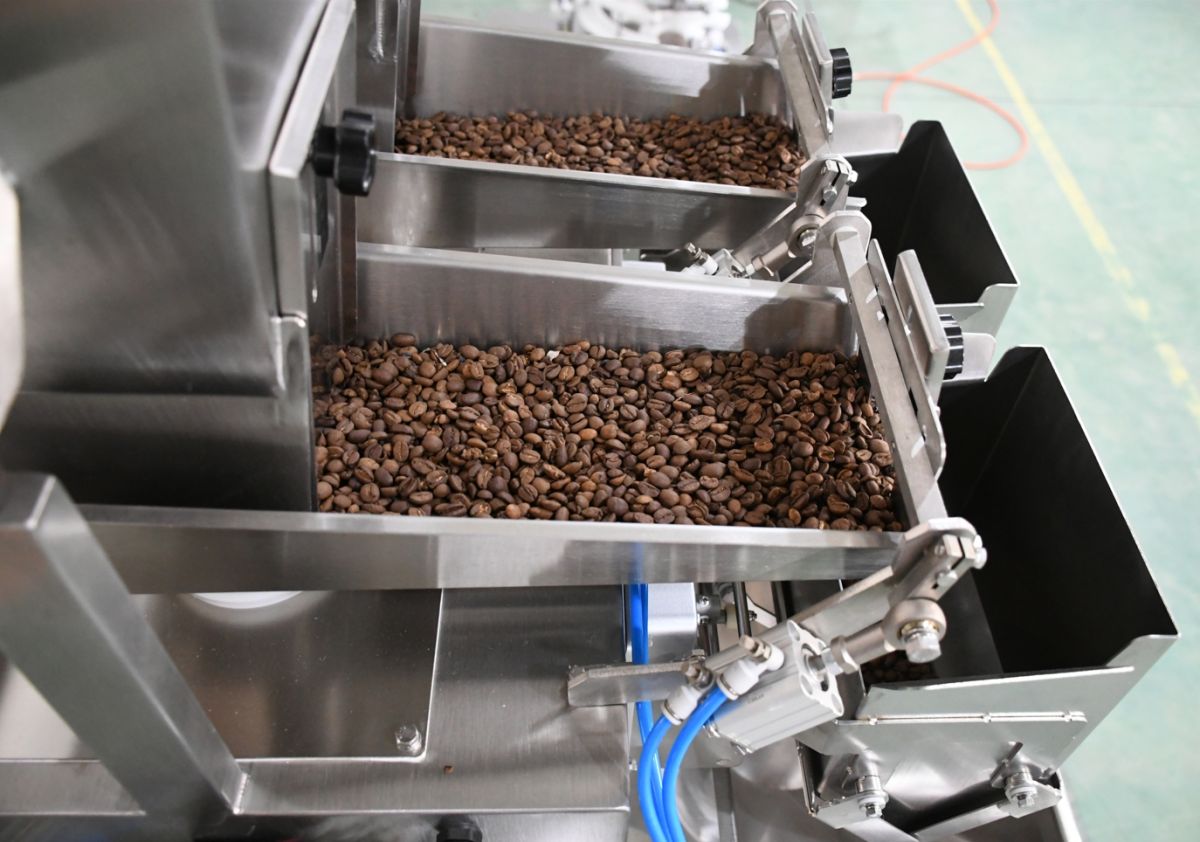
- Your product, in production condition. Not a sample from the lab. Product that is sticky, dusty, fragile or unusually shaped behaves differently on a weigher, in a forming tube and at a seal jaw than clean demonstration material. Send enough for a sustained run, not enough for a photograph.
- Your packaging film or pouches. Film structure drives the seal window. A mono-material recyclable laminate, a paper-based structure and a foil laminate need different temperature, pressure and dwell settings, and they fail in different ways. Bring the material you actually intend to run, including the printed roll if print affects registration.
- A reference pack. One finished pack that represents what good looks like, agreed with your quality team in advance. It removes the argument about whether a wrinkle is acceptable while a machine is running.
- Your acceptance criteria, in writing, before you travel. Speeds, weights and tolerances, plus the seal test values you expect. Agreeing the numbers while the machine is warm and the test is running is how buyers accept something they did not want.
- Your own measuring instruments. A checkweigher, a scale, and where applicable a seal tester or gauge. Independent measurement is the difference between a test and a demonstration.
The ten-point FAT checklist
Each item below produces a document. If an item produces only a verbal assurance, it is not a completed check — it is a promise, and promises do not travel with the machine.
As-built drawings and substitution record
The machine as shipped against the drawing you confirmed, plus a written list of any material or component changed after confirmation, with the reason and your approval.
Food-contact material certificates
For every part that touches product: alloy or polymer grade, supplier, the standard or regulation the declaration relies on, and the date of issue. Certificates older than the last material change are not evidence.
Non-metallic parts and lubricant schedule
Gaskets, seals, O-rings, hoses, PTFE tape and guides with material and temperature rating; every lubrication point with the product used and its food-grade status, and points in no-contact zones identified as such.
Mechanical accuracy
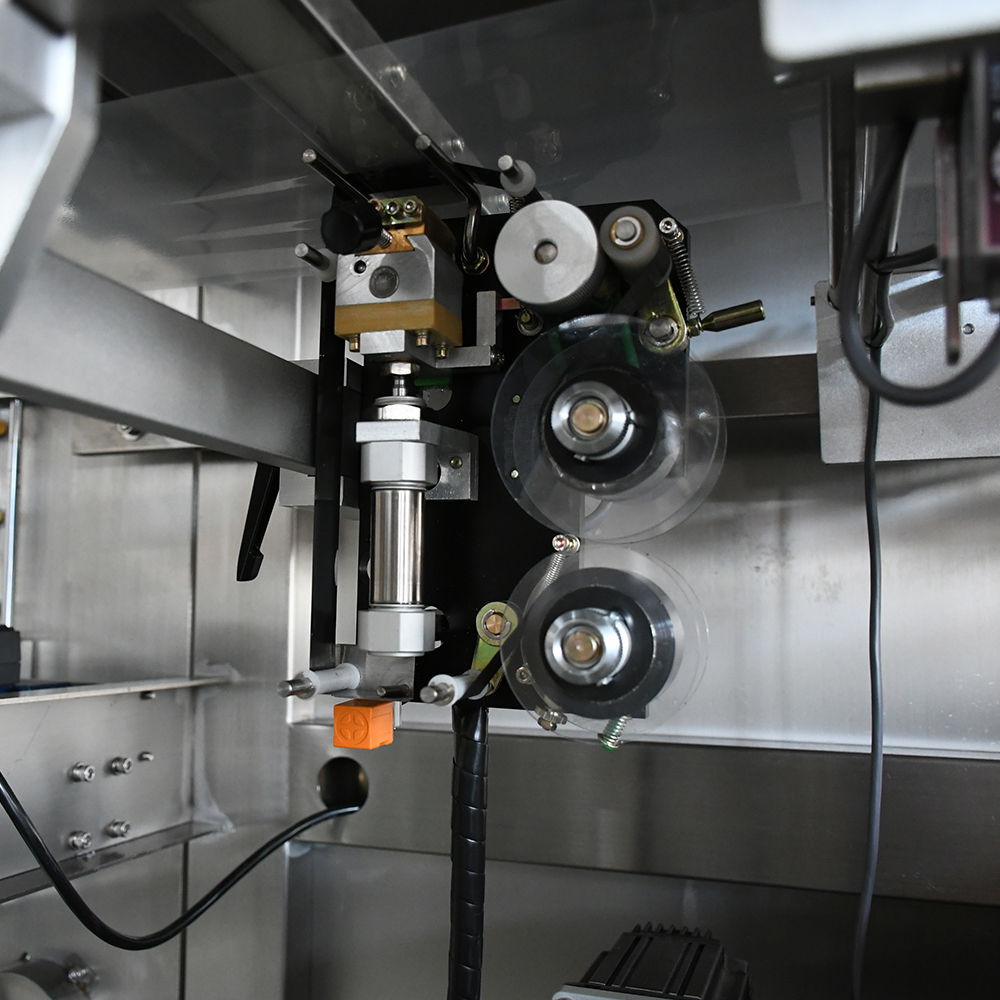
Former and collar alignment, seal jaw parallelism, bag length repeatability, film registration and cutter position, each measured against the drawing tolerance rather than eyeballed.
Empty run at full speed
Every motion cycled, all guarding closed, interlocks live, no alarms, and cycle time compared against the rated speed in the specification.
Loaded run on your product and film
Sustained target speed with your material, no jams, no missed seals, and the reject path deliberately exercised rather than assumed.
Seal and package integrity tests
Peel, dye penetration and burst testing on packs produced during the run, with the values recorded rather than a pass or fail tick. See the section below on why these are separate tests.
Dosing and weighing accuracy
Target against actual over a defined sample: mean, spread and giveaway. A machine that hits the target on average while swinging widely will cost you material every shift.
Electrical and safety verification
Continuity of the protective bonding circuit, insulation resistance, emergency stop, guard interlocks, isolation and lock-out points, and earthing, verified against the electrical standard the machine is built to.
Spare parts, tooling and documentation
Spare part list with lead times for wear items, quick-change parts, special tools, manuals and wiring diagram, PLC program backup, and the certificate pack — in a language your maintenance team reads.
What "pass" has to mean: measurable acceptance criteria
An acceptance criterion that cannot be measured is not a criterion. The table below is the shape of what to agree in writing before the test, so that nobody has to negotiate while the machine is running.
| Check | How to test it | What to record |
|---|---|---|
| Cycle rate | Timed run at the specified speed, on your product, for a defined duration | Actual packs per minute, run duration, number and cause of stoppages |
| Bag length and seal position | Measure across consecutive packs and compare to the drawing tolerance | Mean, minimum and maximum, and whether the value drifted across the run |
| Seal strength | Peel test to ASTM F88 at an agreed specimen width and test speed | The technique used, specimen width, test speed, mean and lowest single value |
| Seal integrity | Dye penetration to ASTM F1929 on packs from the run | Pass or fail per sample, and the defect type where one is found |
| Package burst resistance | Inflation testing to ASTM F1140 or ASTM F2054, or a creep hold near 80 percent of the burst value | Burst pressure and the failure location — seal or material |
| Fill weight | Weigh a defined sample with your own instrument | Sample size, mean, standard deviation, giveaway against target |
| Protective bonding continuity | Verify continuity of the protective bonding circuit as required for the machine's electrical equipment | The measured value against the limit the builder states |
| Emergency stop and interlocks | Operate every stop device and guard switch in turn | Pass or fail per device, and the stopping behaviour observed |
Note the difference between the second column and the third. Almost every buyer specifies the first and forgets the second. A test with no recorded value cannot be compared against the next machine, cannot be trended when output drops six months later, and cannot be shown to an auditor who asks how seal quality is controlled.
Seal strength and seal integrity are two different tests
This distinction causes more trouble than any other single point in packaging acceptance testing, and it is worth understanding properly before you write a specification.
Seal strength measures how much force is needed to peel a seal apart. Seal integrity measures whether the pack has a leak — a channel, a void, or a path through which product or atmosphere can escape. They are different properties, measured by different methods, and one does not imply the other.
A pack can pass a seal strength test and still leak. A strong seal with a narrow channel defect will peel open at a perfectly acceptable force and still fail as a barrier. The reverse also happens: a package can be airtight and still open below the force your own quality standard expects. If your specification names only one of the two, you have left half of the risk uncontrolled.
Practically, that means three families of test on the FAT agenda. Peel testing to ASTM F88 gives you the strength number. Dye penetration to ASTM F1929 is the sensitive test for channel defects that visual inspection misses. Inflation testing to ASTM F1140 or ASTM F2054, including a creep hold, gives you whole-package integrity and — importantly — where the failure occurred: a burst at the seal points to sealing parameters, while a burst in the material points to the laminate. Where a nitrogen flush or modified atmosphere is used, headspace oxygen measurement belongs alongside them, because it verifies the atmosphere was actually established and has not leaked away.
One more trap: peel results are only comparable if the technique matches. Unsupported, supported at 90 degrees and supported at 180 degrees give different force values on the same pack. Agree the technique once, record it, and hold every future test to it.
What to record during the run
The test run should leave a file, not a memory. Four things are worth insisting on, because each one is expensive to reconstruct later.
- Machine settings at the point of best performance. Seal temperature, pressure and dwell; film tension; bag length parameters; dosing settings. Photograph the screens and write the values down. When a new operator changes something in three months, this is what you restore to.
- The operator's procedure. The film path threading, the start-up sequence, the changeover sequence. Documented at the FAT, when the builder's engineer is standing next to you, rather than reconstructed at commissioning.
- Every deviation and its resolution. What failed, what was changed, what was retested. A file with no deviations is not evidence of quality; it usually means nothing was challenged.
- Photographs and video of the reject path, guarding and interface points. These are the items most likely to be argued about after shipping, and a picture taken at the factory settles it in a minute.
Release, balance payment and shipment
The commercial sequence matters as much as the technical one, and it should be written into the contract rather than agreed by email at the end.
- Test, then document, then sign. The release note should reference the recorded values, not a general statement of satisfaction. If a value missed the criterion, either it is corrected and retested, or it is listed as an open item with a date — never absorbed into a signature.
- Tie the balance payment to the signed test, not to the calendar. Most builders work on a deposit with the balance due before shipment. Attaching that balance to a passed FAT with documented results is the single most effective lever you have, and builders who run a documented build process are comfortable with it because they expect to pass.
- Keep an open-items list with owners. A small number of open items is normal on a custom machine. What matters is that each one has a named owner, a fix and a date, and that the packing list records what is being corrected on site.
- Record the machine as shipped. Photographs of the crated machine, the packing list, and confirmation that the documentation pack travelled with it. Documentation that ships separately from the machine has a habit of arriving late.
What FAT cannot cover: SAT and operator handover
A FAT cannot test your plant, because your plant is a different building. Three things are genuinely outside its scope and have to be planned into the SAT.
- Services in your building. Compressed air quality and pressure, power supply characteristics, ambient temperature and humidity. A machine that ran cleanly on the builder's air supply can behave differently on yours, and that is not a build defect.
- Line integration. The handshake with the upstream weigher or filler and the downstream detector, checkweigher, conveyor and case packer. Whole-unit commissioning at the factory proves the machine; only the SAT proves the line.
- Your operators, actually running it. This is the part with the longest tail. An operator who sets seal parameters by feel rather than by test produces leakers that surface in your customer complaint file rather than on your line.
How TOP Y Machinery structures the test before dispatch
From our manufacturing base in Foshan, Guangdong — established in October 2011, 4,500+ m² of workshop, a team of over 50 including electrical, mechanical design, commissioning and after-sales engineers, and a monthly build capacity approaching 70 custom machines — we build to a process designed so that the test at the end is a confirmation rather than a discovery.
- Production starts from a confirmed drawing, not from the order. Dimensions and production operations are marked on the drawing and the drawings are issued for your review and confirmation first. That is what makes an as-built check meaningful at FAT: there is a document to check against. It is also why drawing confirmation, not the purchase order, is the gate that starts the production clock.
- Sub-assemblies are proven before integration. Assembly is carried out in batches, each proven on its own, and only then is the complete machine assembled and run as a single unit. Faults surface inside the batch that caused them, at a stage where correcting them does not mean dismantling a finished machine.
- The run uses real material. Commissioning runs actual product and actual film, not empty cycles. It is the same reason we ask buyers to send production-condition product and film: a machine that has only ever seen demonstration material has not been tested in any sense that matters to you.
- Seal quality is measured, not assumed. Peel testing, dye penetration testing and burst testing are part of how we verify the seal rather than a visual check at the jaw. The values belong in your file, not in a conversation.
- Training ends with a signed record. Operators are taken through film loading, seal parameters, changeover to a new format, fault code reading and first-line diagnosis, and finish against a practical check with records your quality system can file. When an auditor asks an operator how they set seal parameters and why, that record is the answer.
None of this changes what a FAT is. It changes what you find when you get there: a machine built to a document, assembled in verified batches, already run on real material, with its seal test values and its training records in a folder. The test then confirms rather than rescues.
FAQ
Can we skip the FAT and test at our own site instead?
You can, but you lose the leverage. At the builder's site the drawings, tooling, spare parts and engineering team are all in one building, and the builder absorbs the cost of correcting a problem. After shipment, every correction happens on your floor in your production window. If travel is genuinely impossible, ask for a witnessed video run with the recorded values instead — but insist on the values, not a summary.
How long should a factory acceptance test take?
Plan on a full day for a standard machine and two or more for a custom unit or a line, with the loaded run and the seal testing taking the bulk of it. If the schedule only allows an hour for the running test, the schedule is wrong, not the test. Build the FAT duration into the project plan at drawing confirmation.
What if the machine fails part of the test?
Normal, on a custom machine, and not a reason to walk away. What matters is the disposition: corrected and retested, or listed as an open item with an owner, a fix and a date. What should worry you is a test where nothing was challenged and nothing failed — that usually means the criteria were never quantified.
Should the balance payment be tied to the FAT?
Yes. Tying the balance to a passed FAT with documented values is standard practice and gives you a real lever at the only point where you still have one. Builders who run a documented build process expect to pass and generally accept the condition without difficulty.
Do we need both a peel test and a dye penetration test?
Yes, if the pack is a barrier pack. Peel testing to ASTM F88 measures strength. Dye penetration to ASTM F1929 detects the channel defects that visual inspection misses and that peel strength does not reveal. A pack can pass the first and fail as a barrier. Where modified atmosphere is used, add headspace oxygen measurement.
What documentation should physically ship with the machine?
Operation and maintenance manuals, the wiring diagram, the as-built drawing set, a PLC program backup, the spare part list with wear-item lead times, the food-contact material declarations, and the certificate pack — in a language your maintenance team reads. Confirm at FAT that the pack is complete and in the crate, not promised for later.
What to put in the purchase order
Six clauses do most of the work, and writing them costs an afternoon. Fix the specification and the drawing confirmation step. Define the acceptance criteria numerically, including which seal test technique applies. State that the loaded run uses your product and your film, and that you provide both. Require the document pack at FAT rather than after shipment. Tie the balance payment to a signed test with recorded values. And separate FAT criteria from SAT criteria so that line-integration problems are not confused with build defects.
Buyers who do this properly get something better than protection against a bad machine. They get a documented baseline — the settings, the procedures and the measured values of the machine at its best — which is what every future troubleshooting conversation will be compared against. The FAT is not the last step before shipping. It is the first useful record of your machine's life.
Related reading
- Food Packaging Equipment Compliance Guide: FDA, EU 1935/2004 and Food-Contact Materials
- Foreign Object Detection on Food Packaging Lines: Metal Detection vs X-ray vs Checkweigher
- Food Packaging Machine Cost: 2026 Price Guide
- China Food Packaging Machine Manufacturers: How to Find a Reliable Supplier
- Manufacturing Capability: How Food Packaging Machines Are Built
- Operator Training for Food Packaging Machines