Sauce and Paste Packaging Machine: Handling High-Viscosity Products
The Short Answer: Which Machine Handles High-Viscosity Sauce and Paste?
Short answer: For sauces, ketchup, honey, mustard, mayonnaise, and chili pastes — products in roughly the 10,000 to 500,000 cP range — a piston filling machine (also called a positive-displacement or volumetric filler) is the standard choice. Piston fillers move a precise, controlled volume per stroke, so thick, sticky product flows consistently and fill weight holds to ±0.5% on most recipes. Gravity filling, by contrast, works only for thin, free-flowing liquids under roughly 100 cP. On any viscous line, temperature control also matters as much as the filler head: heating the product path by 10–20 °C can cut viscosity by 50% or more, which is why sauce machines ship with jacketed hoppers and heated nozzles, not just stronger pumps.
This guide explains the physics behind thick-product filling, compares piston vs gravity machines with data tables, details the ±0.5% accuracy spec and the temperature-control parameters you should write into your purchase order, and shows the multi-filler SS304 machines TOP Y MACHINERY builds for sauces and pastes.
How Viscosity Changes the Filling Game: Sauce vs Paste vs Liquid
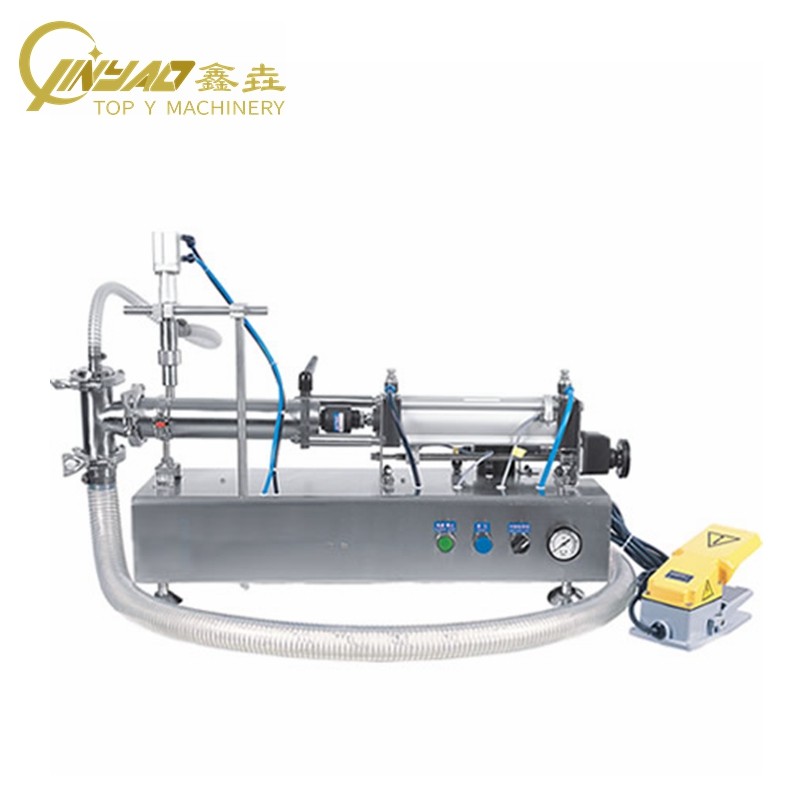
Viscosity — the internal resistance of a fluid to flow — is the single most important property that decides which filling technology works. Thin liquids pour under gravity in milliseconds; thick pastes can take minutes to settle, trap air, string, and stick to every surface they touch. The table below shows typical viscosity values at 25 °C and the filler type that fits each range:
| Product Type | Typical Viscosity (cP at 25 °C) | Behavior Notes | Suitable Filler |
|---|---|---|---|
| Water, juice, thin beverages | 1–5 cP | Free-flowing, foams easily, fast drip | Gravity / overflow / pump |
| Olive oil, cooking oil | 60–100 cP | Flows well but stringy, temperature-sensitive | Pump or piston (multi-head) |
| Honey, syrup, molasses | 2,000–20,000 cP | Very stringy, thickens as it cools | Piston + heated hopper/nozzle |
| Ketchup | 50,000–100,000 cP | Thixotropic — thins when sheared, recovers when still | Piston (submerged or bottom-fill) |
| Mustard, mayonnaise | 100,000–300,000 cP | Paste-like, air entrapment risk | Piston with vacuum/anti-foam features |
| Chili paste, sambal, BBQ sauce | 150,000–400,000 cP | Chunky, particulate — nozzle bore must clear solids | Piston, oversized bore / open valve |
| Peanut butter, thick spreads | 250,000–500,000+ cP | Nearly solid at rest; needs auger or large-bore piston | Piston (large bore) or auger filler |
Reading the table: the jump happens around 100 cP. Below it, gravity and simple pumps are accurate enough. Above it, only positive-displacement filling — a piston pushing a measured volume — keeps weight consistent, because the product no longer "flows" on its own. Ketchup and mayonnaise also show thixotropic behavior: they shear-thin during pumping and thicken again at rest, so a filler must handle the product at the viscosity it has at the nozzle, not at the viscosity it has in the jar.
Piston Filler vs Gravity Filler: Which One for Your Product?
Buyers often ask whether a cheaper gravity machine can handle their sauce. The honest answer is that gravity filling stops being reliable once the product needs help to move. Here is the direct comparison:
| Comparison Factor | Piston Filler (Positive Displacement) | Gravity / Time-Based Filler |
|---|---|---|
| Fill mechanism | Servo-driven piston draws a set volume, then pushes it out | Product flows by gravity; fill volume set by time or level |
| Usable viscosity range | ~1,000 to 500,000+ cP (honey, ketchup, mayo, pastes) | Roughly up to 100 cP (water, juice, thin beverages) |
| Fill accuracy | ±0.5% typical (±1–2 g on a 200–400 g fill) | ±2–3% (time-based) — drifts with head level and viscosity |
| Speed | 20–60 containers/min per head; multi-head scales to 120+ | 40–120 containers/min for thin liquids |
| Foaming / air entrapment | Low — sub-surface or bottom-up nozzles push air out | Can foam on splash; needs special nozzles |
| Stringing / drips | Anti-drip nozzles with suck-back stroke | Drips with sticky products — not recommended |
| Sanitary design | SS304/316 contact parts, CIP-capable | SS304 standard, simpler design |
| Relative cost | Higher — more precision parts and drive system | Lower — suitable only for thin products |
The practical rule: if your product is ketchup, honey, mustard, mayonnaise, jam, chili paste, or any "sauce that stays on a spoon," budget for a piston or positive-displacement machine. If you bottle water, juice, or wine, gravity or pump fillers are the economical fit. Trying to gravity-fill a 100,000 cP ketchup will produce slow, inconsistent, air-pocketed jars and continuous downtime.
Fill Accuracy That Holds: Meeting the ±0.5% Tolerance
The spec that matters for contract packing and food safety compliance is fill accuracy — TOP Y MACHINERY's multi-head piston machines hold ±0.5% by volume on stable recipes. That translates to roughly ±1–2 g on a 300 g jar of ketchup, versus ±6–9 g on a time-based gravity filler. Over a shift running 3,000 jars, a ±0.5% piston filler gives away about 3–6 kg of product less than a ±2.5% gravity filler — the accuracy difference alone often pays for the machine within a year.
Four engineering details make ±0.5% repeatable, stroke after stroke:
- Servo-driven piston stroke: the piston rod position is electronically controlled in 0.01 mm increments, so every stroke displaces the identical volume regardless of how thick the product is.
- Sub-surface / bottom-up filling: nozzles rise with the container and fill from the bottom up, which pushes trapped air out instead of whipping it into the product — critical for mayonnaise and mustard.
- Anti-drip suck-back: a short reverse stroke at the end of each fill pulls product back into the nozzle, eliminating stringing and drip marks between containers.
- Inline checkweighing loop: a checkweigher at the line end feeds weight data back to the PLC, which auto-corrects the stroke if a trend drifts — closing the accuracy loop on every run.
When accuracy loosens: particulate sauces (chunky salsa, sambal with seeds) fill less uniformly because a piece of pepper changes the packed volume. For these, use an open-valve or oversized-bore piston and set expectations at ±1% rather than ±0.5%. Viscosity drift from temperature changes also affects weight — which is exactly why temperature control (next section) is part of the accuracy spec, not an optional extra.
Temperature Control: The Hidden Variable in Viscous Filling
Spec to write into your purchase order: jacketed (heated) hopper and product path with 40–85 °C operating range and ±2 °C temperature stability. Viscosity is strongly temperature-dependent — heating honey from 20 °C to 50 °C roughly halves its viscosity, and warm ketchup fills noticeably faster and cleaner than cold ketchup. A sauce line without temperature control fights a moving target all day: morning batches are thick, afternoon batches (or hot-end-of-shift product) are thin, and fill weights drift accordingly.
Key temperature parameters on a proper sauce/paste filling line:
- Jacketed hopper: hot water or oil circulates around the product hopper to hold it at set temperature (typical setpoints: honey 45–55 °C, ketchup 40–50 °C, chocolate 45–60 °C, jam 70–85 °C).
- Heated filling nozzles: the last contact point before the jar; prevents product from solidifying or stringing at the nozzle tip.
- Product recirculation: slow recirculation keeps the hopper uniform, stops skinning on the surface, and avoids hot/cold pockets.
- PID temperature loop with ±2 °C stability: measured at the hopper outlet and nozzle, logged for batch traceability.
Practical consequence: on a heated line, honey that fills at 55 °C with clean cut-off at 40 bottles/min may string and drip if run at 30 °C. If your product is heat-sensitive (some fermented pastes, fresh chili sauces), keep setpoints low and compensate with a larger piston bore rather than more heat. Always run a temperature log during factory acceptance testing so the spec is verified, not assumed.
How to Choose a Sauce and Paste Packaging Machine: 7-Point Checklist
Use this checklist when you compare machines from different suppliers — each point maps to a measurable requirement:
- Define your viscosity range: measure your product in cP at your planned filling temperature, including cold-start worst case. This picks piston vs pump vs gravity.
- Set the fill weight and tolerance: target ±0.5% for homogeneous sauces, ±1% for particulate products; confirm the machine quotes a verified spec, not a brochure number.
- Specify temperature control needs: jacketed hopper, heated nozzles, ±2 °C stability — or confirm your product is stable at ambient.
- Check particulate clearance: if the sauce contains chunks (seeds, herbs, diced vegetables), verify nozzle bore and valve opening are large enough and the piston valve won't crush pieces.
- Sanitary construction: SS304/316 contact parts, FDA-compliant seals, and CIP (clean-in-place) ports for 15–30 minute washdowns between batches.
- Container and format fit: bottles, jars, pouches, or doypacks each need different infeed, clamping, and nozzle geometry — confirm the machine handles your actual container.
- Ask for a fill test: a serious supplier runs a trial with your product and reports accuracy, speed, and drip statistics before you sign. TOP Y MACHINERY provides this as standard practice.
TOP Y MACHINERY's Multi-Filler Solutions: SS304 Contact Parts
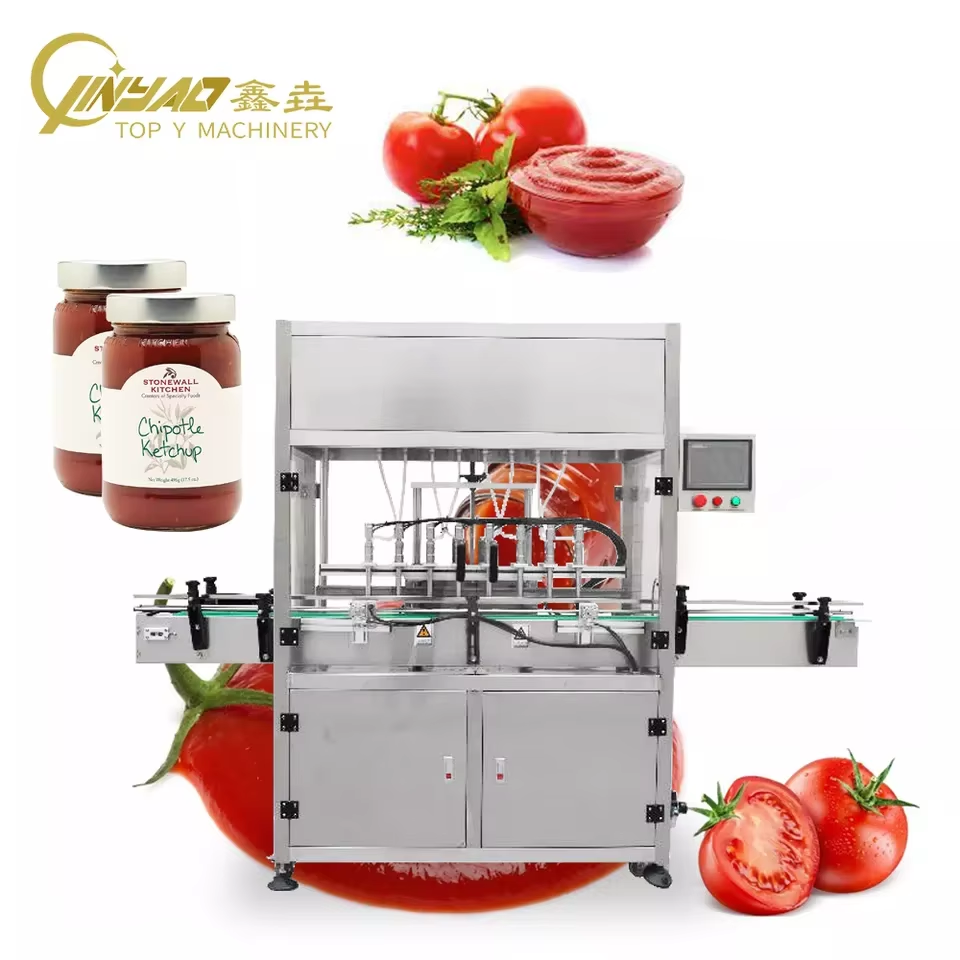
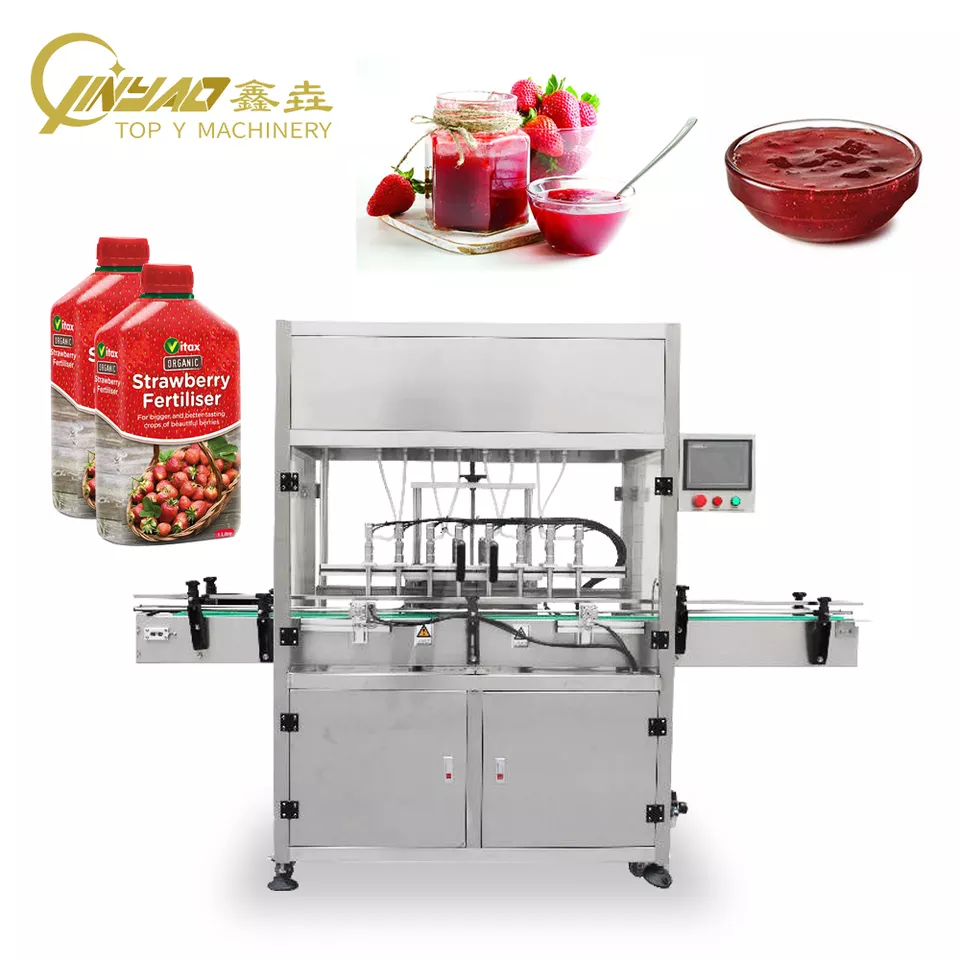
TOP Y MACHINERY builds sauce and paste lines around multi-filler flexibility: the same machine platform accepts 2, 4, or 6 filling heads and can be configured with piston, pump, or gravity dosing depending on the product. All contact parts are SS304 stainless steel (SS316 available for aggressive or acidic recipes), with FDA-compliant seals and tool-free changeover between container formats. Two machines anchor the sauce-and-paste lineup:
TOPY-FM Multi-Head Liquid & Paste Bottle Filling Machine
Automatic 2/4/6-head volumetric filler for glass and plastic bottles — honey, ketchup, oil, sauces, and pastes. Servo-driven piston option holds ±0.5% fill accuracy, with heated-hopper and anti-drip configurations for viscous products.
View product details →
TOPY-MDPL Liquid Bag Filling & Sealing Machine
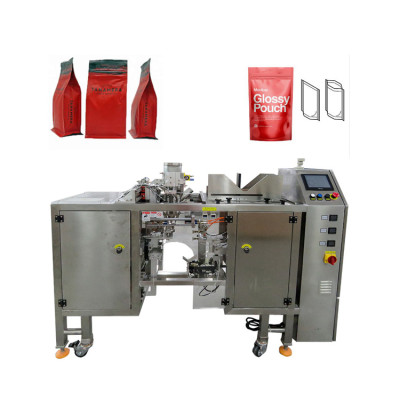
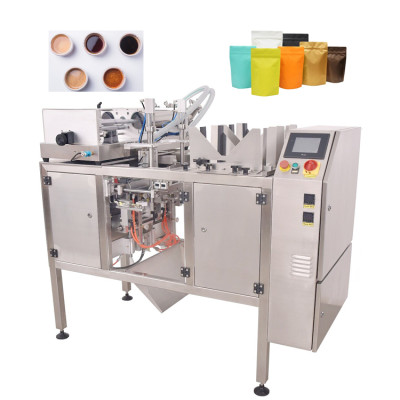
Four-station linear bagger for premade doypack and stand-up pouches, filling viscous sauces and pastes into flexible packaging. SS304 product path, accurate piston dosing, and clean sealing for retail pouches.
View product details →Why SS304 and multi-head matter for your ROI: SS304 contact parts survive daily acid-and-salt washdowns without corrosion, which keeps a sauce line hygienic and compliant over a 5–10 year life. Multi-head flexibility means one machine fills ketchup today, honey tomorrow, and chili paste next month without a second capital purchase — the changeover is a nozzle and piston-size swap, not a new machine. With 20 years of food filling installations, TOP Y MACHINERY configures the head count, piston bore, and temperature package to your recipe before you commit.
Frequently Asked Questions
Can a gravity filler handle ketchup or honey?
No — gravity fillers only work reliably below roughly 100 cP. Ketchup (50,000–100,000 cP) and honey (2,000–20,000 cP) need positive displacement: a piston filler pushes a measured volume per stroke, which keeps fill weight consistent and stops stringing and air pockets. Trying to gravity-fill thick sauces produces slow, inconsistent fills and heavy giveaway.
What fill accuracy can I realistically expect on a sauce line?
A servo-driven piston filler holds ±0.5% by volume on homogeneous sauces — about ±1–2 g on a 300 g jar. Particulate products (chunky salsa, seeded chili paste) realistically hit ±1% because ingredient pieces change packed volume. Verify the spec with a fill test on your actual recipe before purchase.
Why does temperature matter so much for viscous filling?
Viscosity drops sharply as temperature rises — heating honey from 20 °C to 50 °C can halve its viscosity. Cold product strings, drips, and fills slow; hot product flows cleanly. A jacketed hopper with 40–85 °C range and ±2 °C stability keeps viscosity constant all shift, which is what makes the ±0.5% accuracy actually repeatable.
Are the contact parts really food-grade stainless steel?
Yes — TOP Y MACHINERY uses SS304 stainless steel for all product-contact surfaces as standard, with SS316 available for highly acidic or aggressive recipes. Seals and gaskets are FDA-compliant food-grade materials, and the machines are designed for CIP washdown between batches.
One machine for many sauces — is multi-filler changeover practical?
Yes. A 2/4/6-head platform lets you fill bottles one day and pouches the next by swapping nozzles, piston bores, and container tooling — typically a 20–40 minute changeover. That flexibility means ketchup, honey, mustard, and chili paste share one machine instead of four.
How do I prevent foaming and air pockets in mayonnaise and mustard?
Use sub-surface or bottom-up filling nozzles that rise with the container and fill from the bottom, pushing air out ahead of the product. Combined with a gentle piston stroke and slow recirculation in the hopper, this keeps mayonnaise and mustard smooth and air-free down to typical ±0.5% accuracy.
Get a Fill Test for Your Recipe
Start with the numbers: measure your product's viscosity at your planned filling temperature, set your fill weight and target tolerance, and note whether the recipe contains particulates. Then send those three figures to TOP Y MACHINERY — the engineering team will recommend the head count, piston bore, and temperature package, and run a fill test with your actual product before you invest. Browse the complete filling machine range or contact TOP Y MACHINERY for a free sauce and paste line assessment.