Multihead Weigher vs Linear Weigher for Nuts: Cost Savings Guide
Aug 4,2026
The Short Answer: Multihead vs Linear Weigher for Nuts
Short answer: for nuts — almonds, peanuts, cashews, pistachios, and mixed nut blends — a multihead (combinational) weigher typically holds average giveaway under 1 g per bag, while a linear weigher runs at 2–3 g of giveaway. On a mid-size line doing 20–40 bags per minute, that difference is not cosmetic: it is $5,000–$15,000 per year of product that stops being given away, depending on nut price and run volume. A linear weigher is the lower-cost machine to buy, and it is a perfectly good fit for slow lines or products where a couple of grams of tolerance is acceptable. But the moment your bags carry a per-gram price tag — and every nut does — the multihead's accuracy pays for its higher price tag, usually within 8–18 months on premium nuts.
This guide compares the two weighing technologies with a side-by-side accuracy table, a savings calculator you can run with your own numbers, the cases where each machine wins, and the nut weighing options TOP Y MACHINERY offers in both configurations.
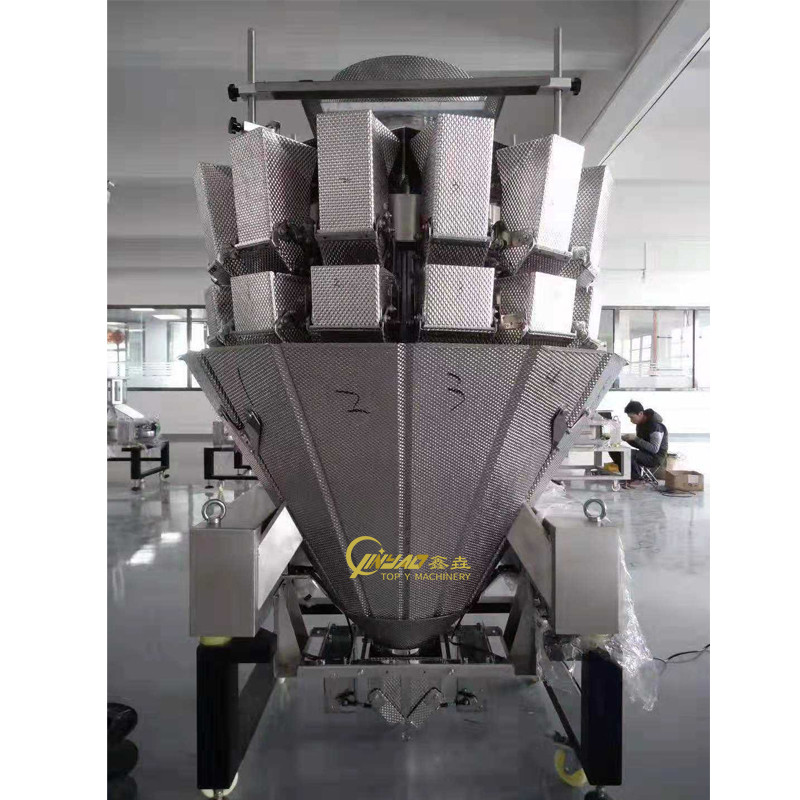
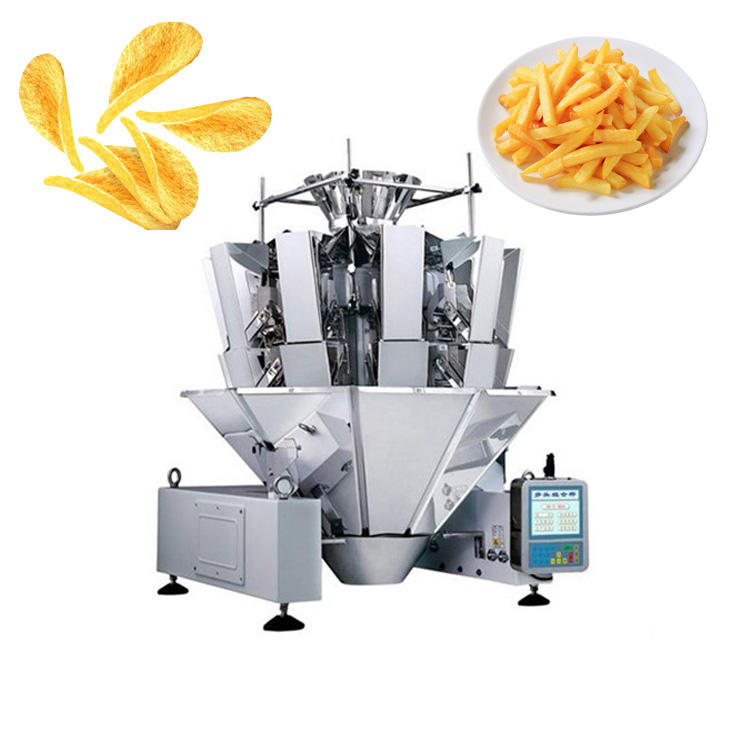
TOPY-VM Automatic 14/10-Head Multihead Weigher — A 14-head or 10-head multi-head weigher splits nuts across vibrating hoppers and combines the lightest set to hit target weight, holding average giveaway below 1 g on almonds, peanuts, cashews, and mixed blends. It replaces manual scale stations and is the accuracy workhorse on premium-nut packaging lines. View the automatic multihead weigher →
How Each Weigher Works: Combinational vs Single-Target Weighing
The core difference is the weighing philosophy. A multihead weigher splits the product across 8–24 vibrating hoppers, weighs each hopper's load on its own load cell, and then the computer finds the combination of hoppers whose summed weight lands closest to the target — typically within a few tenths of a gram. It is built for speed and accuracy on free-flowing granular products like nuts.
A linear weigher (also called a single-head or modular scale) weighs one portion at a time on one or two load cells, then discharges it into the bag. The PLC compares the measured weight to the target and trims the next portion, but because each portion is filled toward a nominal weight with a normal distribution around it, the line must be set above target to avoid under-fills — and that safety margin is the giveaway.
Weighing Principle
Multihead Weigher
Linear Weigher
Core method
Combinational: 8–24 hoppers weighed, best combination summed to target
Single-target: one portion weighed, then trimmed toward nominal
Typical accuracy on nuts
Within ±0.5–1 g; average giveaway < 1 g
±2–3 g; average giveaway 2–3 g
Speed
60–120 weighments/min (more on small targets)
20–60 weighments/min
Product handling
Product passes through multiple hoppers — requires gentle vibration settings for fragile nuts
More moving parts and load cells to clean and calibrate
Simpler; fewer parts; faster washdown
Reading the table: the accuracy gap is the whole story. A multihead's computer never "aims" at the target from one hopper — it picks the combination that is closest, which is why average error drops below 1 g. A linear weigher fills toward a setpoint and accepts the natural distribution around it, so it must overfill to guarantee the legal minimum fill — and the overfill is exactly the 2–3 g giveaway you pay for on every bag.
Accuracy Comparison: Multihead vs Linear on Nuts, Gram by Gram
The spec that matters is average giveaway, not the brochure's "accuracy" claim. On a 200–500 g bag of almonds or mixed nuts, the real-world numbers look like this:
Metric (200–500 g nut bag)
Multihead Weigher
Linear Weigher
Average giveaway per bag
< 1 g (typical 0.3–0.8 g)
2–3 g
Fill weight tolerance
±0.5–1 g
±2–3 g
Under-weight bags (avg)
Rare — target held above legal minimum with small margin
Peanuts in bulk, lower-value grains, simple snacks
What 2 g of giveaway really costs: on 10,000 bags of almonds, a linear weigher at 3 g average giveaway gives away about 30 kg, while a multihead at 0.8 g gives away 8 kg — a 22 kg difference per 10,000 bags. At $6/kg for almonds, that single difference is worth roughly $130 per 10,000 bags of pure recovered product, before counting the compliance margin you can relax.
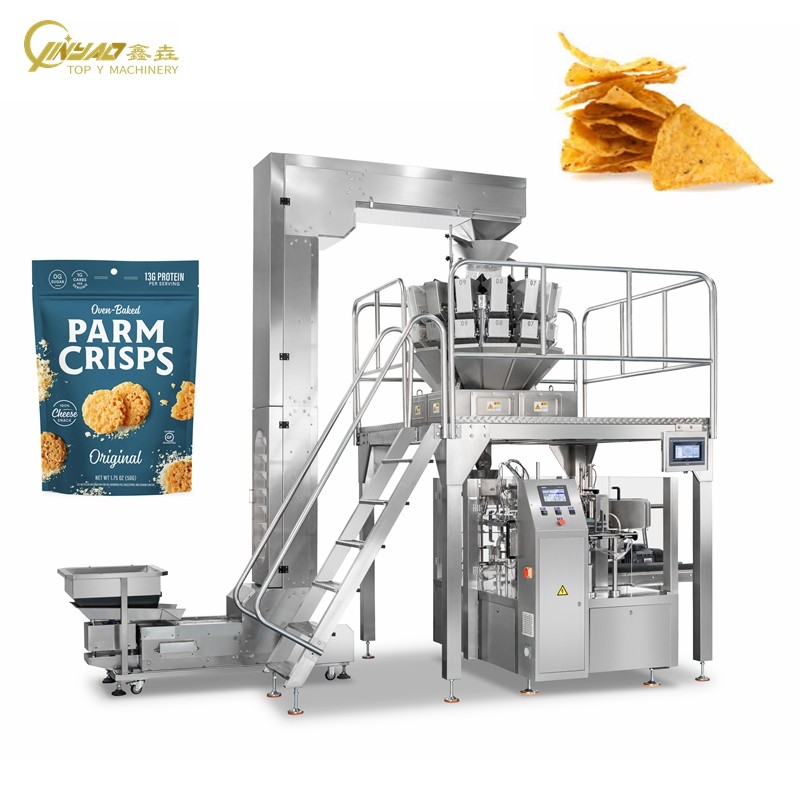
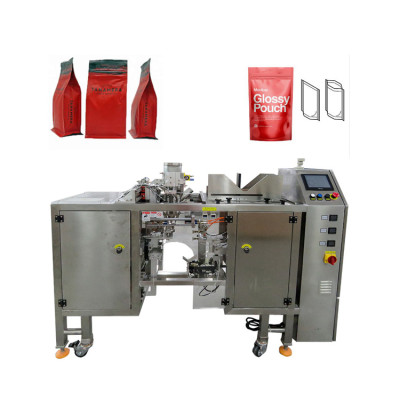
Automatic Premade Bag Packaging Machine with Nitrogen Flushing — This automatic snack packaging machine forms a complete line with a weigher: it opens premade bags, fills the weighed nuts, flushes nitrogen for shelf life, and seals — typically run by one operator instead of a six-person station. View the nut packaging machine →
Giveaway Savings Calculator: Estimate Your $5,000–$15,000 per Year
The formula is simple:
Annual savings = giveaway saved per bag × bags per minute × 60 × hours per shift × shifts per day × days per year × nut price per kg ÷ 1,000
Why the range sits at $5,000–$15,000 for typical operations: most nut packers run one or two shifts at 15–30 bags/min on mid-value nuts. Plug your own speed, giveaway difference, and price into the formula above — if your number lands in five figures, the multihead's extra upfront cost pays itself back quickly, and the recovered product is pure margin from then on.
When a Multihead Weigher Wins — and When a Linear Weigher Is the Right Call
Choose a multihead weigher when:
You pack almonds, cashews, pistachios, or any nut whose price makes 1–2 g of giveaway a real cost.
You need 60+ bags/min to match your bagger's speed.
You must hold strict net-weight compliance (e.g., retail, export, or private-label contracts).
You run mixed nuts or trail mix where portion composition changes every bag.
Choose a linear weigher when:
Speeds stay under ~40 bags/min and the product is low-value or bulk.
Budget is the deciding factor and 2–3 g tolerance is written into the spec.
You handle fragile whole kernels (some cashews, soft dried fruit mixes) and want the gentlest possible product path.
You change products frequently and need the simplest washdown and recalibration.
One nuance many buyers miss: a multihead's accuracy advantage is smallest on cheap bulk product and largest on premium nuts. The cheaper the nut, the more a linear weigher makes sense; the pricier the nut, the faster a multihead pays for itself. That is why the right answer depends on your product value, not just your line speed.
TOP Y MACHINERY's Nut Weighing Options: Both Weigher Configurations
TOP Y MACHINERY supplies both weigher options for nut and snack packaging: high-accuracy modular linear weighers for dependable, economical weighing, and multihead integration for lines where giveaway must drop below 1 g. All product-contact parts are SS304 stainless steel, and every weigher interfaces cleanly with premade-bag fillers and VFFS baggers. Two models anchor the nut lineup:
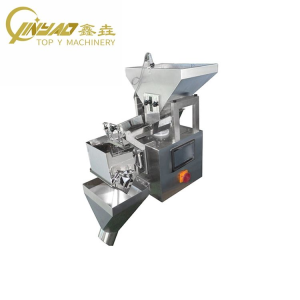
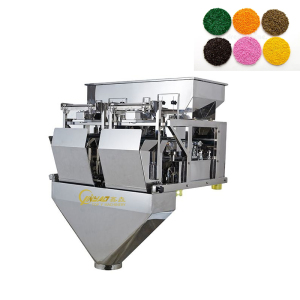
TOPY-VM High Accuracy Modular Scale — Single-Head Linear Weigher
Economical single-head linear weigher for nuts, coffee beans, and free-flowing granules. Precision load-cell weighing with easy target setting, SS304 contact parts, and a small footprint that fits into existing bagging lines.
Two-head linear weigher that doubles throughput for grains, rice, soy beans, and nuts while keeping the same simple, low-maintenance design. Alternating discharge keeps a steady bag flow into fillers and baggers.
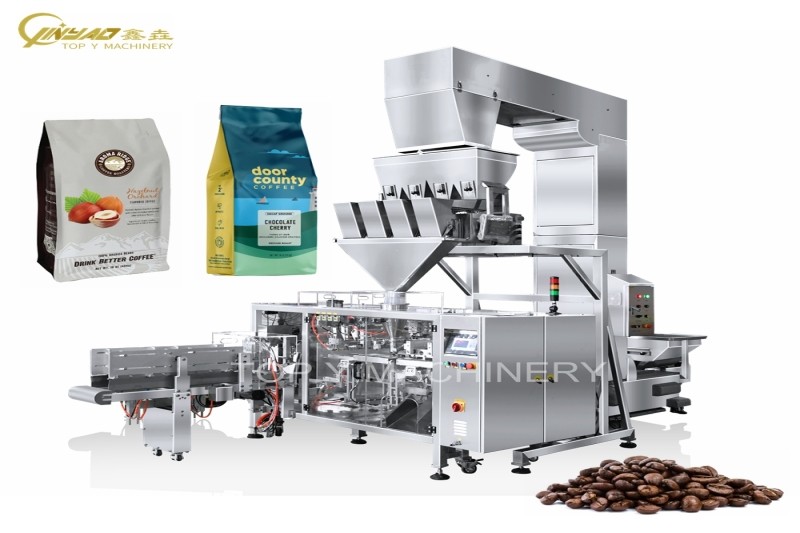
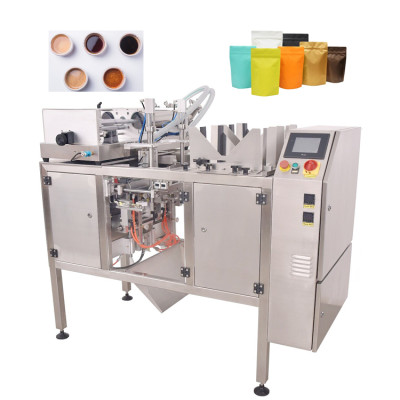
Automatic Weighing-Filling-Sealing Packing Machine — A complete weighing, filling, sealing, and packing machine for rice, nuts, grains, seeds, beans, and chips — the drop-in way to automate an entire bagging step and monitor giveaway directly from line data. View the weighing packing machine →
How TOP Y helps you pick: send your product (nut type and price per kg), target bag weight, and line speed. The engineering team runs a weighing trial and reports the expected average giveaway for both a linear and a multihead configuration, then shows you the payback on the accuracy difference — so you buy the machine your P&L justifies, not the one a brochure recommends. With 20 years of food weighing installations, TOP Y MACHINERY builds the linear and multihead options that fit real nut lines.
Frequently Asked Questions
What exactly is "giveaway" in nut packaging?
Giveaway is the product weight above the declared net weight that you give the customer for free. Because fill weights follow a distribution, a weigher must aim above the legal minimum; every gram over target is product you paid to process but cannot charge for. On nuts, that 2–3 g per bag on a linear weigher adds up to $5,000–$15,000 per year on typical lines.
Is a multihead weigher worth it for a small nut producer?
It depends on your speed and product price. A small peanut line at 10 bags/min saves roughly $4,700/yr at $1.8/kg — enough to justify a multihead on a 3–5 year payback only if volumes grow. For small, low-speed, low-value lines, a single-head linear weigher is usually the financially correct choice; for premium nuts at 20+ bags/min, the multihead pays back much faster.
Can a linear weigher be accurate enough for nuts?
Yes, if your spec tolerates 2–3 g of giveaway and the nut value is low enough that it doesn't matter. Linear weighers hold a consistent distribution around target and are simple to run and clean. They become expensive the moment the product price makes 2 g per bag worth real money — which is the case for most premium nuts.
Do multihead weighers break fragile nuts?
They can, if vibration settings are aggressive — fragile items like whole cashews can split while traveling through multiple hoppers. Modern multiheads, including configurations TOP Y supplies, use adjustable vibration and gentle chute angles to handle whole kernels safely. If you pack very fragile product at low speed, a linear weigher's single handling path is the gentler option.
How do I calculate my own giveaway savings?
Use the formula in this guide: savings = giveaway saved per bag × bags/min × 60 × hours/shift × shifts/day × days/year × price per kg ÷ 1,000. Measure your current average giveaway by weighing 100 consecutive bags, then run the same check after an accuracy upgrade. Most packers find the real number is bigger than the estimate.
Does TOP Y MACHINERY offer multihead weighers too?
TOP Y MACHINERY supplies both weigher options — economical modular linear weighers (single-head and 2-head) as well as multihead combinational configurations for high-accuracy lines — with SS304 contact parts and integration into premade-bag and VFFS bagging systems. Send your product details for a weighing trial and a savings estimate.
Get a Giveaway Audit for Your Nut Line
Start with three numbers: your nut type and price per kg, target bag weight, and line speed in bags per minute. Run the calculator in this guide once with your figures — then send the same three numbers to TOP Y MACHINERY. The engineering team will recommend the single-head, 2-head, or multihead configuration that fits, and report expected giveaway before you invest. Browse the complete weighing and packaging range or contact TOP Y MACHINERY for a free giveaway audit.