Rotary vs. Horizontal Premade Bag Packing Machines Explained: A Deep Dive into Speed, Efficiency, and Innovative Solutions.
Choosing the right packaging equipment is a pivotal decision for factory managers and automation experts. We know that inefficient packaging can lead to a cascade of costly problems, including operational downtime, wasted materials, and missed production deadlines. The knock-on effects of poor packaging choices can ripple through the entire supply chain, impacting everything from transport logistics to brand reputation.
We understand the critical challenge of selecting machines that maximize efficiency without sacrificing product integrity, especially when dealing with irregularly shaped or fragile items. The wrong choice can lead to an increased risk of product damage, higher transportation costs due to non-optimized package sizes, and inefficiencies in warehouse storage. This decision is not just about the upfront investment; it's about the long-term return on investment (ROI) and operational health of your entire production line.
In this comprehensive guide, we will dive deep into two primary types of premade bag packing machines: rotary and horizontal. With the global packaging machinery market projected to grow significantly, driven by automation and demand for packaged goods, understanding these systems is more crucial than ever. We aim to clarify their differences, benefits, and applications, helping you make an informed decision for your operations, guided by insights from leading providers like TOP Y MACHINERY.
Understanding How Rotary and Horizontal Premade Bag Packing Machines Work
To make an informed decision, it's essential to first grasp the fundamental operational differences between rotary and horizontal machines. While both are designed to package products into premade pouches, their mechanical structures dictate their strengths, weaknesses, and ideal applications. The core distinction lies in their layout and motion: rotary machines use a circular, rotating design, while horizontal machines operate on a linear, straight-line basis. This fundamental difference in architecture influences everything from factory footprint to maintenance procedures.
The Dynamic Mechanism of Rotary Premade Bag Packing Machines
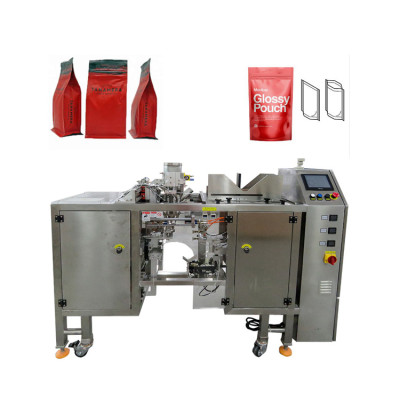
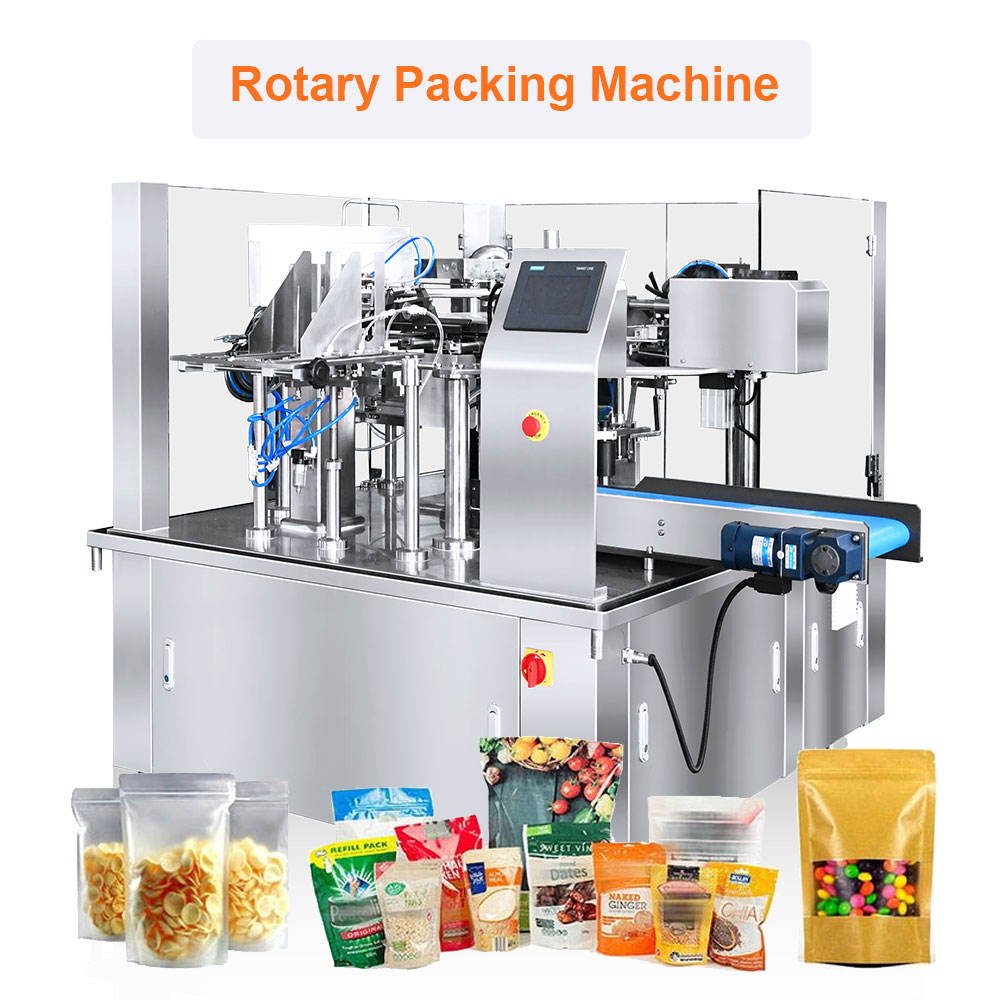
Our Rotary Packing Machine models operate with a distinctive circular workflow. Premade bags are fed into a spinning turntable, or carousel, which precisely moves each bag through a series of workstations arranged in a circle to complete the packaging process. This design is inherently compact, making it a space-saving solution for factories with limited floor space.
Our rotary premade bag packing machines feed premade bags into a spinning turntable. This turntable precisely moves the bags through different workstations to complete various packaging steps. Rotary machines typically feature between 6 and 12 workstations, with more stations offering greater flexibility and functionality for our diverse packaging needs.
The number of workstations on a rotary machine is a key indicator of its versatility. A standard 8-station rotary machine, for example, will perform a sequence of dedicated tasks at each stop along the turntable's rotation. This intricate, multi-step process ensures a reliable and efficient packaging cycle.
The typical workflow includes:
- Bag Loading: An automated arm picks up a single premade pouch from a magazine and places it into grippers on the turntable.
- Date Coding: An inkjet or thermal transfer printer marks the bag with essential information like expiration dates or lot numbers.
- Bag Opening: A vacuum suction pad and an opening jaw work together to securely open the top of the pouch. A sensor detects if the bag has opened correctly, preventing product spillage.
- Filling: The product is dispensed into the open bag using a chosen filling device (e.g., an auger filler for powders, a multi-head weigher for solids, or a liquid pump).
- Tamping/Vibrating (Optional): For powders or granular products, this station gently shakes the bag to settle the contents and remove excess air before sealing.
- Sealing: A pair of heated seal bars clamp down on the top edge of the pouch, creating a strong, airtight seal.
- Cooling & Discharge: The sealed bag is passed to a cooling station to set the seal before being discharged onto a conveyor belt for downstream processing.
This modular, station-by-station approach allows for high levels of customization and precision in the packaging process.
The Straightforward Operation of Horizontal Premade Bag Packing Machines
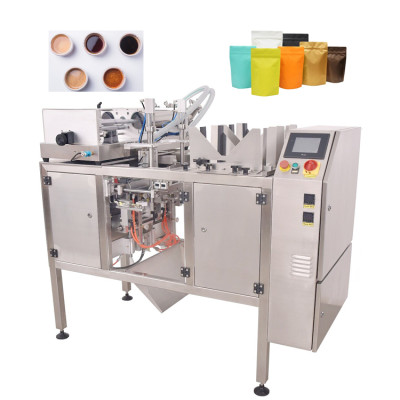
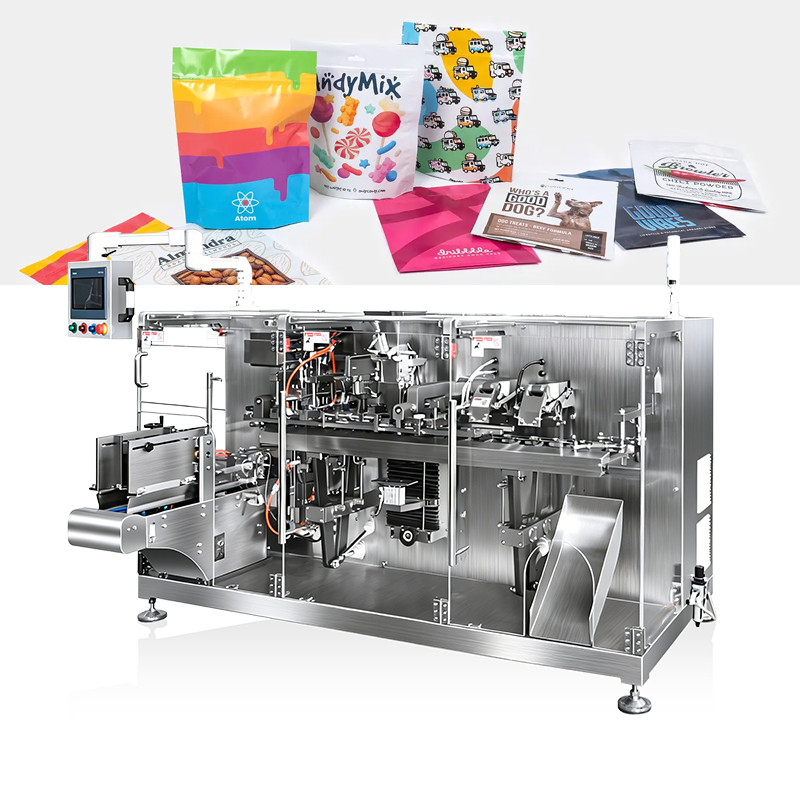
In contrast to the circular design of their rotary counterparts, our Horizontal Packing Machine models execute packaging operations in a linear, horizontal direction. The operational flow is conceptually similar, utilizing a series of stations to fill and seal premade pouches, but the layout is stretched out in a straight line.
Our horizontal premade bag packing machines execute packaging operations in a linear, horizontal direction. Their operational flow is similar to rotary machines, also utilizing multiple stations to efficiently complete the packaging tasks.
The "straightforward" nature of a horizontal machine is evident in its layout. Pouches are picked from a magazine and travel horizontally along a conveyor. At each distinct station along this line, a specific packaging function is performed. This linear arrangement offers excellent visibility and access to each part of the process.
The sequence of operations mirrors that of a rotary machine, but in a linear progression:
- Bag Feeding: Pouches are loaded and indexed one by one onto the horizontal conveyor system.
- Bag Opening & Filling: As the bag moves along the line, it is opened, and the product is dispensed from an overhead filler.
- Sealing and Finishing: The filled bag continues down the line to a sealing station, followed by any additional finishing steps before being discharged.
This linear design can sometimes be simpler in its mechanical transmission compared to the complex gearing of a rotary machine, which can have implications for maintenance and accessibility.
Comparing Speed and Stability in Premade Bag Packing Machines
When evaluating packaging machinery, two of the most critical performance metrics are speed (throughput) and operational stability. While interconnected, they often exist in a delicate balance. A machine that runs exceptionally fast but lacks stability can lead to more downtime and product waste, negating the benefits of its high speed. Conversely, an incredibly stable machine might not meet the production quotas required by a high-volume operation.
Achieving Optimal Speed with Our Premade Bag Packing Machines
The "speed" of a packaging line is ultimately a measure of its throughput—the number of finished bags it can produce in a given time, typically measured in bags per minute (BPM). However, the maximum BPM of a machine is not a static figure; it is heavily influenced by a number of factors. The most significant bottleneck is often the filling speed, which depends on the product's characteristics (e.g., viscosity of a liquid, flowability of a powder) and the type of filler being used.
We observe that the speed of a premade bag packing machine largely depends on the filling speed. For instance, a horizontal machine can reach speeds of about 100 bags per minute when using a double-bag method. In comparison, our rotary premade bag packing machines can achieve an even faster rate, processing up to 125 bags per minute with their double-bag method. However, employing the double-bag method might lead to a higher machine cost and a potentially lower filling volume per bag.
The inherent design of both machine types allows for high-speed operation. High-speed models are engineered with advanced multi-axis servo technology and PLC control systems to maximize output while maintaining precision. Some rotary models can achieve speeds of 80–250 pouches per minute, depending on the configuration and product. Horizontal machines using a dual-filler setup (double bagging) can reach around 100 BPM. Advanced rotary machines can push this even further, reaching up to 125 BPM with a similar double-bagging configuration.
It is crucial to understand that these top speeds are conditional. The "double-bag" method involves using two filling heads, which increases throughput but also raises the initial capital investment and may limit the maximum volume per bag. For many operations, a single-head system offers greater stability and ease of operation in the long run. Ultimately, the effective speed is not just the machine's top BPM but a balanced equation involving the product, filling system, and desired package quality.
Ensuring Stability During Operation: A Look at Premade Bag Packing Machines
Operational stability is just as important as speed. An unstable machine can cause misaligned seals, inconsistent filling, or even complete line stoppages. Stability is not merely the absence of vibration; it encompasses the machine's ability to run consistently and reliably over long shifts with minimal operator intervention.
We find that horizontal premade bag packing machines generally offer greater stability than rotary machines when operating at similar speeds. When packaging heavier products, rotary machines may sometimes require a reduction in speed to effectively manage the centrifugal force from rotation, which helps ensure smooth and steady operations.
At the same operational speed, horizontal machines are often considered more stable. This is primarily due to the physics of their design. The linear motion of a horizontal machine does not generate the same kind of dynamic forces as a rotary machine. Rotary machines, by their nature, create centrifugal force as the turntable spins. This outward-directed force becomes more pronounced at higher speeds and with heavier product weights.
To maintain smooth operation and prevent issues like product settling unevenly or bags being jostled, it may be necessary to slow down a rotary machine when packaging particularly heavy items. The horizontal machine, which is not subject to this rotational force, can often handle heavier products at a consistent speed without this specific constraint. Therefore, for applications involving heavy fills where consistent speed is paramount, the inherent stability of the horizontal design can be a significant advantage.
Pouch Versatility and Filling Capacity of Premade Bag Packing Machines
Beyond speed and stability, a packing machine’s value is determined by its flexibility. This includes its ability to handle a wide range of product volumes and adapt to various pouch types and sizes. In today's market, where product lines are diverse and consumer preferences change rapidly, a machine's versatility is directly tied to a company's ability to innovate and scale.
Understanding Filling Volume Capabilities in Our Premade Bag Packing Machines
The filling volume, or the amount of product that can be placed in a single pouch, is a critical parameter. It is dictated by the physical dimensions of the machine and the pouches it can handle. A machine with a limited filling volume can severely restrict the types of products or market segments a business can serve.
When it comes to filling volume, our rotary premade bag packing machines typically have an advantage, allowing for larger fill amounts. Horizontal machines, however, often face limitations due to their horizontal width constraints, resulting in a noticeably smaller filling capacity. We note that both types of machines offer comparable filling accuracy, as this is primarily determined by the separate filling unit rather than the packing machine itself.
Rotary machines generally offer a greater range for filling volume. Their design allows them to handle wider and taller bags more easily, which directly translates to a larger potential fill capacity. This makes them ideal for bulk products or family-size packages. In contrast, horizontal machines are often limited by their width. The linear transport system can impose constraints on the maximum pouch width, which in turn limits the total volume.
It is important to distinguish filling volume from filling accuracy. The accuracy of the dose—ensuring that each bag contains the correct amount of product—is determined not by the packing machine itself, but by the ancillary filling equipment integrated with it (e.g., auger filler, multi-head weigher, or liquid pump). Therefore, both rotary and horizontal machines can achieve the same high level of filling accuracy, provided they are paired with a quality dosing system.
Adapting to Diverse Pouch Types and Widths with Premade Bag Packing Machines
The ability to handle different pouch formats—from stand-up pouches with zippers to flat bags and gusseted bags—is a hallmark of a versatile machine. Equally important is the ease and speed with which an operator can change between different pouch sizes.
Both our rotary and horizontal premade bag packing machines are well-suited for adapting to most types of premade bags. Rotary machines, however, offer a distinct benefit when we need to work with wider pouches. In contrast, horizontal machines are generally limited to narrower pouch widths. Adjusting the pouch width on a rotary machine is a simple task; we can easily modify settings on the control panel or turn a spacing adjustment knob. For horizontal machines, changing the bag width is far less convenient, often requiring the replacement of parts, which consumes more time and incurs additional costs.
On the whole, both machine types can handle the most common premade pouch styles. However, rotary machines have a clear advantage when it comes to pouch width and ease of adjustment. Their circular gripper system can accommodate a much wider range of bag widths, from small single-serving packs to large bulk bags. Adjusting for a new bag width on a modern rotary machine is often a tool-less, software-driven process. Operators can simply input the new dimensions on the HMI (Human-Machine Interface) touchscreen or make a simple manual adjustment to the gripper spacing. This entire process can take just a few minutes.
Horizontal machines, on the other hand, are less flexible in this regard. Their linear design means that changing the pouch width is often a more involved mechanical process. It can require replacing parts of the bag transport mechanism, which is not only time-consuming but can also add to operational costs through the need for additional change parts. This makes rotary machines the superior choice for operations that require frequent changeovers between different SKUs and pouch sizes, a practice known as high-mix, low-volume production.
Practical Considerations: Maintenance, Cost, and Choosing Your Premade Bag Packing Machine
Choosing the right packaging machine extends beyond technical specifications. Practical, real-world factors such as ease of maintenance and total cost of ownership play a crucial role in the long-term success of your investment. A machine that is difficult to service or has a high lifetime cost can erode profitability, even if it performs well on paper.
Ease of Maintenance for Our Premade Bag Packing Machines
Regular maintenance is essential for keeping any packaging line running at peak efficiency. However, the design of a machine can significantly impact how easy—or difficult—it is to perform routine checks, cleanings, and repairs. Downtime for maintenance is unavoidable, but a well-designed machine minimizes this time.
We've observed that horizontal premade bag packing machines are generally simpler to maintain. They provide convenient access for opening maintenance doors and troubleshooting any issues. Servicing rotary machines often requires technicians to crouch or even lie down to inspect the internal bottom systems, which can make repairs more challenging for us.
In terms of maintenance accessibility, horizontal machines often have the edge. Their linear structure means that control systems and mechanical components are typically located behind the main machine body, accessible through conveniently placed doors. This open, straightforward layout makes it easier for technicians to troubleshoot errors, clean parts, and perform service.
Rotary machines, with their compact, circular design, can be more challenging to service. Key components, including the control system and turntable drive, are often located underneath the main circular plate. Accessing these areas for inspection or repair can require technicians to work in cramped spaces, a situation that may increase service time and complexity.
Evaluating the Price and Value of Premade Bag Packing Machines
While the initial purchase price is a major consideration, it's crucial to evaluate the total cost of ownership (TCO) and the overall value proposition. Value is a combination of price, capability, flexibility, and long-term running costs.
If we compare machines with similar speeds and fundamental features, the price for both types of premade bag packing machines is often quite similar. However, we frequently find that rotary machines offer better overall value. This is typically because they can accommodate larger filling volumes and wider pouches, providing us with more extensive capabilities for our investment.
When comparing base models with similar specifications, the initial investment for rotary and horizontal machines can be quite comparable. However, the value equation often tilts in favor of the rotary machine. As discussed previously, rotary machines provide significantly more flexibility in terms of filling volume and pouch width compatibility.
This inherent versatility means that a single rotary machine can potentially do the work of multiple, less flexible machines. It allows a business to adapt to new products and packaging trends without needing to invest in new equipment. Therefore, while the upfront cost might be similar, the rotary machine's ability to handle a broader range of applications often translates into a superior long-term return on investment (ROI).
Making the Informed Choice: Rotary vs. Horizontal Premade Bag Packing Machines
After exploring the mechanical workings, performance metrics, and practical considerations of both rotary and horizontal machines, the final decision comes down to matching the right technology to your specific operational needs. There is no single "best" machine; there is only the best machine for your product, your factory, and your business goals.
Overall Recommendation for Your Premade Bag Packing Machine Needs
By synthesizing the points of comparison—speed, stability, versatility, maintenance, and value—we can form a clear picture of where each machine excels. This allows us to make a confident, evidence-based recommendation tailored to the unique circumstances of our customers.
Overall, we generally consider rotary premade bag packing machines to be superior, which explains why they are the preference for most of our customers, holding over 95% of the market share. However, horizontal machines still have a valuable place in the market. We might recommend them for specific applications such as small dose filling, high precision requirements, high-speed operations, or when working with a tighter budget.
For the majority of applications, the rotary premade bag packing machine emerges as the more versatile and future-proof investment. Its superior flexibility in handling a wide array of pouch sizes and fill volumes makes it the preferred choice for a vast number of businesses, commanding an estimated 95% of the market share for these reasons. The ability to quickly adapt to changing production demands provides a significant competitive advantage.
However, this does not render the horizontal machine obsolete. It remains a highly valuable and sometimes superior choice for specific, niche applications. These can include:
- High-Speed, Single-Product Lines: For dedicated lines running a single SKU at high speeds, the stability of a horizontal machine can be an advantage.
- Small Dose and High Precision: In scenarios where the application calls for small, precise dosages with a tighter budget, a horizontal machine can offer a more cost-effective solution.
- Heavy Products: As noted, the superior stability of the horizontal machine when packing heavy items can make it the more reliable option.
- Ease of Maintenance Priority: For operations that prioritize extremely simple maintenance access above all else, the straightforward layout of a horizontal machine is a compelling feature.
Ultimately, a thorough analysis of your product portfolio, production targets, and operational priorities will illuminate the correct path forward.
Key Takeaways
- Core Mechanism Difference: Rotary machines use a circular a turntable to move bags through workstations in a compact footprint. Horizontal machines use a linear, straight-line process that offers easy access but may require more floor space.
- Speed vs. Stability: While both can achieve high speeds (up to 125 BPM for rotary), horizontal machines often offer better stability at the same speed, especially with heavier products, as they are not affected by centrifugal force.
- Versatility is Key: Rotary machines excel in versatility, handling a wider range of pouch widths and larger fill volumes. Adjusting a rotary machine for different bag sizes is typically faster and easier than on a horizontal machine.
- Maintenance & Cost: Horizontal machines are generally easier to maintain due to their open, linear design. While initial costs for comparable models can be similar, the greater flexibility of rotary machines often provides better long-term value and ROI.
- The Right Choice Depends on the Application: Rotary machines are the dominant choice for their versatility, making them ideal for most applications. Horizontal machines, however, are a strong choice for niche needs like high-speed lines with heavy products or when ease of maintenance is the absolute top priority.
Frequently Asked Questions (FAQ)
Q1: Which machine is better for packaging liquids and sauces? A: Both machines can be equipped with liquid fillers. However, rotary machines are often preferred for liquids due to their ability to handle spouted pouches and their robust sealing capabilities, which are crucial for preventing leaks. The controlled motion of the turntable also helps in managing product sloshing.
Q2: How difficult is it to integrate these machines with existing production lines? A: Both types are designed for integration. Modern machines use standardized communication protocols like PackML, which simplifies connection to upstream fillers and downstream case packers. The choice depends more on your factory layout. A rotary machine’s compact footprint might fit better in some spaces, while a horizontal machine's linear flow might align more naturally with an existing straight-line conveyor setup.
Q3: Can these machines handle recyclable or sustainable packaging materials? A: Yes, modern premade bag packing machines are increasingly designed to work with a variety of "green" materials, including recyclable mono-material films (like all-PE pouches) and compostable materials. However, it is crucial to test these new materials, as their properties (e.g., stiffness, sealing temperature) can differ from traditional multi-layer laminates. Always consult with the machine manufacturer to ensure compatibility.
Q4: What is the typical footprint of a rotary vs. a horizontal machine? A: A rotary machine generally has a smaller, more squarish footprint compared to a horizontal machine of equivalent output, which is long and narrow. For example, a standard rotary machine might occupy a 2m x 2m space, whereas a comparable horizontal machine could be 4-5 meters long. This makes rotary machines particularly advantageous for factories with limited floor space.
Conclusion
To summarize, we have explored the distinct advantages and specific use cases for both rotary and horizontal premade bag packing machines. We typically find that the enhanced versatility, greater capacity range, and superior overall value of rotary machines make them the optimal solution for the majority of modern packaging requirements. Their ability to quickly adapt to different products and pouch sizes is invaluable in a fast-moving market.
However, horizontal machines clearly excel in particular niches. They provide dependable stability and easier maintenance access, making them a solid choice for dedicated, high-volume production lines or for applications with unique needs where their specific strengths can be fully leveraged.
Ultimately, the best choice depends on a careful evaluation of your specific product characteristics, pouch requirements, available operational space, and budgetary constraints. Understanding these key differences—from the core mechanics to the long-term value proposition—empowers you to select the machine that will maximize your packaging efficiency and drive your production goals forward. By partnering with an experienced equipment provider like TOP Y MACHINERY, you can ensure your investment is perfectly aligned with your factory's needs today and in the future. We encourage you to share this guide with your team and reach out to our experts to continue the conversation.